


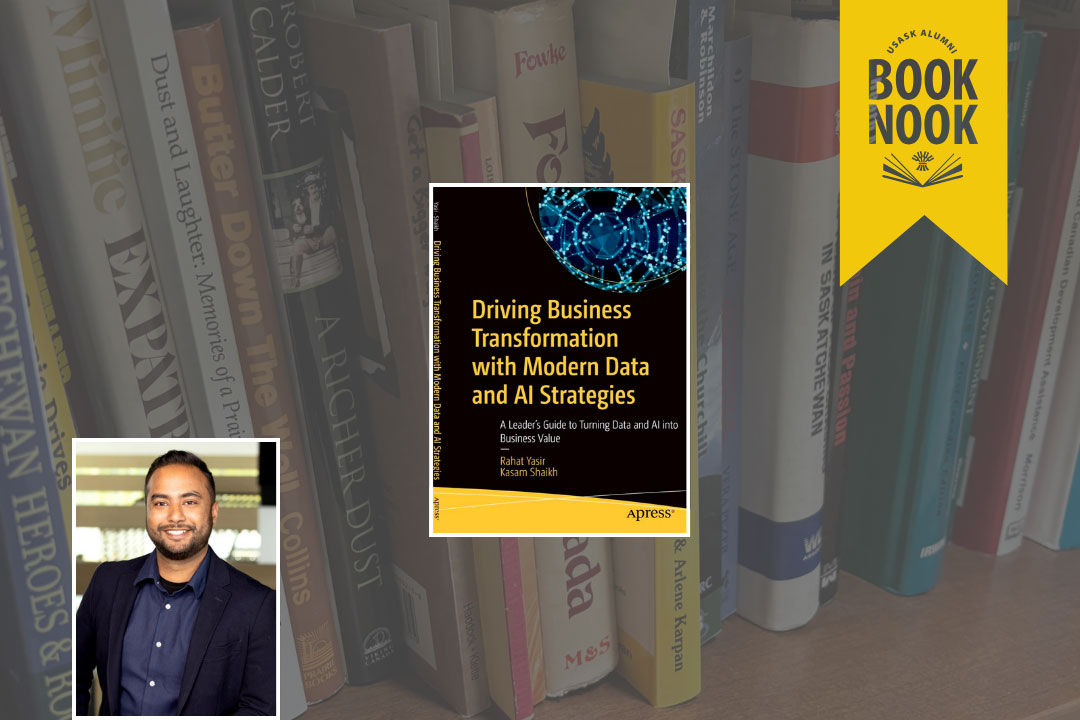
Alumni Book Nook: Rahat Yasir (MSc’18)
USask computer science graduate Rahat Yasir, an award-winning AI and data expert, has written his first book
University of Saskatchewan (USask) computer science graduate Rahat Yasir (MSc’18) has written his first book, Driving Business Transformation with Modern Data and AI Strategies: A Leader’s Guide to Turning Data and AI into Business Value. Co-authored with Kasam Shaikh, the book was released on May 10, 2026, by Springer and Apress, a publisher of books, eBooks, and online content for IT professionals, developers, and tech enthusiasts around the world.
Yasir came to USask after completing an undergraduate degree in computer science and engineering at North South University in Bangladesh. He moved to Saskatchewan to study as a master’s student in the Department of Computer Science at the College of Arts and Science at USask before moving to Montreal, Que., where he currently lives.
As a USask graduate student, Yasir was recognized for co-creating a mobile application called Project Beetle to help farmers survey crop health. Since earning his master’s degree, he has worked across the data and AI (artificial intelligence) domain in a variety of industries. Most recently, he led AI initiatives at the International Air Transport Association (IATA), focusing on global aviation safety and security. Soon he will take on a new challenge leading data and AI initiatives at CAE, spanning civil aviation and defence.
In 2018, Yasir was named one of Canada’s Top 30 Software Developers Under 30, and he is also a 12-time Microsoft Most Valuable Professional in Artificial Intelligence. A proud USask alumnus, Yasir continues to give back to the university that helped launch his career by funding the Rahat Yasir Award for Diversity and Inclusion. To be eligible, students must submit a statement to self-identify as part of the 2SLGBTQQIA+ community and/or as an individual with accessibility needs or a disability or demonstrate how they are an ally to those in these communities. The statement should also include a description of their intent or interest in pursuing a career in a computer science-related field.
In 2024, Yasir returned to his alma mater to provide the keynote address at Digitized, the largest one-day technology career event for Saskatchewan high school students. Digitized takes place on USask’s Saskatoon campus and features speaker sessions, workshops, and panels.
The Green&White asked Yasir about his new book and what inspired him to write it.
What is the focus of your new book?
In today’s digital-first world, data is no longer just a technical asset—it’s a strategic superpower. Driving Business Transformation with Modern Data and AI Strategies is a practical guide for leaders who want to make confident, informed decisions powered by data, analytics, and AI. It demystifies complex technologies and shows how to align data and AI initiatives with real business outcomes. Organizations that embrace data-driven decision-making consistently outperform their peers—innovating faster, understanding customers more deeply, and building lasting competitive advantage. Written for both technical and non-technical leaders, from C-suite executives to transformation and domain leaders, this book makes the case that success in the modern enterprise depends on combining domain expertise with data literacy and AI fluency.
What inspired you to write this book?
We live in a technology-driven world where innovation, efficiency, and problem-solving are moving faster than ever—yet the failure rate of data and AI initiatives remains stubbornly high. That gap was my primary inspiration. I wrote this book to bridge the divide between technical complexity and business leadership, giving both tech and non-tech leaders the clarity and frameworks they need to drive data and AI initiatives that actually deliver ROI (return on investment). Too often, organizations invest heavily in data and AI only to see limited returns—not because the technology fails, but because leadership alignment, strategy, and execution fall short. This book is my attempt to change that.
Did your education at USask play a role in researching and/or writing this book? If so, how?
My master’s at the University of Saskatchewan gave me a strong foundation in data and AI. I learned a tremendous amount from my professor, Dr. Mark Eramian—from developing algorithms and understanding complex systems, to writing clean, efficient code. That foundation proved invaluable and played a major role in shaping the trajectory of my career.
What are five adjectives that you would use to describe your book?
Practical: It’s built around real-world frameworks and actionable strategies, not just theory.
Accessible: It’s written for both technical and non-technical leaders, making complex data and AI concepts easy to grasp for any audience.
Strategic: It goes beyond technology to connect data and AI initiatives directly to business outcomes and ROI.
Transformative: It equips leaders with the mindset and tools to drive meaningful, lasting organizational change.
Empowering: It gives leaders, regardless of their technical background, the confidence and fluency to own and champion data and AI initiatives.
Why would you recommend your book to USask alumni?
As a USask alumnus, the foundation I built here—especially through my master’s and the guidance of professors like Dr. Mark Eramian—was instrumental in shaping my data and AI career. This book is a natural extension of that journey, translating core principles into real-world business leadership. USask alumni are analytical, resourceful, and driven—exactly who this book is written for. Whether you’re a technical professional or a business leader navigating digital transformation, it gives you a practical roadmap to turn data and AI into tangible business value. If my USask journey resonates with you, I believe this book will, too.