


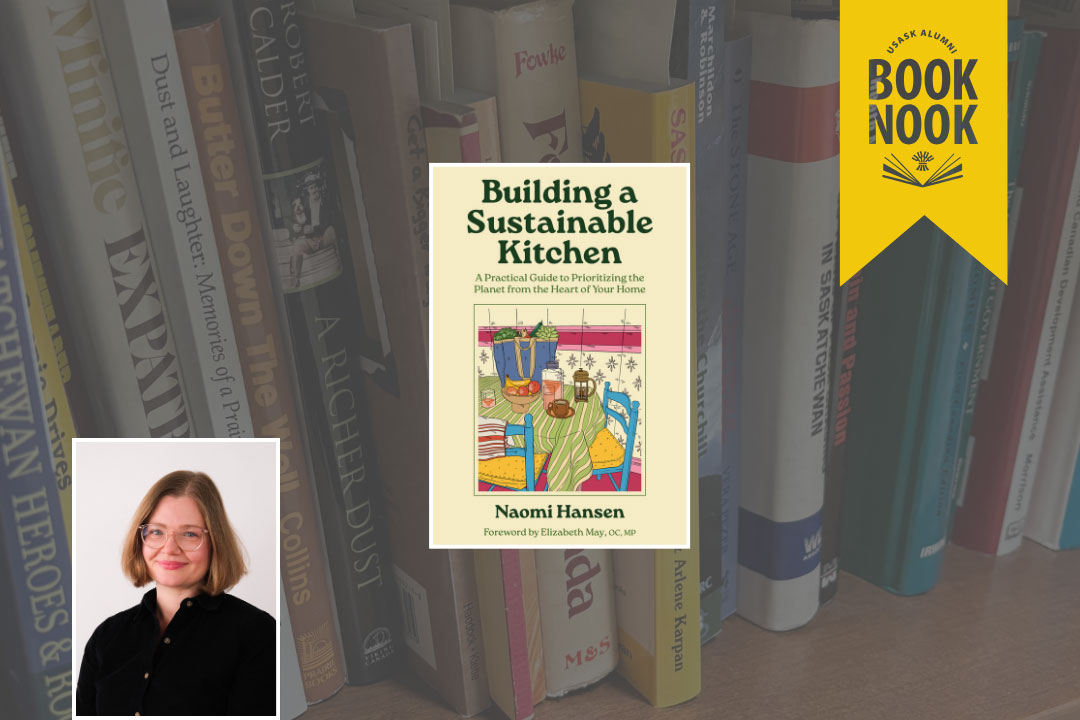
Alumni Book Nook: Naomi Hansen (BA’17)
USask history graduate Naomi Hansen has written a new book about prioritizing sustainability in the home
University of Saskatchewan (USask) graduate Naomi Hansen (BA’17) earned a Bachelor of Arts degree in history from USask’s College of Arts and Science in 2017. Since then, the Saskatoon-based alumna has taken on a variety of freelance roles in the areas of writing, editing, research, marketing, and communications. She currently contributes to numerous Canadian publications, including Chatelaine and Canadian Living, and serves as the Saskatoon Bites food columnist for CBC Saskatchewan.
Hansen’s first book, Only in Saskatchewan: Recipes & Stories from the Province's Best-Loved Eateries, was published by TouchWood Editions in 2022. The non-fiction book earned her two Saskatchewan Book Awards in 2023, in the First Book Award and Book of the Year Award categories. Hansen’s second book, Building a Sustainable Kitchen: A Practical Guide to Prioritizing the Planet from the Heart of Your Home, was published in April 2026 by TouchWood Editions. The new book includes a foreword from Elizabeth May, the leader of the Green Party of Canada.
“The book’s key message is really that taking part in the conversation around sustainability and implementing actions at home and beyond to address climate change, is for everyone. This is true whether you are reducing food waste at home, or whether you are getting involved on a local level,” said Hansen. “The reality is that everyone can play a part here and you don’t need to be an expert in sustainability or environmental science to be a part of this conversation. Sustainability is for everyone; it has to be if it’s going to be successful.”
In Building a Sustainable Kitchen, Hansen draws on wisdom from hundreds of sources—including interviews with experts, academic studies, books, and organizations on the front lines of the climate crisis—and from her own experiences in her kitchen. The Green&White recently asked Hansen about what inspired her to write the book and how her USask education proved to be beneficial in the process.
What inspired you to write this book?
Building a Sustainable Kitchen is a book that goes back to around 2018 for me. Writing a book about sustainability was not at all on my radar at the time, but when I think about the starting point for me with sustainability in general, it can be traced back to 2018 when I undertook a project on my personal Instagram account where I tried various sustainable lifestyle initiatives at home, and then reported the results to my small group of followers, mainly any family and friends that were on the app at the time.
I started this little project because I had been feeling increasingly anxious and preoccupied with the growing impacts of climate change, much of which was accelerated by a particularly bad wildfire season in Saskatchewan in the summer of 2018. And so, I was looking for ways to mitigate my own carbon footprint. So, I decided to sort of jump on the bandwagon of low-waste living, which is something that was really everywhere at the time—social media, popular media sources, that kind of thing. So, I bought reusable goods like beeswax wrap, cloth produce bags, and stainless steel straws. I started a backyard compost; I was becoming more intense about our garbage and recycling, and what we put in there. And with my little Instagram project, my small audience did actually show great interest in what I was doing. And I was sort of surprised by the interest. I was posting these very amateur, low-quality videos just talking about what I was doing, and I received messages daily with new questions for me to explore—questions like where to recycle lightbulbs in Saskatoon, or what to do with excess plastic bags, and so on.
Then, however, the COVID-19 pandemic started, and most of my efforts sort of collapsed. Actions like bringing reusable items to public places, like your own coffee mug, or cloth produce bags, were no longer allowed—understandably, of course—and so some elements of this little sustainability project came to an abrupt halt. But even though that came to a halt, I did not forget about it; it was always sort of in the back of my mind.
Meanwhile, I wrote and published Only in Saskatchewan. After its publication and some time had passed, I sort of knew that I wanted to return to the topic of sustainability. Wildfire seasons were getting worse—they still are—the weather was getting more extreme, and I was personally getting more climate anxious. So, sort of as a part coping mechanism, and then partly because I wanted to do the research anyways, I started writing more regularly for various publications about lifestyle sustainability topics. I wrote articles about topics like food waste, whether compostable plastics were in fact compostable, whether beef could be sustainable, what to expect at a zero-waste store, and so on—many of which are topics that are covered in Building a Sustainable Kitchen in a much longer format. But what I learned from working on these articles was that when it comes to sustainability, there’s a lot more to the story than just recycling or buying reusable kitchen gear. And recycling or buying reusable kitchen gear aren’t necessarily bad actions, but the reality is that these actions merely scratch the surface of both the depth and reach that individual action in addressing climate change can have. The easiest way to put it is really that these actions and many other popularized actions are on the right track, but the track we’re talking about here is long and complex. And, so, these realizations eventually turned into the idea for Building a Sustainable Kitchen, which I first started discussing with my publisher back in 2022. So, it’s been sort of a while in the making here. And really what I wanted to do was to expand on some of the topics I had already been writing about in a longer format and really do a deep dive into exploring food and what we do in the kitchen and how that intersects with climate change.
Did your education at USask play a role in researching and/or writing this book?
Yes! I include historical tidbits in some chapters, like recycling, garbage, and in talking about waste more generally. And it was also helpful with the research aspects.
Because I studied history in university, I find that whenever I start researching something, I always look at the history first. So, recycling, or plastics, or landfills, or whatever it was, before I started researching or writing about that in general, I wanted to know how we got to where we are today—even just for context. And there was actually a lot of history I gathered that I didn’t need or use in the book in the end, but I still felt it was important context for me to know, and it certainly framed how I wrote certain things.
But the thing that is interesting about a lot of that history is that it reveals that some of this stuff is recent, really, in the grand scheme of things. So, for example, blue box recycling systems where materials are picked up curbside first appeared in Canada in the 1980s. That makes these types of recycling systems not even 50 years old. Or another example is plastics; 1950 is widely considered to be the beginning of more widespread, global production of plastics. Then, after that point, you see a lot of these common kitchen items roll out. Plastic garbage bags are invented in the 1950s. Resealable plastic bags with an integrated zip-top and plastic grocery bags were both invented in the 1960s. So, I find this interesting because a lot of the things we take for granted, or assume it has always been such and such way, aren’t really that old when you look at them from a historical perspective. And one of the things I took away from some of that research, like the key point for me of looking at the history, is that if our use of plastics, for example, and how we dispose of things, how we value things, and even how we view waste, etc., has changed over time historically, then why can’t it change again?
What we consider trash today may not have been considered trash 50 or 100 years ago. So, these things can evolve. But it is really my background that has instilled that in me—asking the question of why and how we got here historically as a first step.
What are five adjectives that you would use to describe your new book?
Practical, approachable, inspiring, useful, and informative.