


Alumni Book Nook: Glen Sorestad (BEd’63, MEd’76)
USask alumnus Glen Sorestad, a Canadian literary icon, has written a new book of poetry titled First Light, Last Light
University of Saskatchewan (USask) graduate Glen Sorestad (BEd’63, MEd’76) is one of Canada’s most acclaimed poets. The Saskatoon-based writer of poetry and prose served as Saskatchewan's first Poet Laureate from 2000-2004—becoming the first provincially appointed poet laureate in Canada—and is the author of 17 poetry books, many chapbooks, and numerous short stories (many of them broadcast on CBC radio). Sorestad’s work has been shared and celebrated around the world, and he has given more than 500 public readings throughout Canada, the U.S., France, Norway, Finland, Slovenia, and Cuba.
Sorestad studied at USask’s College of Education, earning a Bachelor of Education degree in 1963 and a Master of Education degree in 1976. He worked as a teacher in Yorkton, Sask., from 1963 to 1967 before moving to Saskatoon, where he taught at both École Alvin Buckwold School and Evan Hardy Collegiate. He also served as the president of Thistledown Press from 1975 to 2000 and has had an active writing career since the early 1970s.
Sorestad is a Member of the Order of Canada and received in succession the Queen's Golden, Diamond, and Platinum Jubilee Medals. His poetry has been translated into eight languages and has appeared in more than 80 anthologies and textbooks as well as in many literary magazines, journals, and e-zines.
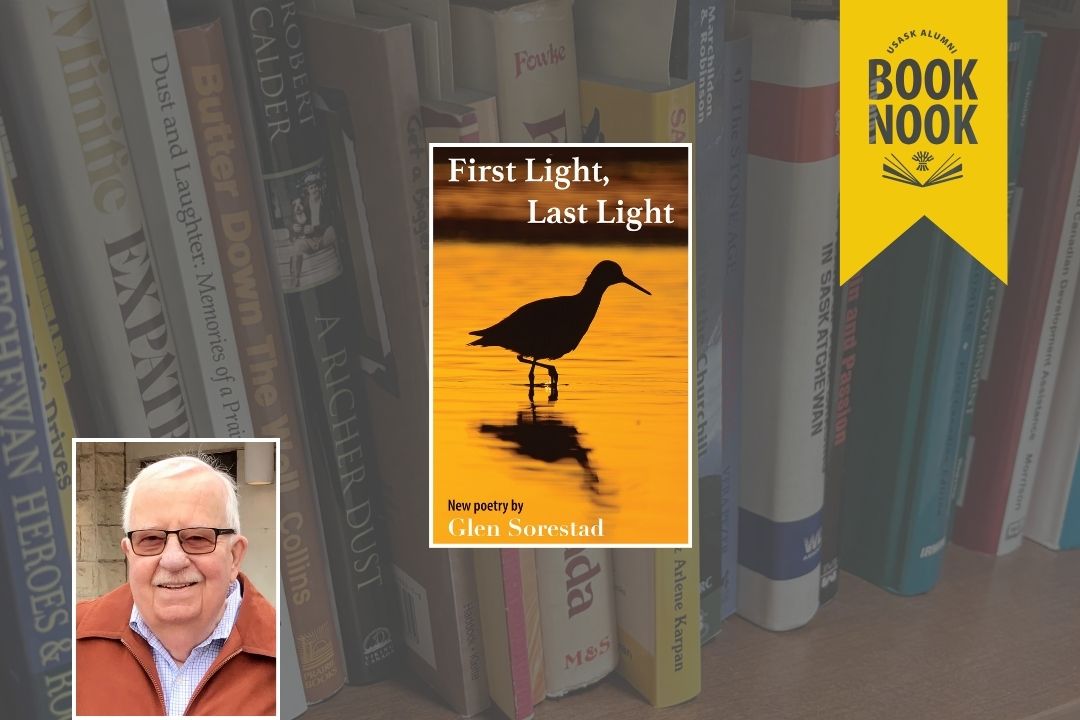
Sorestad’s latest book of poems, First Light, Last Light, was released in October 2025 by Regina’s Shadowpaw Press. The Green&White asked him about the focus of his new book and what inspired him to write it.
What is the focus of your new book?
The poems of First Light, Last Light are divided into two major sections. The first section of poems deals with human relationships, family, friends, chance encounters, seeing the world we inhabit and experience. The poems of the second part of the volume are looking outward at the world we inhabit, how we interact and experience birds and animals, weather—the natural world of which we are also a part.
What inspired you to write this book?
I think this book is really a continuation of what I have always been interested in writing about: human relationships and what we learn from our human interactions, but also what we learn and absorb from our experiences with that outer, non-human world that can teach us so much.
Did your education at USask play a role in researching and/or writing this book? If so, how?
My education and experiences at the University of Saskatchewan have most definitely influenced all of my writing in one way or another. I sometimes can imagine, when I am writing a particular line or lines, that I can hear the voice of the late Dr. Carlyle King, throwing back his head and looking skyward as if he was about to utter a favourite Carl Sandburg line, and I try to shape the sound of the line I am writing to suit King’s voice. Edward McCourt and Ronald Marken, too, had very positive influences on me through their encouragement and their teaching.
What are five adjectives that you would use to describe your book?
I may describe my book with certain terms that other readers would dispute. It’s really one person responding to what he has experienced around him as he moves closer to the end of his life. At times it may be humorous, touching, surprising, frustrating, or rewarding for the reader.
Why would you recommend your book to USask alumni?
My fellow alumni are also readers and, as such, they might be inclined to support a fellow alumnus by giving his book a reading.
Is there anything else you would like to add?
I believe there is something very Saskatchewanian about this book of poems and that many readers will identify with certain poems very closely, maybe uncomfortably, maybe uproariously. Who knows?