


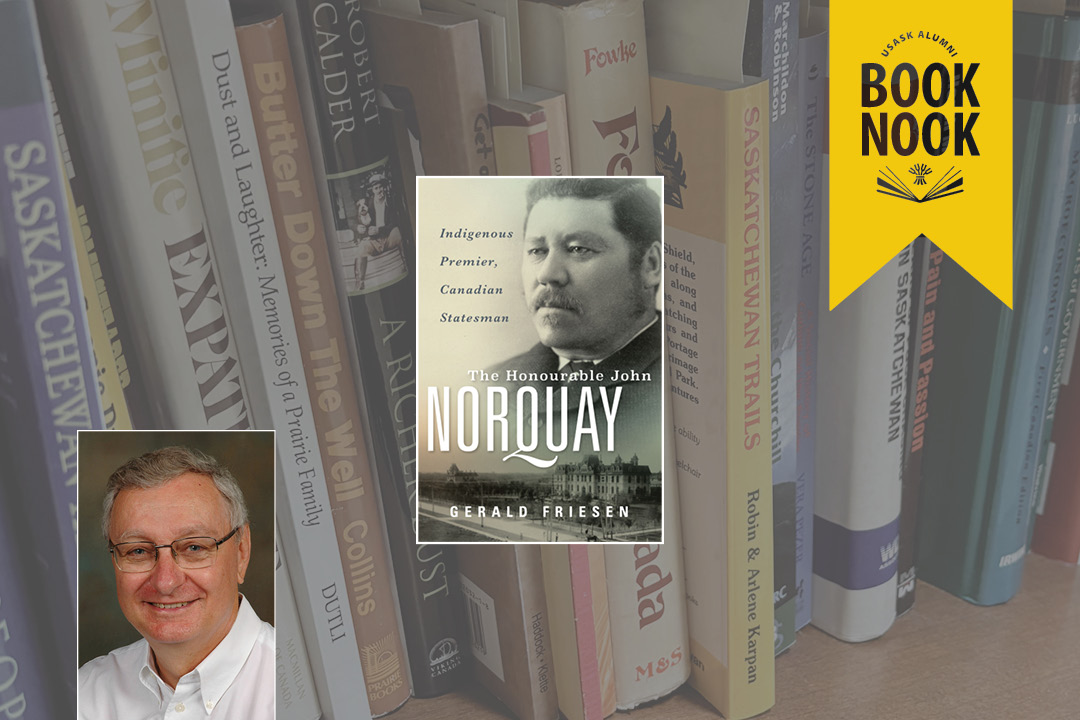
Alumni Book Nook: Dr. Gerald Friesen (BA’64, PhD)
USask alumnus Dr. Gerald Friesen, a distinguished professor emeritus at the University of Manitoba, has authored an award-winning book about former Manitoba premier John Norquay
Dr. Gerald Friesen (BA’64, PhD) traces his love for history to his time at the University of Saskatchewan (USask), where he first studied the subject at the post-secondary level in the 1960s at USask’s College of Arts and Science.
“My USask education, and especially the teachers in the history department, meant everything to me then—and still do,” said Friesen, who now resides in Winnipeg, Man.
After completing his undergraduate studies at USask, Friesen went on to earn a master’s degree and a PhD in history at the University of Toronto. Today he is a distinguished professor emeritus in history at the University of Manitoba, and his primary research interests include the history of Western Canada; the history of working people and labour movements; and the history of communications. He has received numerous awards and honours for his scholarly work, including the Order of Canada and the CHA Prize for Best Scholarly Book in Canadian History (formerly called the Canadian Historical Association Macdonald Prize).
Friesen’s latest book is The Honourable John Norquay: Indigenous Premier, Canadian Statesman, published by the University of Manitoba Press. His previous books have included The Canadian Prairies: A History (1984); River Road: Essays on Manitoba and Prairie History (1996); The West (1999); Citizens and Nation: History, Communication and Canada (2000); Rural Life: Portraits of the Prairie Town 1946 (2004); Immigrants in Prairie Cities: Ethnic Diversity in Twentieth-Century Canada (2009, co-authored with Roy Loewen); and Canadians and Their Pasts (2013).
The Green&White asked Friesen about his memories from his undergraduate days at USask and about his newest book, The Honourable John Norquay: Indigenous Premier, Canadian Statesman.
What inspired you to write this book?
The Norquay book was a retirement project. Manitoba was the only prairie province when John Norquay was premier (1878-1887), and its experience was a proxy for the rest of the region. Norquay has been described as the alter ego of Louis Riel. He established a path for the Métis that prevailed for a century, and he pioneered the prairie resistance movement to John A. Macdonald’s centralist vision for Canada. His life—from orphan and prodigy to national political figure—is fascinating. The fact that I was the first to read a vast Norquay archive—over 5,000 letters to him and by him—make the book new and different for those who have been told the war in 1885 and the Canadian Pacific Railway were the only decisive moments in 19th-century prairie history.
What has the reader response been to the book?
It has been received generously in reviews and has won a number of awards, including a Dafoe Book Prize (best Canadian history book 2024), a Clio (Canadian Historical Association prize in prairie history), and the McWilliams Award (scholarly book) from the Manitoba Historical Society.
You studied in the University of Saskatchewan’s Department of History in the 1960s. Why did you choose to study at USask?
Having grown up in Prince Albert, Sask., Saskatoon stood out as the convenient and economical choice for university. I lived in St. Andrew’s College for all four years and roomed with a high school classmate who was a model student (he went on to do a PhD in the UK). Chemistry and biology didn’t really agree with me, but I liked history, French, and political science classes. That led to an honours degree in history (1965).
What did you enjoy about your time as a USask student?
I found the college and campus life to be very interesting and benefited enormously from the helpful, engaging professors in the history department. Another fond recollection: walking across the campus in the freezing Arctic darkness at 8:30 am for curling and wrestling classes. The memory remains vivid 64 years after the fact.