


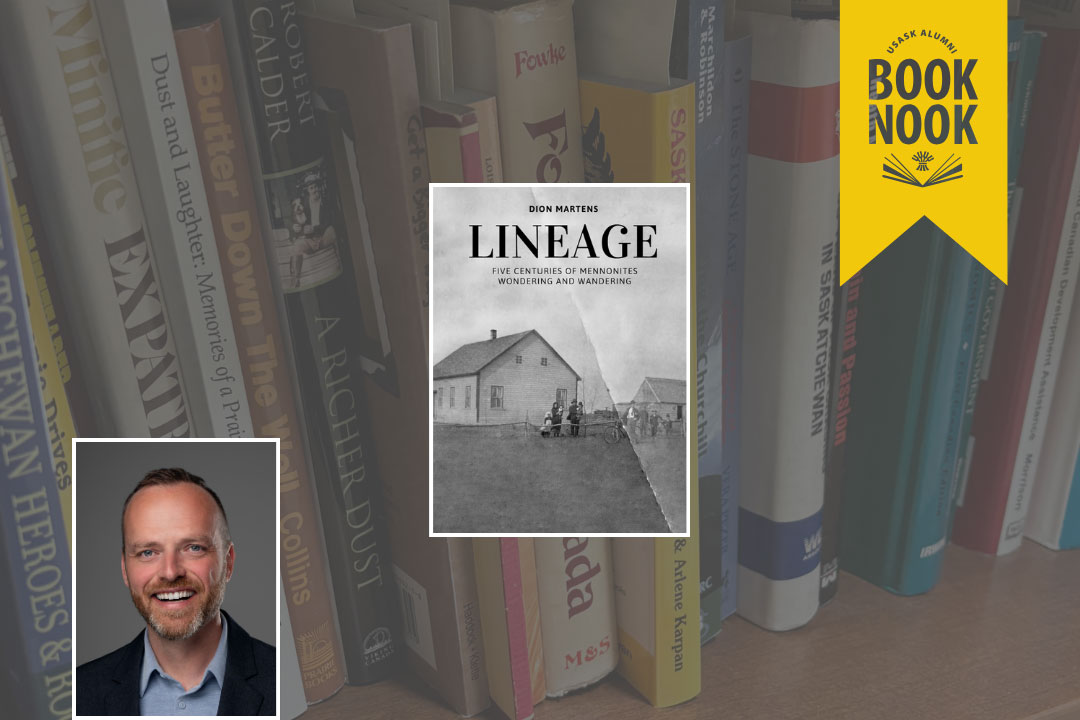
Alumni Book Nook: Dr. Dion Martens (PhD’15)
The first novel written by USask graduate Dr. Dion Martens was inspired by Mennonite history and stories from Martens’ own family
University of Saskatchewan (USask) alumnus Dr. Dion Martens (PhD’15) has written his first book, a work of historical literary fiction grounded in the real lives of Mennonite people and archival research. The new novel, Lineage: Five Centuries of Mennonites Wondering and Wandering, was released on April 1, 2026, by Pandora Press.
Prior to writing the book, Martens received his PhD at USask in 2015 after studying at the Johnson Shoyama Graduate School of Public Policy (JSGS). He is now an adjunct professor at JSGS and works as an agri-food business executive in Saskatoon, currently serving as the executive director of the Saskatchewan Egg Producers.
The Green&White asked Martens about what inspired him to write the book and how his USask education was an asset during the process.
What is the focus of your new book?
Lineage tells the broader story of Mennonite history through the real lives of two families across five centuries—from the Netherlands to Poland and Prussia, across Imperial Russia, and finally to the Canadian prairies. Along the way, they face persecution, seek freedom, build new lives, and wrestle with faith, identity, and change. Rooted in real lives and historical events, the novel draws on informed imagination to fill the spaces where the record falls silent.
What inspired you to write this book?
The book was inspired by a long-standing interest in my own family history and in the broader Mennonite story. Over the years, I came across archival records, family stories, and historical accounts that were rich in detail but often fragmentary. I was drawn to the idea of bringing those lives to light—honouring what is known while thoughtfully reconstructing the moments that history leaves incomplete. In many ways, Lineage grew out of a desire to better understand where we come from, and what we carry forward across generations.
Did your education at USask play a role in researching and writing this book?
Yes, very much so. My time at the University of Saskatchewan helped shape how I approach research, critical thinking, and complex questions. While Lineage is a work of fiction, it is grounded in careful historical inquiry, and my academic training played an important role in how I engaged with archival sources, interpreted evidence, and constructed credible narratives. I would also credit Professor David Parkinson, who taught an English class I took at USask, with deepening my love of reading and writing, and shaping how I see and tell stories in a more intentional way.
Why would you recommend your book to USask alumni?
Lineage will be especially meaningful for those of Mennonite ancestry or with an interest in Mennonite history, as it tells that story in a deeply personal and accessible way. It is also rich in history more broadly, which may appeal to readers who enjoy immersive, historically grounded storytelling. At the same time, it may resonate more broadly with USask alumni who are interested in questions of identity, belonging, migration, and what we carry forward across generations. It’s also a story that ultimately arrives on the Canadian prairies, which may feel close to home for many readers.
What are five adjectives that you would use to describe your book?
Sweeping, grounded, reflective, human, and historically rich.
Is there anything else you would like to add?
I’m deeply grateful to the many individuals and institutions that helped bring Lineage to life—from archivists and historians to family members who preserved stories across generations. It has been a meaningful journey to trace these lives and share them in this way. I’m also especially thankful to the University of Saskatchewan for the role it has played in shaping how I think, research, and write.