


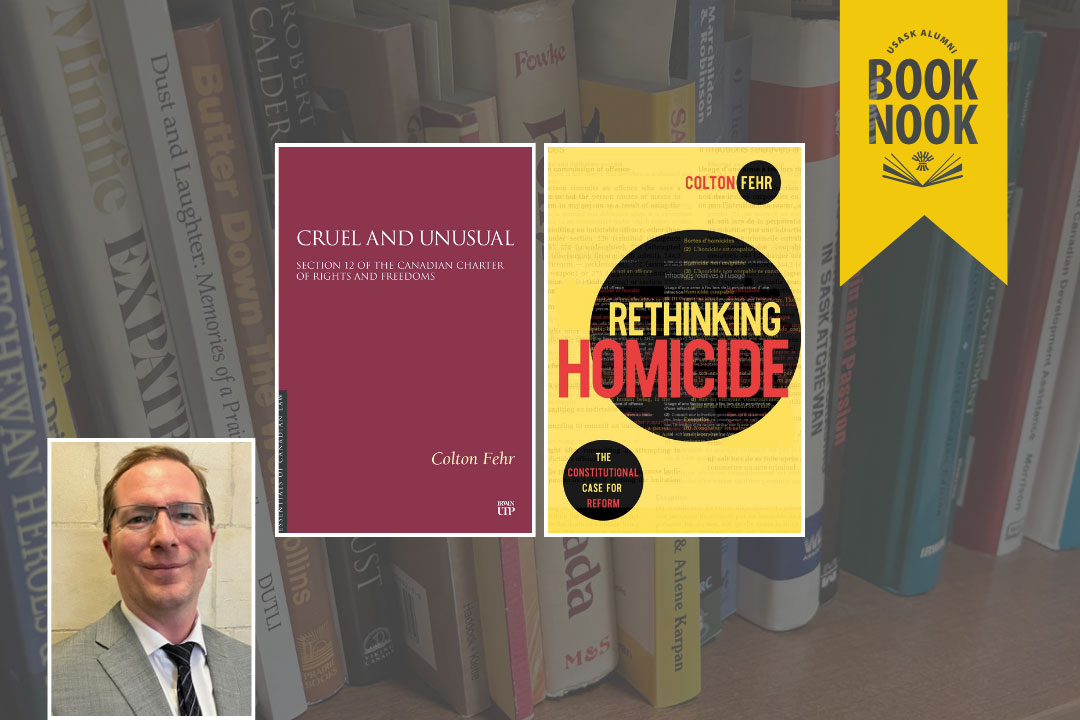
Alumni Book Nook: Dr. Colton Fehr (BA’10, JD’13)
USask graduate Dr. Colton Fehr, an assistant professor in the College of Law, has written two new books on law reform
University of Saskatchewan (USask) alumnus Dr. Colton Fehr (BA’10, JD’13) has written two new non-fiction books that address law reform in the criminal law: Rethinking Homicide: The Constitutional Case for Reform (McGill-Queen’s University Press) and Cruel and Unusual: Section 12 of the Canadian Charter of Rights and Freedoms (University of Toronto Press).
The first book focuses on reforming various components of homicide law, while the second offers a description and criticism of the jurisprudence developing the prohibition against cruel and unusual treatment or punishment found in section 12 of the Canadian Charter of Rights and Freedoms.
“I wish the law to be updated to accord with our fundamental values as recognized in the Charter and elsewhere,” said Fehr, an assistant professor at USask’s College of Law, when asked what inspired him to write the books.
Fehr, who lives in Saskatoon, completed his undergraduate degrees at USask: A Bachelor of Arts in political studies and a minor in Russian language at the College of Arts and Science in 2010, and a Juris Doctor at the College of Law in 2013. He then earned his Master of Laws degree at the University of Toronto, followed by a PhD at the University of Alberta. Before embarking on a career in academia, Fehr worked as a law clerk at the Provincial Court of Saskatchewan as well as a Crown prosecutor for Saskatchewan Justice. He then served as an assistant professor at the School of Criminology at Simon Fraser University and at the Faculty of Law at Thompson Rivers University, before joining USask’s College of Law in a tenure-track position on Jan. 1, 2024.
At USask, Fehr’s teaching and research interests include criminal law, criminal procedure, evidence, and constitutional law. He serves as an editor for the Criminal Law Quarterly and the Manitoba Law Journal and is also the author of two previously published books, Judging Sex Work: Bedford and the Attenuation of Rights (UBC Press, 2024) and Constitutionalizing Criminal Law (UBC Press, 2022).
The Green&White recently asked Fehr about his two newest books—Rethinking Homicide: The Constitutional Case for Reform and Cruel and Unusual: Section 12 of the Canadian Charter of Rights and Freedoms—and how being in a rock band has helped him hit the right notes as a writer and a scholar.
Your two new books address law reform in the criminal law. What impact do you hope your books will make in this area?
I hope the books are able to influence the courts and Parliament when deciding how to treat those charged and convicted of crime. I am particularly hopeful that my work will help courts understand and develop the relationship between criminal law and the Charter, as Canada is a leading jurisdiction in the world in that respect.
Why would you recommend your new books to USask alumni?
The books engage with questions relating to moral and, to a lesser extent, political philosophy that readers from these backgrounds may find interesting. Ditto with my earlier two books with UBC Press.
You have written more than 50 academic articles, and you are the author of several books. What draws you to writing and publishing?
I have always had a deeply felt need to pursue justice. That’s just something one has inside of them. When I see that justice is not being met, I want to use my skillset to provide insights from my broader study of the law and reflection on its principles. Courts often don’t have as much time to sit with issues, so hopefully spending some of my time reflecting deeply on core issues will prove valuable to them.
Your teaching and research interests fall broadly into the areas of criminal law, criminal procedure, evidence, and constitutional law. What interests you about these areas?
I have always been interested in the state and how it relates to its citizens. These areas—especially criminal law, criminal procedure, and constitutional law—provide the most obvious sites of contestation that push the limits of that relationship.
In addition to your career in law and academia, you are a musician who has served as the bass player for the Saskatchewan band Autopilot. What are some parallels between academia and music?
The band is still going strong—and even stronger, I’d say—without me, which is awesome to see! I was an early member with the band (joined in 2003) and played with them until shortly before the COVID-19 pandemic, although I was off and on once I finished law school in 2013. There has always been so much talent in Autopilot, and I was very fortunate to be a part of the band. I really love Autopilot's creative emphasis. The band always focused heavily on writing, not covering songs written by other bands. This forced us all to think creatively and do so together—a skill that translates directly to academia. As occurs with writing songs, often one needs to sit with a riff or idea for a long time to sort it out and connect it to other parts. In other cases, you know you struck the right chord right away. Writing music allowed me to exercise those skills often and with extremely talented musicians, and I think the skills I took away from that experience are broadly translatable to writing lengthy books and articles. Being in a band that toured heavily also required a lot of organization and ability to adapt to very different, and sometimes very peculiar, circumstances.
You earned both your Bachelor of Arts and Juris Doctor degrees at the University of Saskatchewan, and you are now a professor at USask’s College of Law. What is it like to teach at your alma mater?
The students here are wonderful and very inquisitive. It was a bit odd, though, stepping into a classroom and remembering the exact spot where I used to sit as a student (back when I had that long rock star hair).
What is your advice for law students and law graduates who may want to follow in your footsteps and write a book on a particular area of law?
Make sure that you have your foundational principles in order and use them as building blocks to construct your preferred theory of a particular area of law. As those principles will all but certainly be contested, students should also be willing to revisit even their own work and ideas when they run into roadblocks. Good scholars, I think, know that it’s not about being “right;” it’s about pursuing the best answer.