


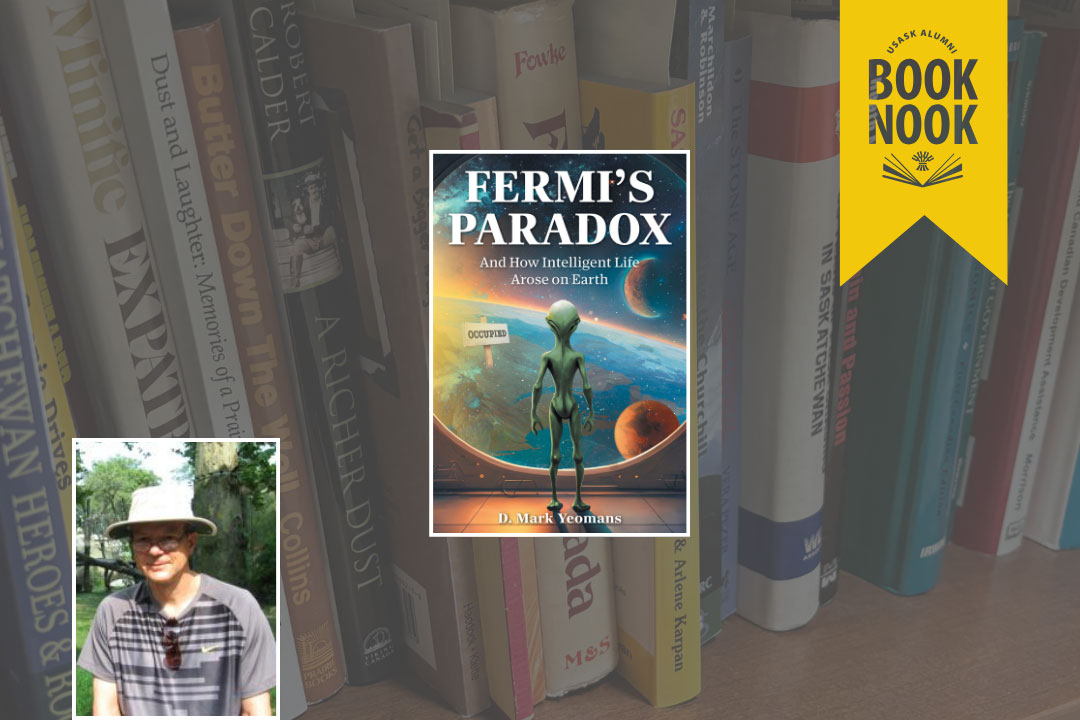
Alumni Book Nook: Dr. D. Mark Yeomans (BE’80)
In his first book, scientist Dr. D. Mark Yeomans explores how intelligent life arose on Earth and ponders whether it exists beyond our home planet
University of Saskatchewan (USask) alumnus Dr. D. Mark Yeomans (BE’80) has written his first book, a multidisciplinary work of non-fiction that explores the past five billion years on Earth and questions the existence of extraterrestrial intelligence. Yeomans said the book, Fermi’s Paradox: And How Intelligent Life Arose on Earth, is quite topical given the recent Artemis II crewed lunar flyby mission and the Pentagon’s release of Unidentified Flying Object (UFO) files.
“Perhaps the reason we don’t see evidence of extraterrestrial civilizations is that it is more difficult for intelligent life to arise than we thought,” he said. “To help answer this question, the book examines how intelligent life arose on Earth.”
Yeomans’ deep interest in science proved to be invaluable as he wrote Fermi’s Paradox: And How Intelligent Life Arose on Earth. Currently living in Regina, Sask., Yeomans’ undergraduate studies took place at USask’s College of Engineering, where he earned a Bachelor of Science in Engineering degree in mechanical engineering in 1980. He then went on to earn a master’s degree in petroleum engineering at the University of Oklahoma and a PhD in experimental nuclear physics at the University of Regina, before taking on a post-doctoral appointment at Utrecht University in the Netherlands. Recently retired, throughout his career Yeomans worked as a petroleum engineer in industry, a nuclear physicist in academia, a small business owner, and a horse trainer.
Yeomans describes his new book, which was released in March 2026, as fascinating, foundational, comprehensive, multidisciplinary, and fun. The Green&White recently asked him about what inspired him to write Fermi’s Paradox: And How Intelligent Life Arose on Earth and why he would recommend the book to other USask alumni.
What inspired you to write this book?
There are three big questions: Is there a God? Is there life after death? Are we alone? I thought I could make a contribution to answering the last one. Also, in our post-truth world, somebody has to make the case for reason, and interest people in science. Why not me? I’m reasonable.
What is the central thesis of your book?
Fermi’s paradox is the high probability of, but lack of evidence for, extraterrestrial civilizations in our galaxy. In fact, (Italian-American physicist Enrico) Fermi asked, “Where is everybody?” I take a slightly different approach to answering this by examining how intelligent life arose on Earth. So, I don’t really have a thesis. The book is an exploration.
What was the writing process like for you?
I don’t write; I potter! The book is 678 pages and was researched and written on half an hour a day. It is multidisciplinary and covers the past five billion years. So, it was fascinating if you like that sort of thing.
How did it feel to complete and publish the book?
When somebody climbs Mount Everest, they set a goal, then they do the training, then they successfully complete the climb. My goal was to research, write, and publish this book, so I imagine I have the same feeling of accomplishment as the mountaineer.
Your book was described in a Kirkus review as “a fact-filled and very inviting exploration of biology.” What other feedback have you received?
Not much—it’s a recent release, and quite long. . . . I have heard a couple of comments that it is surprisingly readable for a book that contains a lot of science. Good—that is what I set out to do!
What is your advice for other USask alumni who may wish to write a book?
If, like me, they are writing while doing other things (like working), I would suggest to treat the writing process like an exercise program. Find a time during the day when you can regularly sit down for half an hour and devote it to writing. What worked for me was after the evening news, before bedtime. Don’t try to do too much. If you feel inspired one day, then work longer. If you can’t face it one day, don't worry about it. Just try to be fairly regular. I would also say, “Listen to your book.” My book turned out very differently from the one I set out to write.
Do you have plans to write another book?
Yes! The publishing process operates on the geological timescale, especially when you throw in a pandemic. So, I began researching another book—essentially on the mind/body problem in the age of AI. I have two more I want to do after that. I’m 67. I will either have to write faster or keep very good care of myself.
Why would you recommend your book to USask alumni?
During COVID, a lot of people examined their lives and asked, “Why are we here?” Part of the answer to that question is “How did we get here?” The book attempts to answer that.