



USask graduate calls the accent shots on stage and set
Holly Renaut (BFA’08) has translated her USask drama training into a global career
By Joanne PaulsonIn the pantheon of coolest jobs ever, Holly Renaut’s career as an accent coach and actor must rank in the 99th percentile.
Case in point: The creation of an alien accent for the 2022 series The Man Who Fell to Earth, which Renaut helped develop for British award-winning actor Chiwetel Ejiofor, known for his Oscar-nominated role in 2013’s 12 Years a Slave.
“He had to speak with an American accent but had to intentionally mispronounce things. We created an exaggerated accent; if this otherworldly creature learned to talk, how might he say it differently?
“That was my first major contract in TV and film. Since then, I’ve done a lot of different productions.”
Renaut, a graduate of the former Department of Drama (now the School for the Arts), has also landed many roles as an actor. Among them was Sophie in the Apple TV series Land of Women with Eva Longoria.
She also dubbed the roles of Lola in Noche de Chicas and Emma in Desde el mañana, both on Disney+; and in animation, voiced the roles of Abigail and the Magic Quokka in Joy Eternal.
Recently, she was also the acting coach for The Walking Dead: Daryl Dixon, “everyone’s favourite character, that was filming here in Spain.”
Based in Madrid, the English-Spanish bilingual coach and actor is eternally grateful to her education at USask—from a department with a long history. The Drama Program celebrates its 80th anniversary this year with various celebrations, notably a showcase of original one-act plays in March and a banquet on March 21.

Accent coaching was and is a niche occupation in the stage, TV and film industry, she said.
“It isn’t something I necessarily chose…. I didn’t even know it was a job in the industry that existed,” Renaut recalled about her time at USask in an interview from Madrid.
“My voice teacher was Julia Jamison, and she was the one who brought it to my attention that I was quite good at accents. I remember clearly working with her in her voice class. All of us learned how to sound more American … and we all had to do a standard British accent.
“She was wonderful and kind and humble enough to say, ‘I think you should demonstrate this accent because you actually do it to a very high level, and very authentically.’
“I kind of started helping her teach the British accent.”
Also beneficial was the depth of the department’s training, she added. Some drama programs focus on acting, but at USask, students were engaged in many kinds of stagecraft from costumes to props to lighting and sound.
“We did so many things at the same time and they had very high expectations of us. That prepared me very well for the life that I have now, which is doing many things in the industry at a quite high level.”
How to teach an accent
The trick, of course, was learning to teach accents professionally beyond just demonstrating and telling actors, “You say it like this.”
“I started, on my own, studying all kinds of things from linguistics to anatomy, a bit of neuroscience, to how we learn to speak, how babies learn to speak. It snowballed from there,” Renaut said.
Voice coaching is very individual, she noted. She begins with listening to actors give an accent their best shots, allowing her to grasp what they are hearing.
“It’s very hard, because some people hear a lot of differences and some genuinely don’t. It’s a little bit like music. Some can instantly pick up a tune and some can’t and know they can’t, and some can’t and think they can.”
While the actors are speaking, she watches how their mouths move and listens for the “areas of tension” in their speech.
From there, Renaut helps the actors position their muscles in the right place to achieve the accent.
“We build it up sound by sound. Usually, we’re working on a script, and we’ll get things like the musicality and intonation of the language, and then hopefully program it all in so they can rely on muscle memory when they get to their stage or set.
“If they can’t, I’m usually there listening to the directors and helping them incorporate that into the acting, which is the important thing. If you get too stuck on the accent, it can actually be a barrier to a good performance.”
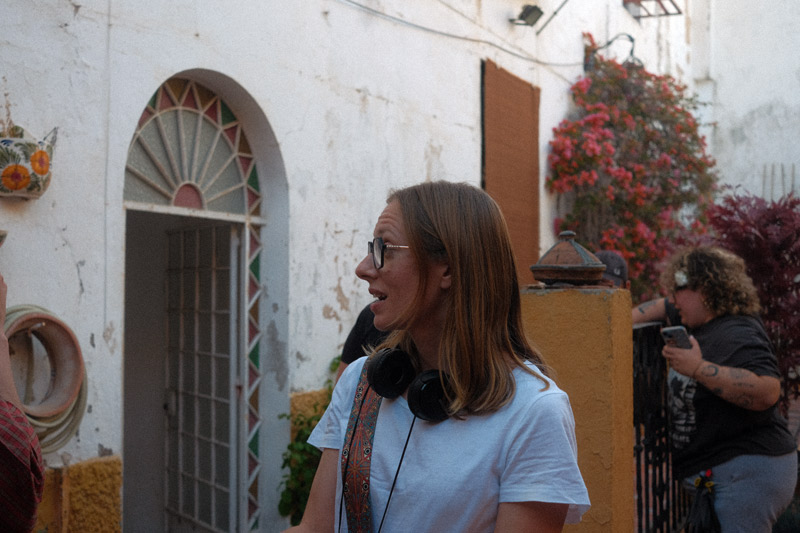
Building the career
After graduation from USask, Renaut moved to London where her acting and accent coaching career took off.
"I really got into Shakespeare there, and played Viola in Twelfth Night, and Mistress Quickly in Merry Wives at the Royal Shakespeare Company outdoor summer stage.
“I hit a big crescendo in my career in the last 10 years, maybe the last 12 years where I haven’t had any side jobs. I’ve only been coaching or acting.”
She then returned to Saskatchewan and did a couple of tours with Wide Open, the puppetry company, followed by training in Massachusetts with Shakespeare & Company, and then moved to Ireland, where a setback loomed: after filming a movie, she learned her scenes had been cut.
“I felt I was sort of getting on the right track and then that happened, and I thought I need to leave this industry and I’m moving to Spain,” she said with a laugh.
Yet it didn’t take long before she got back into the industry. Today, she teaches in a variety of ways, including through Compass Arts, an acting retreat and production company she runs with her husband, producer/composer Yago Cardalda. She also runs regular workshops in the UK where she has a big base, and during the COVID pandemic created an online program called the Accent Challenge.
She now works with thousands of actors all over the world, but is also ready to tread the boards again.
“I need a bit of a balance. If I do too much of one thing, I start to crave the other.
“I’ve been on a lot of sets as a coach for the last couple of years, so I told my management, let’s push the acting this year.”
She credits her success not just to her drama training, which began at Aden Bowman Collegiate’s Castle Theatre, but also her Saskatchewan roots.
“The thing that has helped me stay where I’m at is a sort of Saskatchewan kindness and friendliness, where you treat everyone equally. Growing up in that culture has helped me a lot, because not everybody has that. I think a lot of people get intimidated in those situations and for some reason I don’t.
“And everyone has to shovel their snow.”
How to do a Saskatchewan accent: pucker up
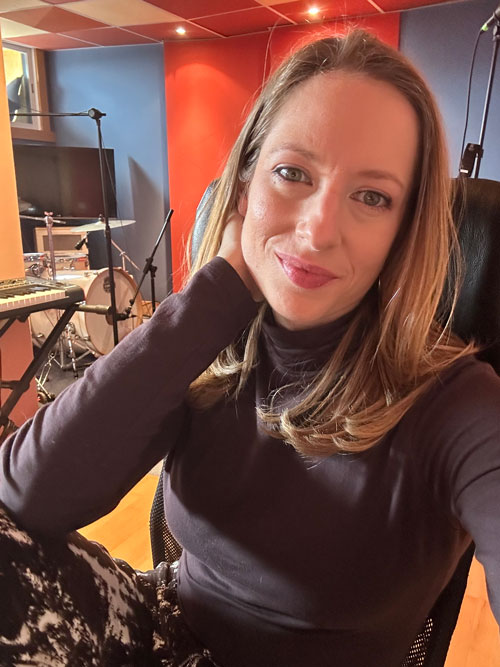
“Saskatchewan. Funnily enough, I have never been asked for this accent,” Renaut said, laughing.
But she has her theories about how to teach the accent of home.
Saskatchewan people make many sounds where the throat closes a little bit due to the cold weather, she noted.
Helping an actor with a general American accent shift to a Saskatchewan accent would mean the sounds would be “much more closed,” she said.
“We have all these sounds that are similar to the American accent but smaller. All their ‘sahries’ become ‘sore-ees,’” she said about the much-used-in-Canada “sorry.”
“We don’t move our jaw muscles very much. The American ‘ah’ sound for an ‘or’ is really closed in Saskatchewan. So that would be one thing I would focus on.”
Also, Canadians “go oat” instead of “out,” but never “oot,” she added.
Diphthongs too become smaller and shorter. “Where some people would say tonight with a big I, in Saskatchewan we tend to say tonight very quickly.”
Saskatchewan people may tighten their mouth muscles, “but we have big personalities. We compensate for the small movements by being very expressive in our melodies and our speech. There’s a lot more up and down in pitch.
“People in Saskatchewan show a lot of vocal enthusiasm. They’re very expressive and quite musical.
“And you have to say bunnyhug.”
Article originally published for https://artsandscience.usask.ca