


Prairie roots, global game
Alumnus Troy Gottselig (BEd’11), who won a national championship with the Huskies men’s basketball team, reflects on his time as a USask student-athlete
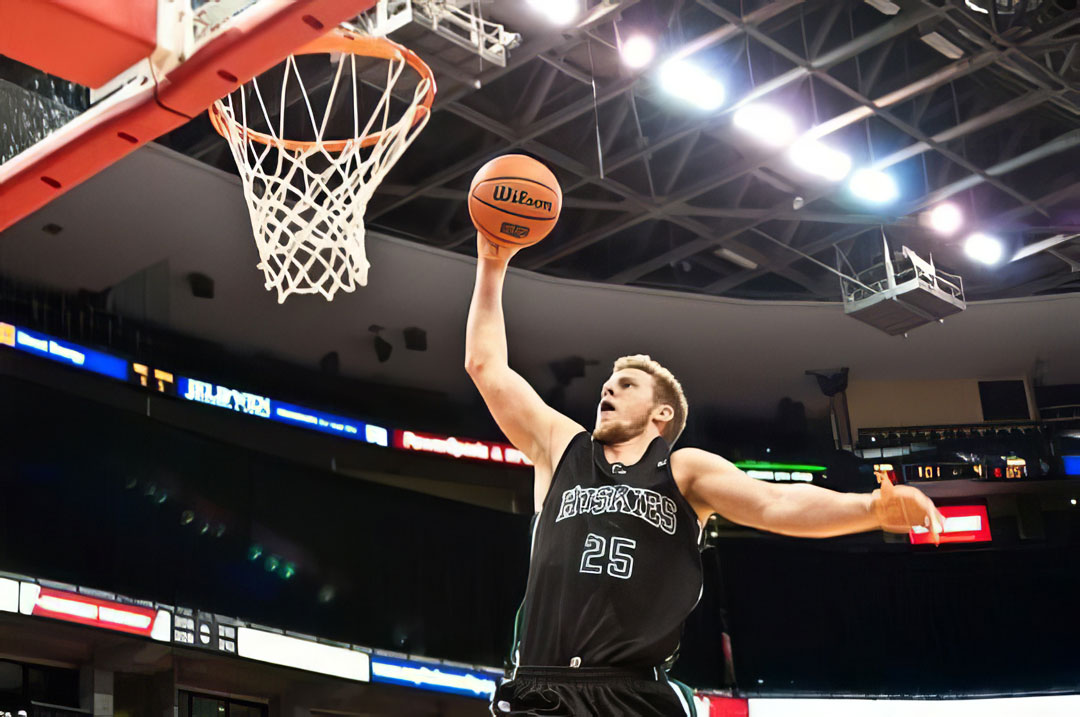
By Sean ConroyAfter winning a national championship with the Huskies, University of Saskatchewan (USask) graduate Troy Gottselig (BEd’11) embarked on a pro basketball journey that saw him represent his country and play professionally throughout Europe. He credits his Saskatchewan roots and his USask education with helping him to realize his hoop dreams as well as the success he’s enjoyed post-playing career.
The Green&White recently caught up with the College of Education alumnus and newly minted Wall of Famer, who is now running his own venture, Gottselig Elite, in Abbotsford, B.C.
The 2009-10 Huskie men’s basketball team was recently inducted into the University of Saskatchewan Athletic Wall of Fame. You were a key contributor to that championship run, including being recognized as Most Valuable Player in the national championship tournament. Looking back at that season, what were some stand-out moments?
That season was the highlight of my career, hands down. What stands out most to me were the relationships we built and the complete buy-in from every player on the team. Midway through the season, we faced some adversity and internal issues. Over the Christmas break, our team leaders called a meeting with coach (Greg) Jockims (BSc’88) where we worked through our challenges together. From that point on, we went undefeated to close out the season.
We made a collective decision to win a championship. Every ego had to be set aside for the good of the team. Once that happened, full trust was established, and an unbreakable brotherhood was formed. We weren’t the most talented team in the country, but we had an incredible bond and a true “next man up” mentality. There was never any doubt that we could win.
After winning the Canada West title, the national newspaper seeded us fifth in the tournament, behind UBC and Calgary—both teams we had beaten. We used that as motivation. While we may not have had the most raw talent, we knew nobody trained harder or was in better physical shape than we were. We were the biggest and strongest team by far, which I credit to our intense pre-season training led by Greg, Barry Rawlyk (BSc’82, BEd’83), and our trainer Bruce Craven (BSc’88, MSc’91). We were also an extremely cohesive unit defensively and simply outworked everyone in the country, in true small-town Saskatchewan fashion.
There is often an enduring bond among Huskie teammates. What has the bond been like for you guys on the national championship team? Do you stay in touch with your fellow alumni and teammates?
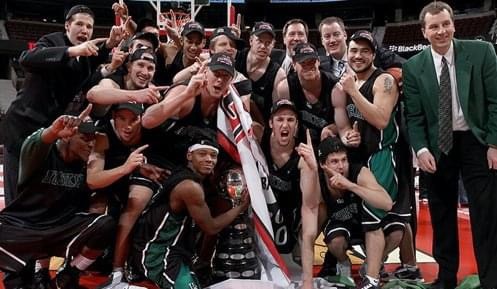
I still talk to most of those guys, and we’ve remained close friends to this day— especially the bigs (power forwards and centres). We’ve reunited for weddings, and some teammates even make trips out to the coast to visit with their families. The lasting relationships say everything about the team and the brotherhood we built. The closest friendships are the ones from the championship teams I have played on.
I often tell my kids that the closest friendships you’ll ever form are the ones developed through sports teams. When it’s all said and done, what truly matters is the relationships you gain along the way. The cool part is that you don’t even realize it’s happening while you’re in the middle of it.
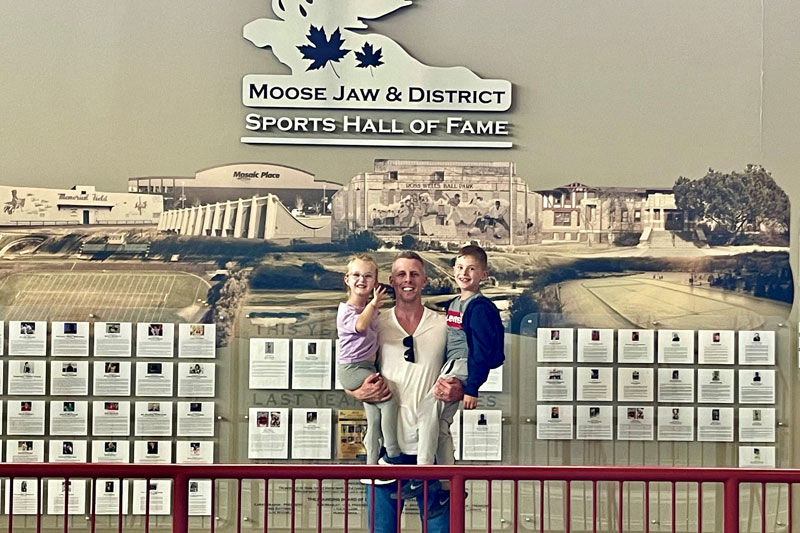
In addition to the Wall of Fame induction, you have also been inducted into the Moose Jaw and District Sports Hall of Fame for your high school basketball and football accomplishments. How does it feel to have your athletics career accomplishments honoured in such a permanent and public way?
Hall of fame inductions were never on my radar or something I ever thought about during my career. Those honours are simply a byproduct of hard work, commitment, and dedication to your craft over time. It’s not just about skill or accomplishments, but about the impact you make on organizations, your community, and people’s lives. Being inducted into my hometown’s hall of fame was especially meaningful, knowing I gave everything I had with the tools I was given and helped others along the way. I certainly didn't get there alone, and I’m incredibly thankful for everyone who played a role in my journey. Being an underdog my entire life has made these accolades even sweeter.
Like most kids in Saskatchewan, I grew up playing hockey, but we couldn’t continue due to affordability and time constraints running a mixed farming operation. That taught me what it meant to sacrifice something I loved for the greater good. In Grade 6, mom bought me a pair of Nikes and encouraged me to play school sports like basketball, and always made sure one of them was in the stands supporting as best they could. Basketball ran in my family. Knowing the odds were stacked against me in the sport I chose made these honours even more special. Being recognized by the city that helped shape me really brought everything full circle.
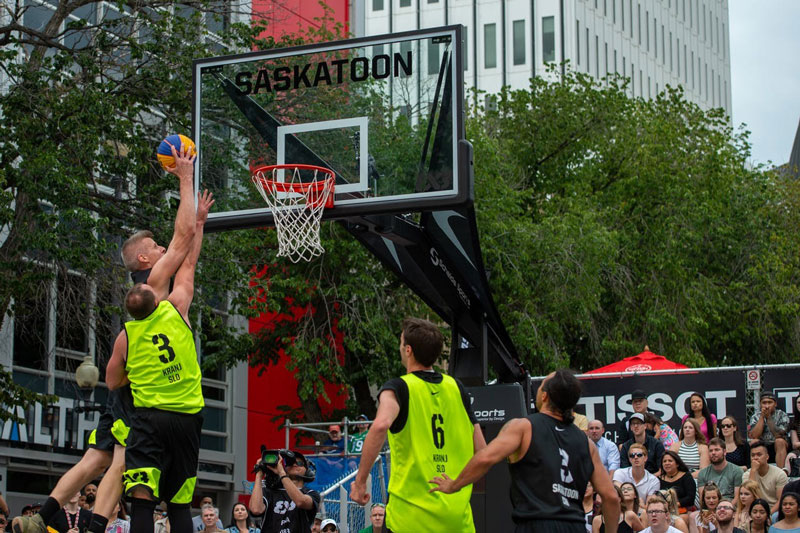
After graduating, you earned a spot on Canada’s national basketball team, and you also represented Canada at the FIBA 3x3 Basketball Tournament. From there, you played professionally across Europe, including in Denmark, Slovakia, Czech Republic, and Luxembourg, before finishing your career with the Vancouver Bandits of the Canadian Elite Basketball League. What do you take away from your post-Huskies professional journey?
My professional journey was a tremendous learning experience, filled with both highs and lows. I got to see the world and get paid to do it, which is something I’ll always be grateful for. Living in different countries and experiencing new cultures broadened my perspective, though I will admit the transition was challenging for a farm kid from rural Saskatchewan.
One moment that stands out is going from cutting hay all day back home to receiving a call to try out for the Canadian national team in Toronto shortly after winning a national championship. Making that team became my calling card for Europe, but the rapid transition was overwhelming. At that point, my maturity and experience weren’t quite where they needed to be. Thankfully, my character and upbringing helped carry me through the challenging moments.
I eventually found my groove in Eastern Europe and was playing my best basketball around age 25. I didn't have much guidance early on and learned many lessons the hard way, but I wouldn’t trade those experiences for anything. They led me to where I am today—with my beautiful wife, two amazing children, and a career I love. The most fulfilling part was learning what I could overcome. I dealt with a lot of adversity and anxiety being in unfamiliar places, away from family, the farm and friends, and the challenge of being expected to perform every night. The game also changes when money is involved, and that was something I struggled with adapting to. What I failed to recognize at the time was how good I really had it, but something was always pulling me back and I later realized it was my roots.
Coming from a championship culture at USask, where everyone played for each other, to professional teams where players were often focused on individual advancement, was tough, but I am grateful for what it taught me. I was never recruited for elite skill, but I understood what it took to win as a team, and I believe that character kept me on rosters overseas. If I could do it over again, I’d change a lot—but that’s life. Those lessons now allow me to guide my own children, my nieces and nephews, and the athletes in my community. Growing up, professional basketball never felt like a possibility where I was from, so just being able to say I did it and made it that far is something I’m proud of.
You earned your Bachelor of Education degree at USask as a phys-ed major. How has your degree and experience as an education student helped you in your career?
Earning my Bachelor of Education from USask, combined with my experiences as a student-athlete, continues to pay dividends to this day. I give a lot of credit to my late father, George, who encouraged me to pursue teaching and play in Saskatchewan. He believed in the lifestyle it could provide and knew I had a passion for helping people. He always reminded me that basketball would eventually end and that I needed something to fall back on. The bonus of playing in Saskatchewan was the proximity to the farm to be able to continue to help out when I could.
After winning the national championship, I had immediate professional opportunities overseas, but I chose to stay and finish my degree first. Although it delayed my pro career and limited some options, I’ve never regretted earning my degree first. It’s opened doors for me and provided long-term stability.
After my professional career, I taught physical education for three years before opening a successful fitness and sports performance training business in B.C., which I continue to run today.
I founded Gottselig Elite Basketball in 2016 while I was still playing overseas. My vision was to give back to my community by creating an annual premier basketball camp opportunity for athletes in Saskatchewan to learn from current pro and university players, and also give them the opportunity to showcase their skills in front of U SPORTS and Alberta Colleges Athletic Conference (ACAC) coaches in attendance. These coaches got to scout talent and in return received monetary scholarships for their programs funded by camp registration fees. Scholarships were given to players that showed outstanding community involvement, in particular volunteering with children and youth.
The camp saw three years of growth and success before COVID shut it down. I then pivoted to a name change, Gottselig Elite, opening my own gym in my residence for youth and teens looking to improve their athletic performance, and for adults of all ages and abilities looking to improve their overall health and fitness with a focus on increasing muscle and strength. I also still work with youth wanting to improve their on-court basketball ability.
Helping young athletes and people of all ages become stronger, healthier, and better versions of themselves has been incredibly rewarding. It also gave me the tools to manage large groups, which I utilized running large-scale basketball camps that gave talented Saskatchewan kids an opportunity to showcase their skills to university coaches—an opportunity that wasn’t available to me.
I give a lot of credit to USask for laying the foundation that allowed me to succeed.
What advice do you have for today's current generation of Huskie student-athletes?
Set goals but, more importantly, write them down. Set your goals to the highest possible achievement in your field. Be patient and don’t take anything for granted. Nothing worthwhile happens overnight; meaningful success often takes years, even decades. I was a late bloomer and didn’t hit my stride until age 25, peaking around 28, so patience is key. Writing goals down brings them to life.
Years after my career ended, I looked back at my high school yearbook and saw that I had written “play professional basketball overseas” as my main goal, even though I didn’t truly believe it was possible at the time. I wasn’t good enough to play university basketball out of high school and had to take the junior route, but somehow that written goal manifested itself.
In a world of instant gratification, it’s important to stay patient with yourself, not cut any corners, and keep building your craft. I learned this the hard way professionally by expecting too much too soon and chasing big contracts instead of putting in the work first. Those lessons are ones I now pass on to others. And, yes, maybe I should’ve written “NBA” instead.