


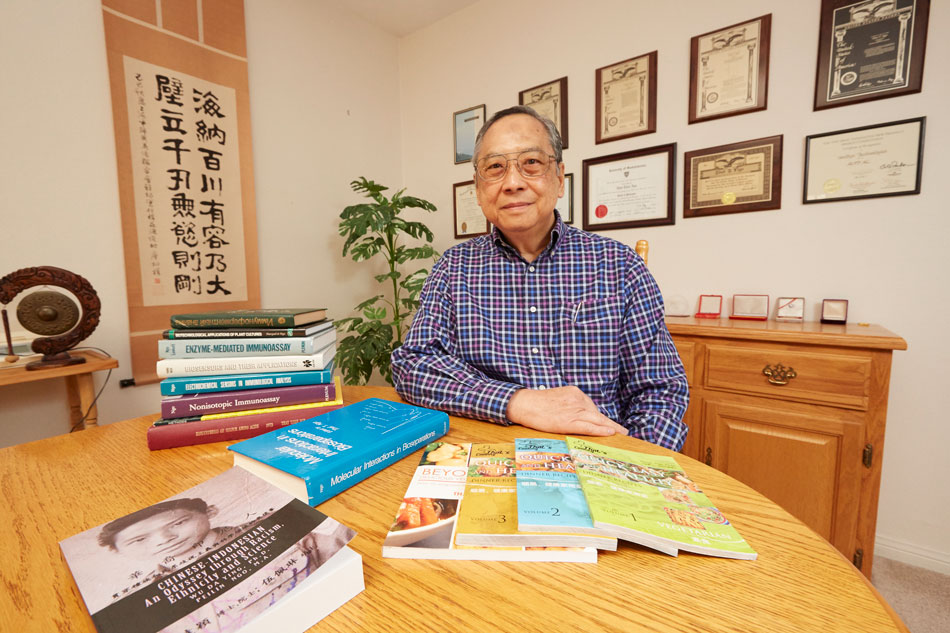
‘There are no words to describe how grateful I am’
Distinguished alumnus Dr. That Ngo (BSc’69, Sc’70, PhD’74, DSC’21), whose groundbreaking invention helped revolutionize diabetes care, chronicled his appreciation for USask in a 2024 self-published memoir
By SHANNON BOKLASCHUK“The University of Saskatchewan gave me endless possibilities and varieties of viable options.”
That is how Dr. That Ngo (BSc’69, Sc’70, PhD’74, DSC’21), a distinguished University of Saskatchewan (USask) alumnus and honorary degree recipient, describes his time at USask as a student in the 1960s and 1970s.
“Perhaps most importantly, it guided me and gave me a chance to discover my love for biochemical research and exploration of the biomolecular world during my formative years and shaped the path for the rest of my life,” Ngo added.
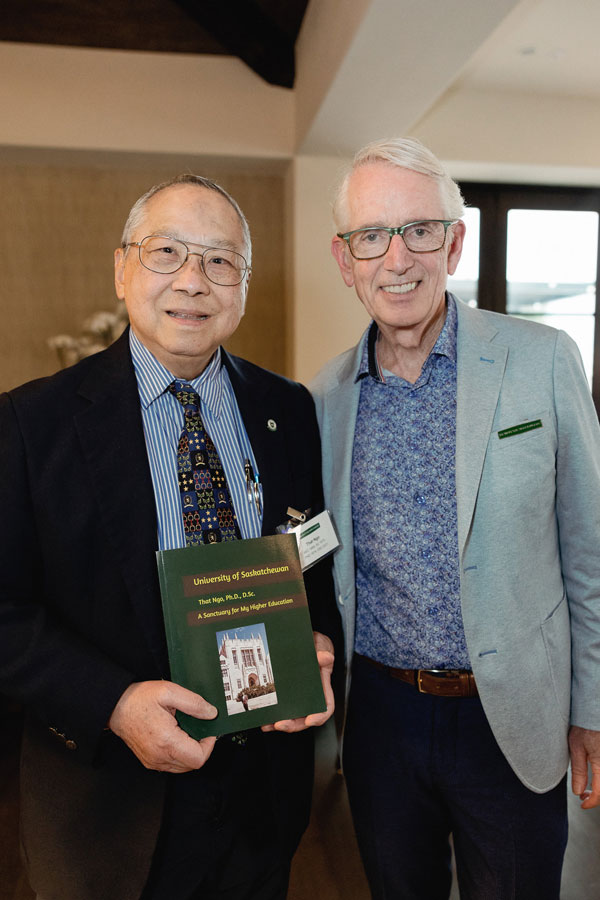
These reflections are included in a passage in the preface of Ngo’s 2024 self-published memoir, The University of Saskatchewan: A Sanctuary for My Higher Education, which explores the reasons Ngo left Indonesia to study in Canada. The book highlights his academic growth at USask, where he pursued degrees in biochemistry at the undergraduate and doctoral levels.
Ngo wrote the book to capture the impact that USask has had on his life and the gratitude he still feels more than 50 years after earning his PhD at the university in 1974.
“It is my attempt to showcase the University of Saskatchewan, its rich academic tradition, its welcoming people, its beautiful campus, and its most conducive learning environment,” Ngo told the Green&White.
Ngo also wrote the memoir to document the racial discrimination he faced during his youth in Indonesia and the challenges he overcame to achieve his post-secondary goals.
“Sometimes I do wonder and think about questions that, perhaps, have no answers,” Ngo wrote in the book. “What if I had never left Indonesia to attend the University of Saskatchewan, where would I be today and what would I be doing? It’s an incredibly profound feeling.”
The road to USask
Ngo’s early life began far away from the USask campus; he was born in 1944 in a small Indonesian town in East Java, at the foot of an active volcano. Because Ngo’s parents were Chinese immigrants, and because he wasn’t old enough to apply for Indonesian citizenship, he was not allowed to attend the state-run schools there and instead attended a private Chinese-language institution. When the time came after high school to go to university, Ngo knew he would need to leave Indonesia to achieve his dreams.
“Leaving Indonesia was the result of racial discrimination,” Ngo told the Green&White. “As Chinese Indonesians, a minority group, we faced an embarrassing and stark reality: after finishing high school, we (had) no place to study in Indonesian universities. Because our diplomas were from Chinese Indonesian schools, and we are ethnically Chinese, we were denied (access) to attend any Indonesian university. In Indonesia, since its independence from Dutch occupation in 1945, very few young Chinese Indonesians were able to attend university. This is tantamount to cutting off our way up the social ladder.”
Firmly believing that “higher education and scientific knowledge can change human destiny,” Ngo refused to give up his dream of attending university. While struggling with racial oppression and insults in Indonesia and facing uncertain financial support from his family, Ngo contacted universities in Canada and Germany and tried to learn as much English and German as he could. Ngo’s journey ultimately led him to USask’s College of Arts and Science. He arrived in Saskatchewan in 1966 with $50 in his tie—and little else.
“Arriving at the University of Saskatchewan in mid-October 1966 was the most unforgettable day in my life,” Ngo wrote in his memoir. “It officially started my full-time formal university life, studying biochemistry as an undergraduate.”
The first two years at USask were exciting but challenging for Ngo. In his second year of studies, for example, he received the devastating news that his father’s shop in their small town had been confiscated by the Indonesian military. The news had a profound impact on him and jeopardized his ability to continue his studies in Canada, as he suddenly lost his sole source of financial support. Yet Ngo would not give up.
Through his unwavering determination and hard work, and with the support of many people he met at USask, Ngo excelled in his studies and completed his undergraduate degree within four years. To pay for his education, he balanced weekend jobs during the academic year with working full-time during the summer months, ultimately earning his Bachelor of Science degree in 1969. Ngo then went on to become a graduate student at USask, receiving his PhD in 1974.
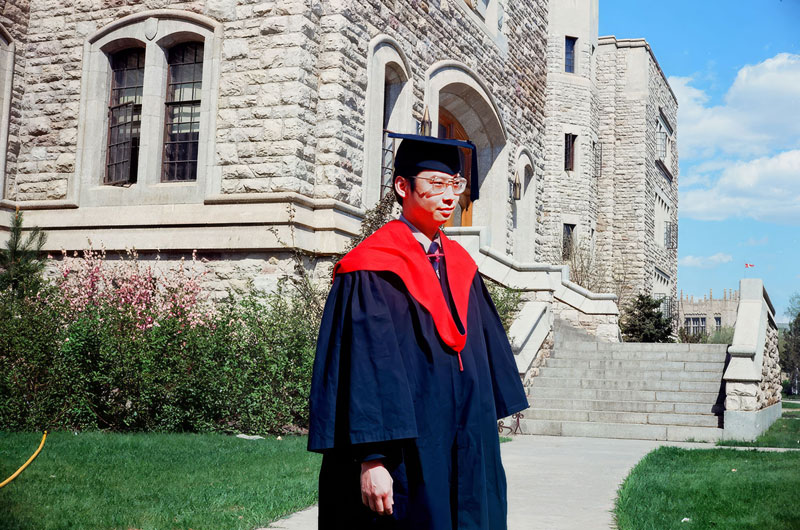
Ngo told the Green&White that “eight years of dedicated study, training, and immersion” at USask “laid a solid foundation” for him to enter the fields of biomedical research and biotechnology upon graduation.
“The diversity of classes offered by the College of Arts and Science was an extra bonus that I very much appreciated as I began writing research proposals,” he said.
An extraordinary career
After graduating from USask, Ngo went on to become a celebrated biochemist, research scientist, and innovator who served as president and CEO of companies in Canada, the United States, and China. Throughout his career he published more than 140 scientific articles and edited seven books. He is also known as a prolific writer of poetry, newspaper articles, and cookbooks as well as for his 2013 memoir, Chinese-Indonesian: An Odyssey through Racism, Ethnicity and Science.
Ngo attributes much of his success to his time at USask.
“The decision to study at the University of Saskatchewan in Canada was the most consequential choice that I made. It was the most important turning point in my life,” Ngo wrote in his 2024 memoir, The University of Saskatchewan: A Sanctuary for My Higher Education. “It turned my life of despair in Indonesia into hope, state of confusion into focus, and the feeling of disgust and contempt for society into appreciation and admiration.”
Today, Ngo is the holder of 14 different industry patents. He has made a significant difference on a global scale, particularly as the co-inventor of the Ngo-Lenhoff peroxidase assay—a groundbreaking technological procedure that has benefited patients living with diabetes around the world. The laboratory technique was adapted for use in the OneTouch home-based blood glucose test, then the only home test systems available for patients with diabetes.
“This method of blood glucose measurement enabled diabetics for the first time to measure their own blood glucose at home on a daily basis. As a result, it led to an unprecedented paradigm shift in the way diabetes is managed and treated, thereby improving the quality of life of millions of diabetics,” Ngo wrote in his 2024 memoir. “This is a good example of the application of basic research results to other practical issues.”
In recognition of his innovative work, Ngo has received numerous awards and honours, including the Society of Chemical Industry Merit Award and being named a fellow of the American Institute of Chemistry, the National Academy of Clinical Biochemistry, and the Royal Australian Chemical Institute. In 2016 he was selected as one of the College of Arts and Science’s Alumni of Influence. He maintains contact with USask and continues to give back to his alma mater, establishing the That Ngo Fund for Study Abroad in the College of Arts and Science, an endowed fund that provides support to students who participate in international learning experiences.
“As a small gesture to promote understanding amongst nations, I set up a scholarship fund for helping University of Saskatchewan students to study abroad,” Ngo told the Green&White.
In 2020, in recognition of his commitment to philanthropy, Ngo received the Honoured Supporter Award from the Saskatoon Chapter of the Association of Fundraising Professionals. In 2021, USask recognized Ngo’s many accomplishments and contributions with an Honorary Doctor of Science degree during the university’s Spring Convocation. Honorary degrees are the highest honour the university can bestow.
At the age of 82, Ngo is now retired and living in California, but USask continues to occupy a special place in his heart. In his 2024 memoir, Ngo described USask as the university that opened his horizons and inspired his thirst for knowledge. In reflecting on his career, he wrote that USask is where his “love for biochemistry was undoubtedly planted, germinated, nurtured, and grown.”
“It goes without saying that my gratitude and love for the University of Saskatchewan is as big and as tall as the proverbial Tai Mountain in China and as vast and deep as the Pacific Ocean,” Ngo wrote in the book. “That was a great blessing, which allowed me to pursue higher education and led me to the path of becoming a researcher in biochemistry. There are no words to describe how grateful I am.”