


New WCVM-linked textbook puts practical bovine immunology in practice
A new textbook on bovine immunology for practicing veterinarians and veterinary students has deep roots in the Western College of Veterinary Medicine (WCVM) at the University of Saskatchewan.
By Caelan Beard
Practical Bovine Immunology was written and illustrated by a multi-generational team. Its co-authors are two leaders in bovine medicine: Dr. John Ellis, a longtime WCVM faculty member, and his former graduate student, Dr. Victor Cortese (PhD’99).
Ellis is internationally recognized for his vaccine safety and efficacy research. Cortese — who completed his PhD at the WCVM with Ellis in the 1990s — was Zoetis’s director of cattle immunology and still lectures and consults with veterinarians and producers worldwide. Cortese was named one of the most influential bovine veterinarians in the U.S. by Bovine Veterinarian Magazine.
The project came about in 2024 when Cortese delivered a keynote lecture at a large bovine veterinarians’ meeting in South Africa. After his talk a representative from Springer-Verlag, an international science publishing company, asked Cortese if he’d be interested in writing a practical immunology textbook for bovine practitioners.
Cortese agreed, if Ellis would co-author it. The collaboration would be a chance to work closely together again and allow them to split the work. “I knew it would be a large undertaking,” Cortese says.
Compared to existing texts, their book provides a more straightforward approach to immunology and cattle, says Ellis: “There certainly are several good comparative and veterinary immunology books available, but they’re pretty dense for the average reader.”
Instead, Ellis and Cortese wanted to develop a textbook that was “more user-friendly for practicing vets and veterinary students who want a review of the basics and more applied stuff, specifically [related] to cattle,” says Ellis.
The 171-page text reviews basic immunological concepts, as well as more practical information and applications of bovine immunology. It’s also tailored to responses in cattle; for example, it includes specific information about various organ systems.
“The other textbooks that are available, you can find the information, but it just takes a bit of digging,” Ellis says. “Our goal was to make this focused on bovine immunology, rather than a more comparative approach.”
The textbook emphasizes a clear and practical application of the concepts learned. Each chapter includes a case study, with questions to engage readers and illustrate how immunology is relevant every day. It tackles topics that are important to bovine veterinarians and others in the field, Cortese says.
“We hope that it will be a resource on a lot of these topics pertinent in practice and help people understand more of what they’re learning.”
From avian to bovine illustrations
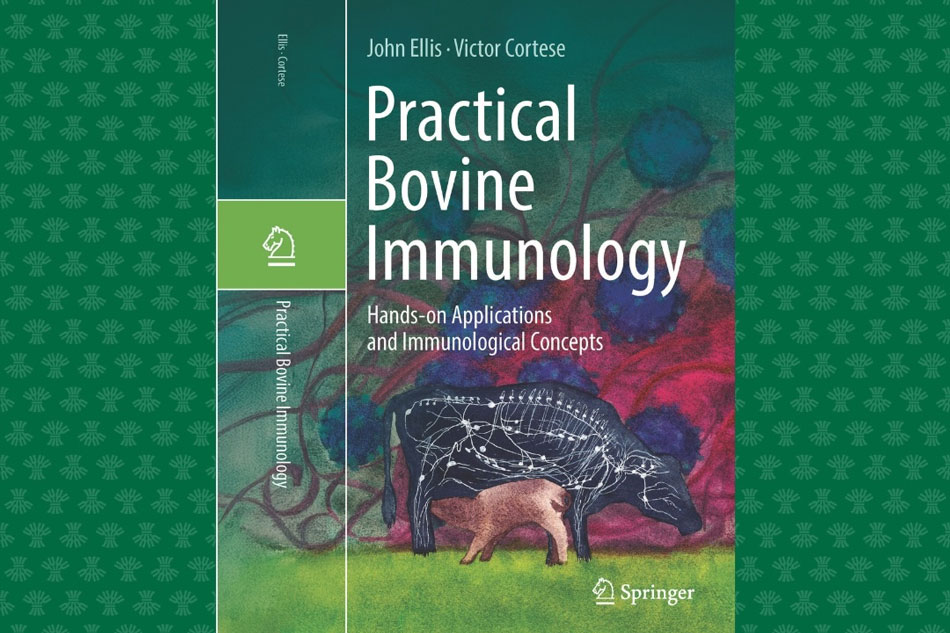
The textbook’s cover illustration also has roots to the WCVM: it was designed by Dr. Evanna Lai (DVM’25), a 2025 WCVM graduate. She’s now completing a rotating small animal clinical internship at Cornell University’s College of Veterinary Medicine.
Lai was one of Ellis’s students, and during her time at veterinary school, she earned “a bit of a reputation” as an artist. When it came time to decide on cover art, Ellis immediately thought of Lai.
“[She] not only finished at the top of the class in veterinary virology but is an accomplished watercolour artist,” Ellis says.
Once Lai completes her internship, she begins an avian medicine and surgery residency at the Medical Center for Birds in California. Her art reflects her veterinary pursuits: Lai mostly paints birds (@artbyevanna). But when Ellis contacted her, Lai welcomed the book cover project as a challenge to portray a species she doesn’t normally paint.
“I think he was hoping my veterinary education would help me create something that wouldn’t just be a realistic watercolour rendition of some cows in a field,” says Lai.
As Lai explains, the cover illustration shows a cow and calf standing in a field, with the cow silhouetted and bearing an artistic interpretation of the animal’s lymphatic system. In the background, there’s a semi-abstract depiction of lymphocytes with T-cell receptors on the surface and a dendritic cell looming large behind all the design’s other components.
With Lai’s contribution, it means three generations of WCVM faculty and graduates were involved in the textbook’s creation, says Ellis.
As leaders in bovine medicine, both Ellis and Cortese hope the textbook can help fill a void for busy, practicing veterinarians and help students better understand the day-to-day applications of bovine immunology.
Caelan Beard is a freelance journalist, communications specialist and author. She lives in southwestern Ontario.
Article originally published at https://wcvmtoday.usask.ca