


Multi-media artist engages with Sask. landscapes through lens of conservation
The latest project for USask graduate Heather Cline (BFA’93, MFA’02) is Viewfinder, a collaboration with the Nature Conservancy of Canada
By SHANNON BOKLASCHUKFor University of Saskatchewan (USask) graduate Heather Cline (BFA’93, MFA’02), creating artwork offers an opportunity for public engagement and storytelling.
The visual artist, who is based in Regina, Sask., has a deep interest in public interaction, and has participated in residency programs and community engagement across Canada.

“I come from a background of being a narrative artist and I do projects where I collect stories. Sometimes in the past that was through archival methods or secondary sources but, over the last probably 15 to 20 years, most of it’s been through public engagement—through talking to people,” said Cline, whose engagement activities have included setting up a “Story Collection” office from an inner-city storefront in Oshawa, Ont., and riding along on combines in rural Manitoba.
A previous decade-long project for Cline involved collecting everyday stories from Canadian people and creating paintings of places in response. That work involved community engagement, recording interviews, and filtering her perception of geographical spaces through the lived experiences of other people.
“There’s a big project I did called Quiet Stories from Canadian Places, where I went to communities across Canada and collected stories,” Cline said. “One happened to be an agricultural community in Inglis, Manitoba, and I picked them because they have a National Historic Site there with the only five remaining grain elevators in a row in North America.”
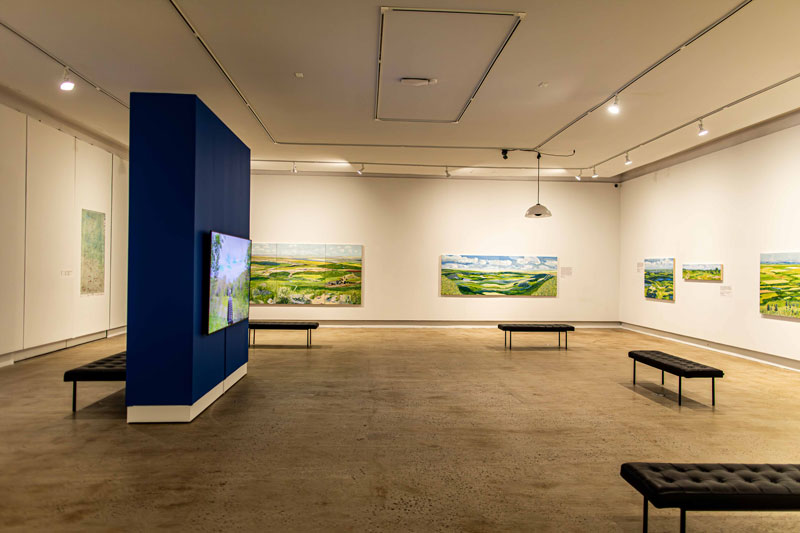
Learning more about agriculture in Canada through the Quiet Stories project provided a natural segue for Cline’s latest project, Viewfinder. Throughout the collaborative project with the Nature Conservancy of Canada (NCC), Cline viewed Saskatchewan landscapes through a conservation lens. The result is a multi-media exhibition featuring paintings, audio works, and video that showcases Cline’s interactions while walking on the land alongside NCC staff and stakeholders. The Viewfinder exhibition will be on display at the Art Gallery of Swift Current in Swift Current, Sask., until April 4, 2026.
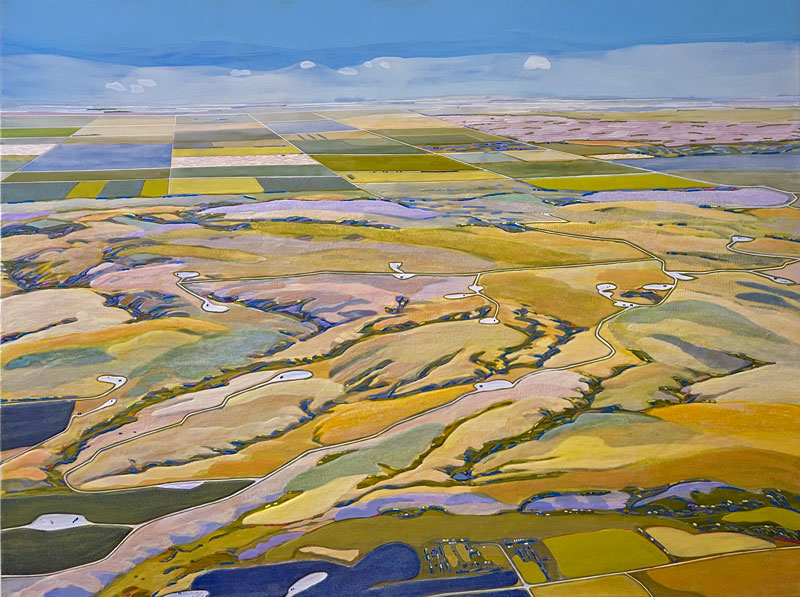
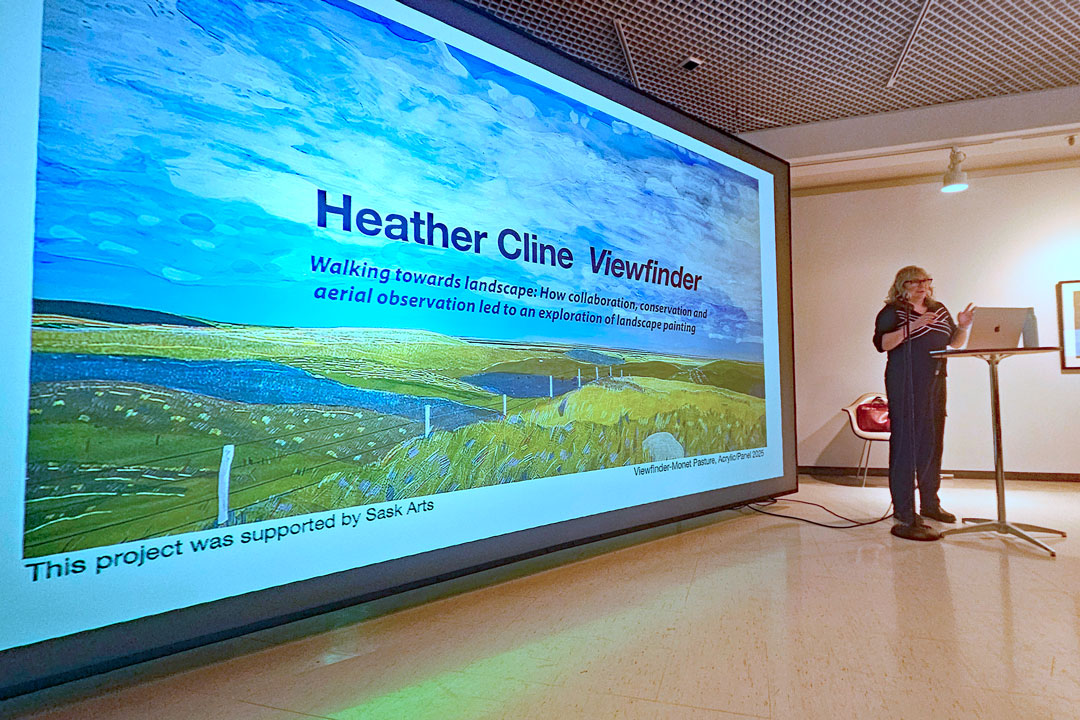
Cline recently gave a talk on the USask Saskatoon campus about Viewfinder. During the talk, which was held at USask’s Kenderdine Art Gallery on Jan. 14, 2026, she discussed the practice and history of landscape painting on her artistic development in the context of her most recent collaboration with the NCC. She also shared stories from the field and talked about her experiences of observing the land from the passenger seat of a Cessna Skyhawk, while touching on the challenges and rewards of an art practice based in public engagement.
“That talk was situated within the celebration of the International Year of Rangelands and Pastoralists,” Cline said. “That did focus my talk on the project itself. The group that I worked with, with the Nature Conservancy of Canada, is called Working Landscapes and I love the program because it’s about working with people who are agricultural producers or landowners who have a keen interest in conservation, and they bring their expertise to help them.”
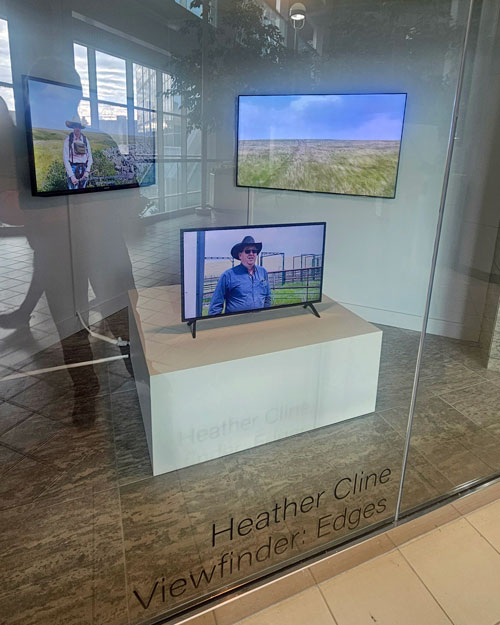
Until March 13, 2026, Cline has an installation on view in the two window vitrines at the Kenderdine Art Gallery. The installation is related to the Viewfinder project, through which she examined issues such as food production, the rise of factory farming, and land and habitat conservation. Cline said she admires the NCC’s “very kind, collaborative approach to tackling the issue of the reduction that’s happening in native habitat.” She also noted that Saskatchewan ranchers are “an incredible group” of people who are stewarding the largest tracts of native prairie in North America.
“Part of how I’ve always approached projects is to be the artist who acts as witness and not the expert,” Cline said. “Then I seek out experts or people to tell me what they think or what they’re doing.”
Early on in her artistic practice, Cline focused on collage assemblage. She now considers projects like Viewfinder to be a continuation of that work, “but now I’m using the video and the audio as a layer of collage with the painted works,” she said.
“So, to really view the work properly—just like the smaller installation that I have at the Kenderdine—I want people to be going back and forth between the video content and the paintings,” she said.
“The paintings, to me, have a very emotive impact and also they sit within a really interesting place in terms of art history and what paintings mean. Then, by adding the voice of the people who I walked with, I hope that will shift how people are viewing the paintings.”
Cline earned her Bachelor Fine Arts degree at USask’s College of Arts and Science in 1993, followed by her Master of Fine Arts degree in 2002. Since then, she has exhibited in multiple group exhibitions, with solo exhibitions at the Robert McLaughlin Gallery in Oshawa, Ont., the Mendel Art Gallery in Saskatoon, and regional exhibition centres throughout Western Canada. Her work can also be found in public and private collections throughout North America and in Europe, including the Colart Collection, the Mendel Collection at the Remai Modern, the Saskatchewan Arts Board, and Global Affairs Canada.
Attending USask to study art was a natural fit for Cline. She was born and raised in Saskatoon, and both of her parents encouraged her to pursue post-secondary education. Cline’s father, USask alumnus Ellis Cline (BSA’58), had previously earned a degree at USask’s College of Agriculture and Bioresources before she enrolled at USask.
“I came from a family where both of my parents really believed in education and there was kind of an assumption that if you can go to university, that you should go,” Heather Cline said. “Each of my siblings and I, we all have at least one degree, if not multiple degrees.”
Cline said her professors and instructors at USask empowered her and gave her confidence to become a full-time artist. One of Cline’s first art instructors was abstract painter and USask alumnus Robert Christie (BA’67, ARTS’70, BEd’72), who was a partner in the commercial gallery The Gallery/Art Placement, Inc., in Saskatoon.
“From that connection, I ended up working for him after I finished my Bachelor of Fine Arts,” Cline said. “So, academia not only gave me an education, but it connected me to the art community in a meaningful way.”