


‘It’s basically all perception’
USask Master of Fine Arts candidate Shona Dietz (BFA’01) explores the passage of time, altered realities, and the aging brain in her new exhibition
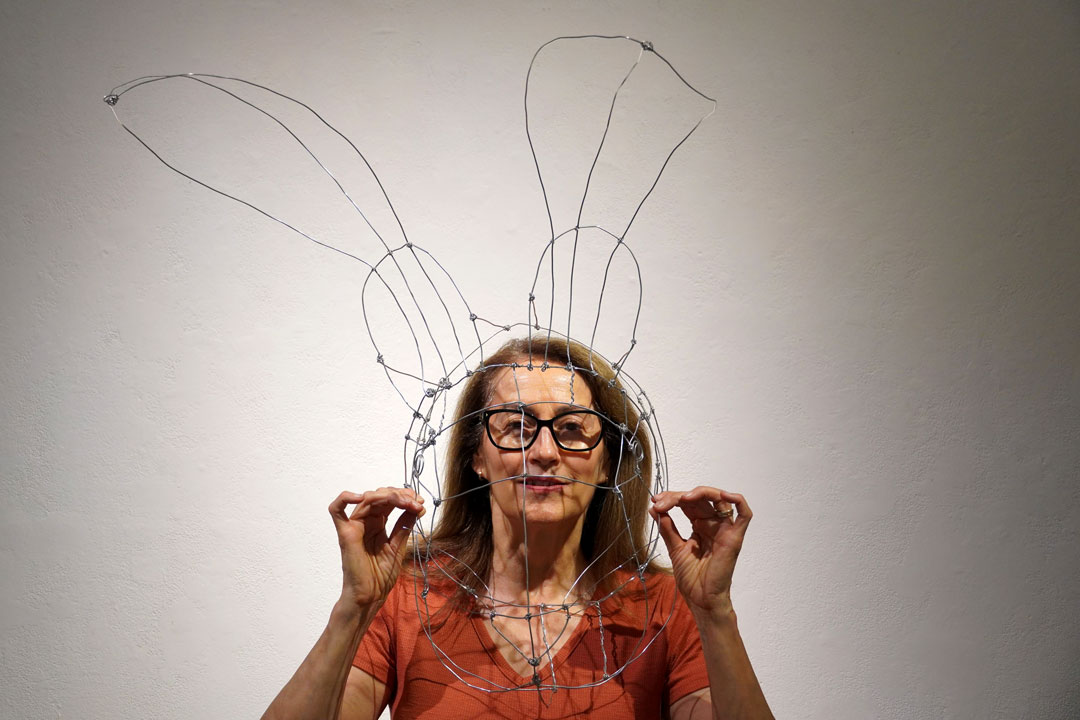
By SHANNON BOKLASCHUKUniversity of Saskatchewan (USask) graduate student Shona Dietz (BFA’01) believes artists should explore what’s personal and relevant to them.
“The seeds all have to be inside of you,” she said.
For Dietz, that means examining relationships, family connections, memories, and perceptions through her practice as a Saskatoon-based multi-media artist. One of her past touring shows, for example, featured life-sized sculptures of family and friends constructed out of thousands of tea bags.
This week, Dietz’s latest exhibition, Whose Reality is it?, is on view at the Gordon Snelgrove Gallery on the USask campus. The exhibition marks a major step toward earning a Master of Fine Arts (MFA) degree in visual arts at the School for the Arts at USask’s College of Arts and Science.
Through her MFA show, Dietz explores how people perceive things in various ways, as well as altered realities, the inevitable passage of time, and the aging mind—phenomena that she recognizes as universal and cross-cultural in nature.
“It’s all humanity. If we’re lucky enough to age, we’ll all face it,” she said, during a recent interview at the gallery as her MFA exhibition was being installed.
Dietz said that at age 69, with four grown children and six grandchildren, the process of aging is on her mind. She earned her first degree at USask—a Bachelor of Fine Arts—25 years ago, in 2001, when her children were young. Decades later, she has realized a longtime dream by returning to the USask campus in her late sixties to pursue her master’s degree.
For Dietz, it was the right choice to return to the university. She found renewed creativity and inspiration through USask courses after previously experiencing a “dry spell” in her artistic practice. She had hoped studying again at USask, starting with just a couple of classes at first, would be the change she needed—and it was.
“I thought, ‘I’m making myself (take) a couple classes to see if I liked it’—and I love the campus life,” she said. “I seriously love the campus life. I don’t know why it is; it’s like it makes you alive to be here. Really, seriously, I feel alive when I’m here.”
Dietz challenged herself by diving into digital work at USask to grow in that direction, as she had always previously worked with physical materials. The move toward digital exploration in her artwork was positive for her.
“Turned out, I loved it all,” she said.
Dietz now envisions her MFA show as an offshoot of her previous work on family and memory. Over the years she has been impacted by interactions with family members who have experienced memory loss and probable Alzheimer’s disease, and that has sparked within her a deep interest in aging and perceptions of reality.
“It was familiar to me, because I know it,” she said. “Familial things are important.”
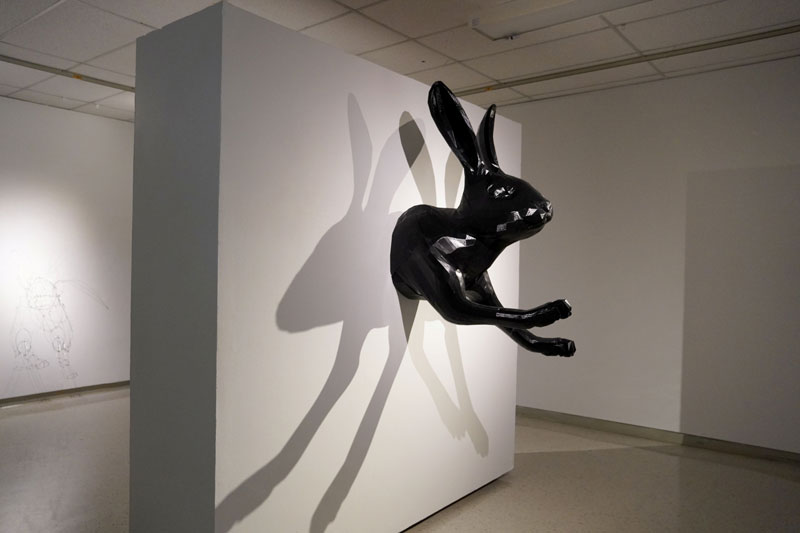
One of the factors Dietz has enjoyed most about working on her MFA show is the opportunities it has presented to try new things. For example, Dietz’s installation Big Black Hare—comprised of 3D printed sculptures, a movable wall, and galvanized steel wire sculptures—marked her first foray into 3D printing. Bringing the large rabbit to life was a learning process and a significant time commitment. In the end, the various pieces of the rabbit don’t fit together perfectly—but Dietz said that’s like life, and it exemplifies what it means to be human.
“It has flaws, like we do,” she said.
Dietz noted that she was inspired to create the wire sculptures that bookend the Big Black Hare’s 3D printing after learning about the work of American sculptor Alexander Calder, who is considered the originator of the mobile art form. For Dietz, Big Black Hare presents the human life cycle, from childhood to adulthood and to older adulthood and beyond, and the wire at the end of the installation represents the broken synapses of the brain.
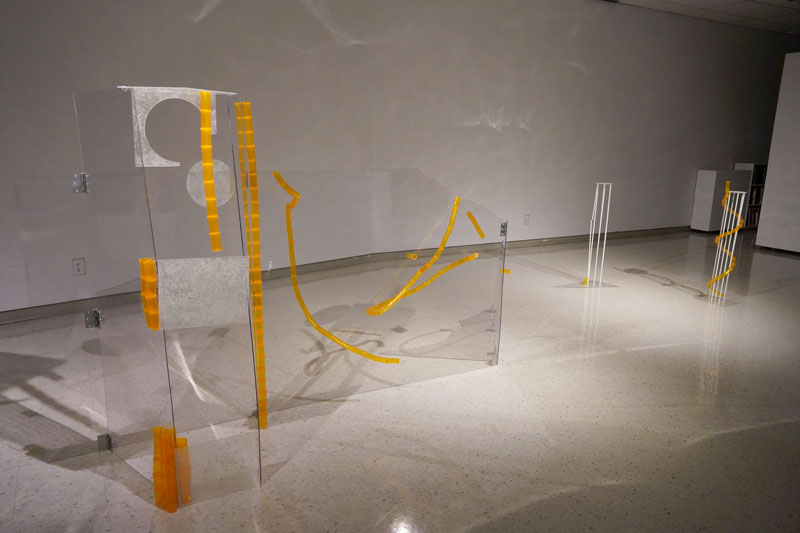
One of Dietz’s other major MFA projects, Rewired, is an installation that also features galvanized steel wire as well as numerous other materials, including Plexiglas, steel hinges, angle braces, dry foam block scrapings, and empty orange pill bottles. The installation represents the descent into aging and coming to terms with the process. Dietz said her work also represents the choice of whether to take “a medical route” to cope with aging, and the difference between the strength of support versus struggling alone.
“It’s basically all perception,” she said.
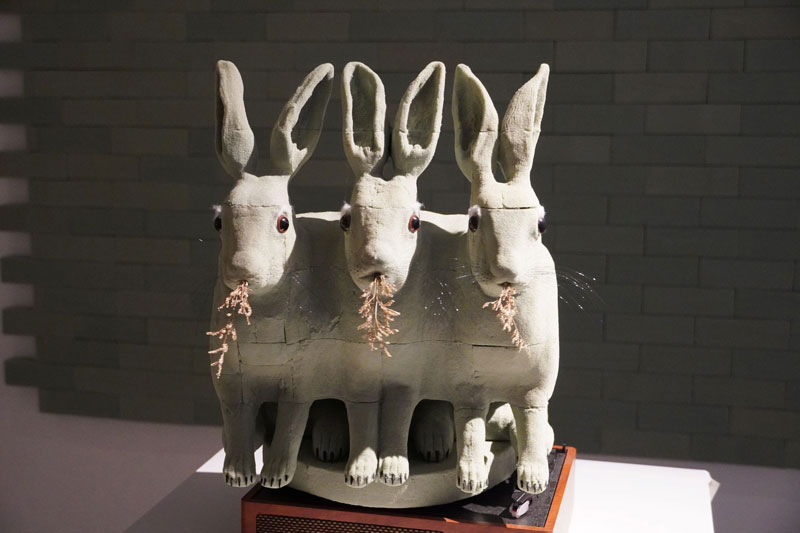
Like aging, the themes of perception and multiple realities run throughout Dietz’s work, including in the mixed-media sculpture Cracks, which features a three-headed hare spinning on a turntable. As they stand near Cracks, viewers will hear audio work consisting of Dietz’s voice, audio engineer Wayne Giesbrecht’s voice, and the pair collaborating on the audio work. For some people, the sounds may feel unexpected or disorienting in connection with the moving sculpture. Those are fitting sensations for an exhibition that seeks to imagine a world that provokes the emotions felt by those who live within alternate realities, including their loved ones and caregivers.
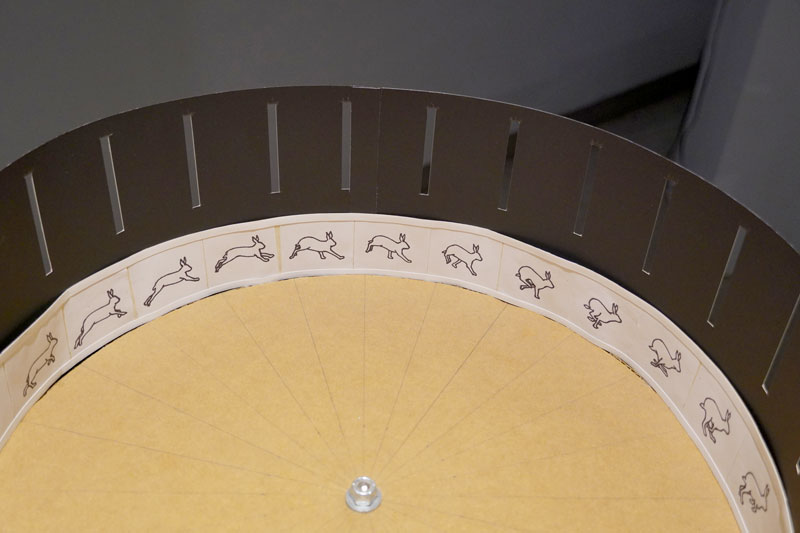
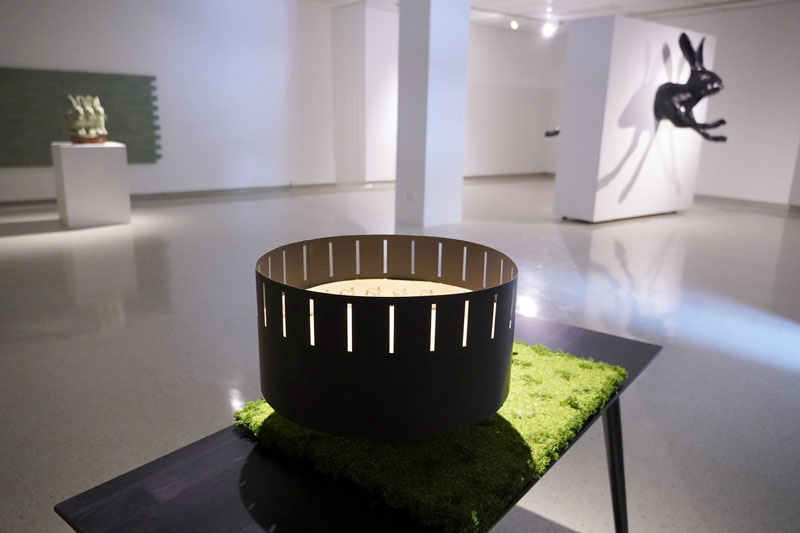
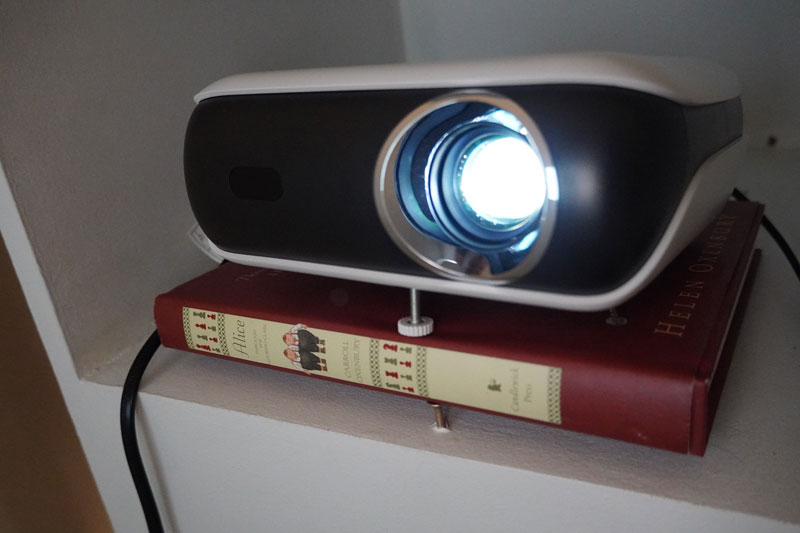
Yet another key artwork in Dietz’s MFA exhibition highlights the passage of time and the changes that happen over time. With Run Rabbit Run, Dietz contrasts the playfulness and gentleness of a running rabbit in a zoetrope—a pre-film animation device—with a nearby modern-day video on a loop. The video references the childhood of today, with team sports like hockey and the deeply embedded use of technology portrayed in the imagery, while the zoetrope represents the childhoods of yesteryear. Fittingly, the video equipment is propped up by a copy of Lewis Carroll’s 1865 book Alice’s Adventures in Wonderland, a book that is significant to Dietz and represents childhood curiosity, alternate realities, and the years gone by.
For Dietz, putting together the MFA show has been a great experience, and she will miss being a USask student once she graduates. Her exhibition is on now and runs until Aug. 29 at the Gordon Snelgrove Gallery. The closing reception will take place from 7 pm to 9:30 pm on Aug. 28, with a performance by Dietz at 8 pm that evening. The opportunity to bring a performance to the gallery is another highlight for Dietz, who looks forward to connecting with those in attendance.
“I love doing performance because performance is a way to relate,” she said.