


USask archaeology alumna helps ensure ‘important history is protected and remembered’
Jessica Sick, who graduated from USask in 2024, now works in cultural resource management (CRM) in Alberta
By SHANNON BOKLASCHUKWhen Jessica Sick (MA’24) enrolled in the archaeology program as a graduate student at the University of Saskatchewan (USask), she quickly knew it was the perfect fit.
“I’ve always held an interest in studying bones, digging around, and learning about how we evolved as a species,” said Sick, who earned her Master of Arts degree in archaeology in 2024.
After completing her studies at USask, Sick returned to her hometown of Calgary, Alta., where she currently works in cultural resource management (CRM) as a junior archaeologist. She describes CRM as the process of identifying, evaluating, and protecting historical and archaeological resources and sites impacted by development.
“CRM is important because it is essentially the first line of defense between historical resources, government bodies, and developers to make sure important history is protected and remembered,” said Sick, who engages in fieldwork across Alberta.
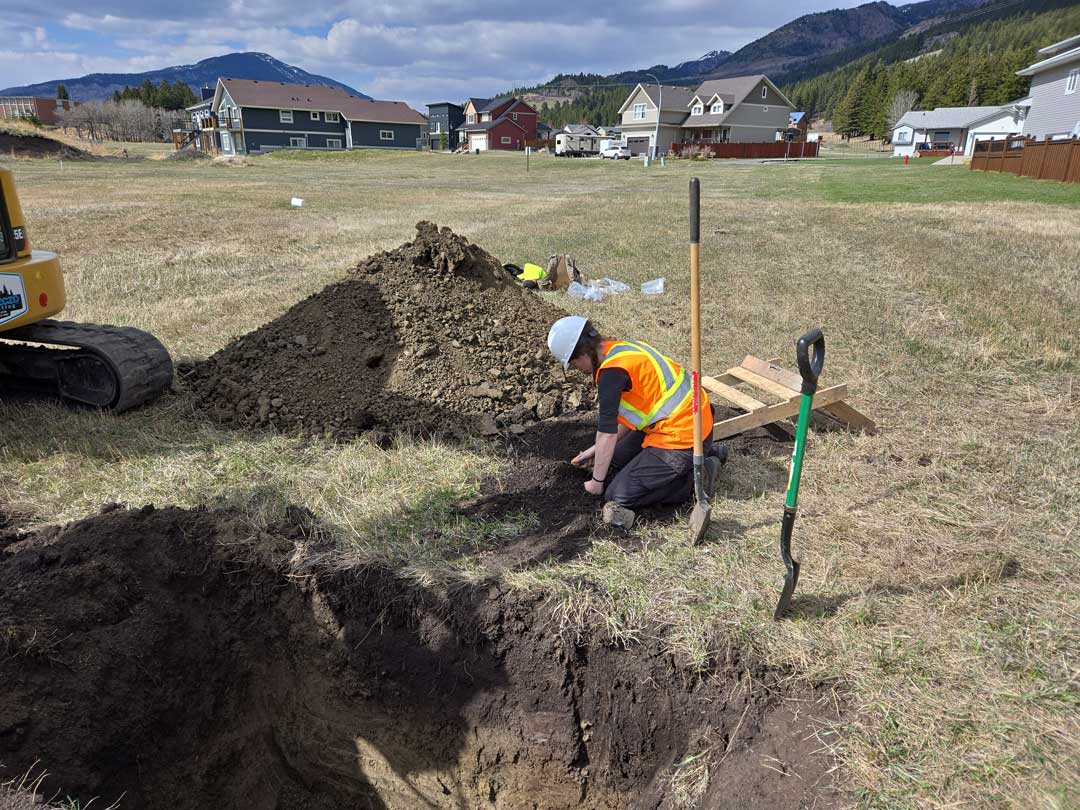
For Sick, CRM fieldwork typically involves preliminary assessments that include conducting shovel tests in a proposed area of development. She and her colleagues look for archaeological or historical resources that are in or around the proposed development area, write notes, collect environmental data, and recover any artifacts they find. The fieldwork also involves doing more thorough excavations in areas where artifacts or features are known to be found so that they can be documented, recovered, and protected before any development takes place.
Sick said her studies at USask, including participating in archaeology field schools, helped prepare her for the fieldwork that is involved in CRM.
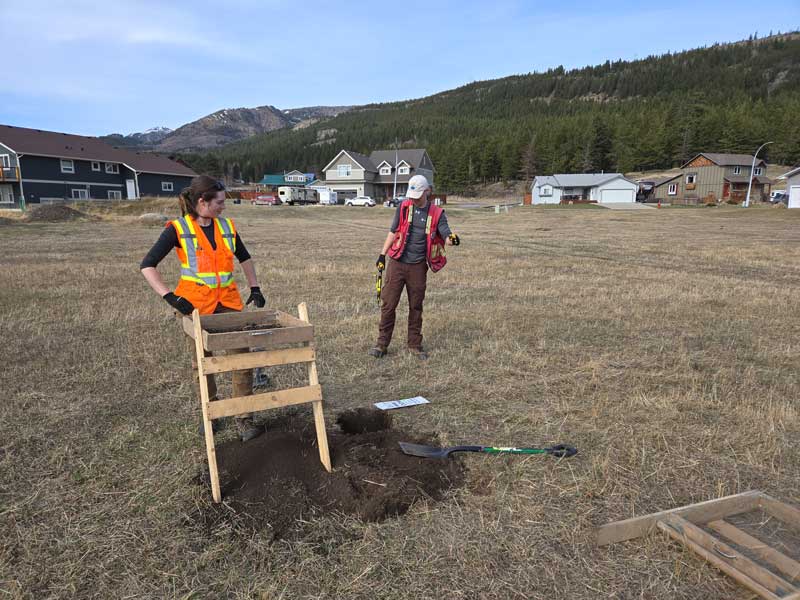
“Fieldwork involves days, or sometimes weeks, of long hours in often remote locations, doing laborious digging, sifting, and data recording,” she said. “It’s very much like field school, except you have to do it faster to remain on budget.”
When asked about the best part of the job, Sick said it’s “the excitement of finding artifacts or features.”
“Often we don’t find much at all, but the giddiness I feel in finding that one arrowhead or bone or stone circle and knowing there’s probably more out there is my favourite part.”
While CRM is hard work, Sick said it offers great job prospects for archaeology graduates and enables new graduates to build valuable skills and connections with archaeologists, anthropologists, and other experts.
“I would recommend CRM to any student wanting to explore archaeology as a career to gain a baseline perspective, especially those who enjoy adventure, activity, and the unexpected,” she said.
As a USask alumna, Sick continues to value her time as a USask graduate student. At USask, she examined modern-day dog specimens to help shed new light on Indigenous dog-sledding practices of the past.
Sick also continues to feel fortunate to have had the opportunity to work with her co-supervisors, Dr. Tatiana Nomokonova (PhD) and Dr. Angela Lieverse (PhD) in the Department of Anthropology in USask’s College of Arts and Science. Her master’s thesis— titled “Reconstructing Sled-Pulling Activity in Western Arctic Dogs Using Entheseal Changes”—was part of a larger project focused on Indigenous dog sledding in the Circumpolar North, funded by the Social Sciences and Humanities Research Council (SSHRC) and led by University of Alberta archaeologist and USask adjunct professor Dr. Robert Losey (PhD).
“I actually encountered the opportunity to work on the project as I was looking into getting a master’s degree in anthropology or archaeology,” Sick said. “I sent out an e-mail to Angela Lieverse on a whim and asked if she or anyone in her department were looking for new master’s students, and she told me of this project. After learning about it, it was such a great opportunity, and I decided to accept their offer to work on it as a student.”
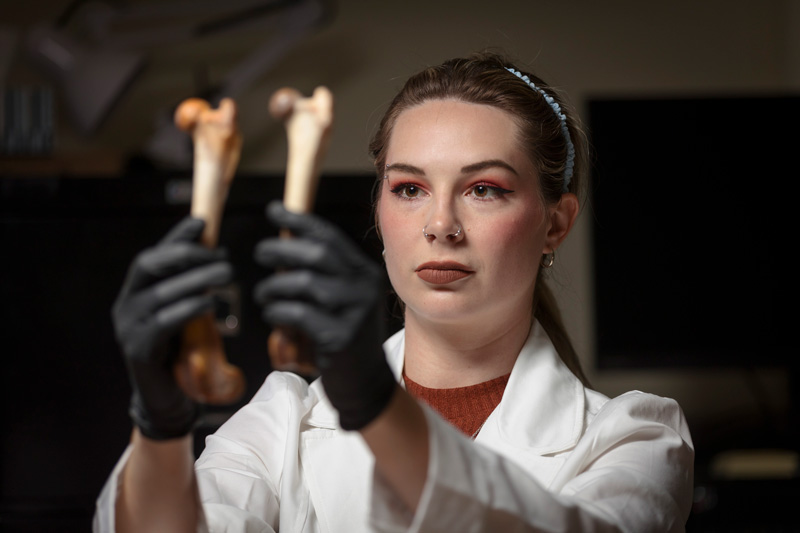
Through her master’s degree research, Sick studied entheseal changes—alterations that can be observed in muscle and ligament attachment sites on bone—to identify working activities in dogs. Sick said that repetitive and strenuous physical activity throughout an animal’s life, such as participating in sled pulling, could change entheseal structure over time. By studying these entheseal changes on modern-day North American dog bones, Sick’s research aimed to better understand the lives of sled dogs of the past, including what activities they may have participated in, how they moved, and how they interacted with humans. She was also interested in learning more about the human-dog relationship, the history of domestication, and how humans and dogs co-evolved together.
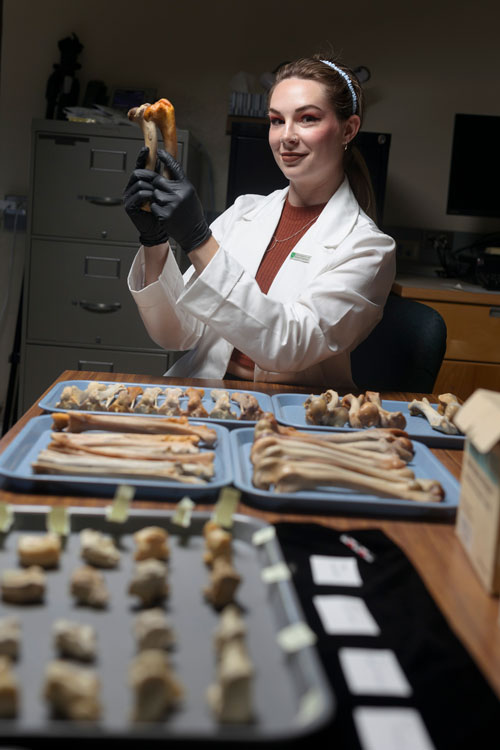
“After creating and testing a manual to visually score entheseal changes (EC) on modern dogs, the results were promising: Seven out of 13 attachments in the shoulder, ankle, and knee showed significantly higher scores in sled dogs,” Sick said.
“Additionally, canids with the highest scores tended to be the largest and oldest male sled dogs due to the accumulated influence of gravity, sex hormones, and working activity on entheses over an individual’s lifetime. These results weren’t the same for non-working pet dogs or wild canids, which reinforces an intertwined relationship between activity and other major influential factors affecting EC that are specific to sled dogs. In addition, observer error tests for my method showed agreement levels comparable to, and sometimes higher than, other observational EC methods.
“Basically, the results showed that the method can be a useful new tool to identifying sled dogs of the past,” she said.
When asked about the best part of studying archaeology at USask, Sick said that, “officially, the best part of my studies at USask was getting to work on such a meaningful and engaging project with a team of experts.”
“Contributing to the field of archaeology is a dream come true and I am so grateful to have been a small contributing part of it,” Sick said.
“Unofficially, the best part was the technical side of my degree,” she added. “I spent days and days staring at bones and writing a huge manual about them—what’s not to enjoy?”
Sick said she would highly recommend USask to prospective archaeology graduate students. The university’s thesis-based archaeology master’s program places importance on community-based research, particularly with Indigenous communities, and on working with local archaeological societies to ensure that research aligns with community priorities.
The professors and researchers at USask are also stellar, said Sick.
“Our department is uniquely fortunate to have some amazing names with great reputations in archaeology on the local and global scale,” she said. “Choosing USask as your foundation to start, or continue, your career in archaeology offers you great opportunities to find your niche, make lasting personal and professional connections, and nurture your life as a new professional.”