

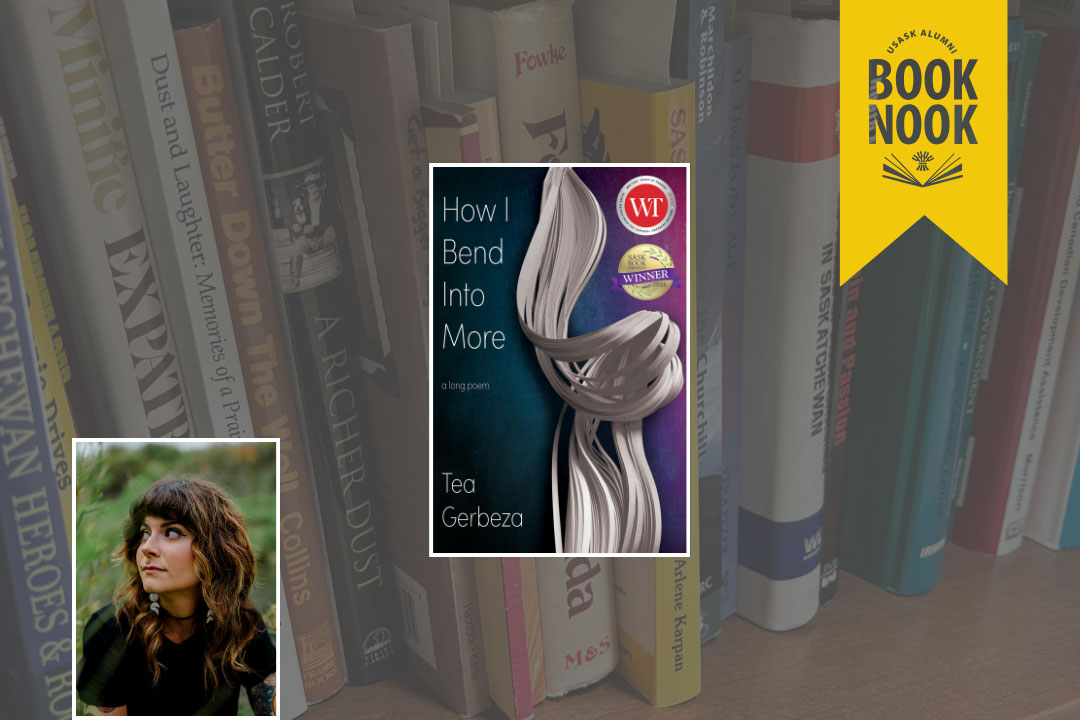
Alumni Book Nook: Tea Gerbeza (MFA’21)
USask graduate Tea Gerbeza’s book, How I Bend Into More, was honoured with a Saskatchewan Book Award earlier this year
University of Saskatchewan (USask) graduate Tea Gerbeza (she/they) wrote her first book, a long poem titled How I Bend Into More, as a graduate student in USask’s Master of Fine Arts in Writing program. Since graduating from USask in 2021, Gerbeza has worked as a Program Coordinator at the Saskatchewan Writers’ Guild and as a professional writer, mentor, educator, editor, and artist.
On May 1, 2026, Gerbeza received the good news that How I Bend Into More was selected to receive the SK-Arts Poetry Award Honouring Anne Szumigalski during the Saskatchewan Book Awards gala in Regina, Sask. The Green&White recently caught up with Gerbeza, who is based in Regina, to talk about the award-winning book and their advice for other USask alumni who may be interested in writing and publishing.
Green&White: What inspired you to write this book?
Gerbeza: My disabled experience navigating spinal fusion surgery for my scoliosis, scoliosis-related disability, the realities of an episodic disability, and the casual ableism I experienced from peers and society. The book is a reclamation of body and self.
G&W: You received a Saskatchewan Book Award in May. Congratulations! What are your reflections on receiving this award?
Gerbeza: Receiving the Saskatchewan Book Award for Poetry honouring Anne Szumigalski was an honour and delight. I didn’t write How I Bend Into More thinking it would win any kind of award; rather, I wanted the book to reach people, make them feel something, or witness them in ways they never have been witnessed before but needed to be. For my book to have received this recognition is beyond anything I thought would happen, and it feels like an important reminder that stories like mine—disabled, queer, neurodivergent—are needed and vital. I also think that a book like How I Bend Into More, with its weird form and structure and blend of multimodal elements, rips open what a poetry book can do and be.
G&W: How I Bend Into More was also a finalist for the Writers’ Trust 2025 Dayne Ogilvie Prize for 2SLGBTQ+ emerging writers. How did it feel to receive this recognition for your work?
Gerbeza: Being recognized for this prize was truly a surreal and special experience. I met so many cool and incredible writers I otherwise wouldn’t have. It meant so much to me to be recognized as a queer artist in this way, especially, as much of my life I felt like an imposter in my queerness. This award validated my voice as a queer one, as my book is not explicitly about being queer, but rather, queerness is imbedded in the structure of the book, in the friendships that come to life in the lines, in the queer disabled body coming into itself.
G&W: You are a multimedia artist. How does the written word fit into or complement other elements of your artistic practice?
Gerbeza: The written word has always fit in or complemented my other art practices, as my brain doesn’t really know how to work separately. With paper quilling—majority of what appears throughout my book—sometimes words or lines communicate an essential piece to the overall work and other times, like in my book, the quilling takes on a vital role in expressing what words can’t. I found this essential when writing How I Bend Into More, as I wasn’t able to fit my experience of rearticulating a disabled body with only words, so paper quilling added a dynamic that felt like me in all my multitudes.
G&W: Did your education at USask play a role in writing How I Bend Into More? If so, how?
Gerbeza: Yes. This book was my master’s thesis! I received mentorship with Jennifer Still that was essential in drafting the first draft of the book, and the thesis writing semester was integral to its growth as a book. I received such important and poignant insights from my supervisor Dr. Sheri Benning (BA’02) and committee members Dr. Jeanette Lynes and Dr. Kathleen James-Cavan and examiner Dr. Emilia Nielsen. My thesis also won the 2022 USask Graduate Thesis Award in Fine Arts & Humanities.
G&W: Why would you recommend your book to USask alumni?
Gerbeza: I’d recommend my book to readers to help someone else feel seen and held if they’ve experienced similar hardships and experiences. And to those who need to learn how to be more anti-ableist and prioritize accessibility in their life, this book will be educational.
G&W: What are five adjectives that you would use to describe your book?
Gerbeza: Emotional, experimental, powerful, educational, and hopeful.
G&W: Are you currently working on any other books or writing projects?
Gerbeza: Yes. I’m currently working on a few things, including a sequel to How I Bend Into More that explores more deeply the Yugoslavian Civil War/Bosnian War my family escaped, focusing on questions of memory, trauma, and motherhood/motherlines. The second project I’m slowly working on is a memoir that attempts to answer the question: how do we come back to/into our bodies after trauma and loss? The book’s focus is around my second trimester pregnancy loss.
G&W: What is your advice for other USask alumni who may be interested in writing and publishing a book?
Gerbeza: First, write the book you want to write and that excites you. Second, publishing is a slow process; it can take a few years from contract to physical book. Third, rejection will happen and it sucks, but it doesn’t mean your writing sucks. Finally, engage in community whenever you can through readings, gatherings, festivals, writing organizations like Saskatchewan Writers’ Guild, etcetera. Community and friendship are what helps us in the lows and highs of our careers.