


Supporting the AgBio advantage through a flexible donation
Gift from Bob Mason (BSA’65) and Cora Greer (BA’70) will help the College of Agriculture and Bioresources grow.
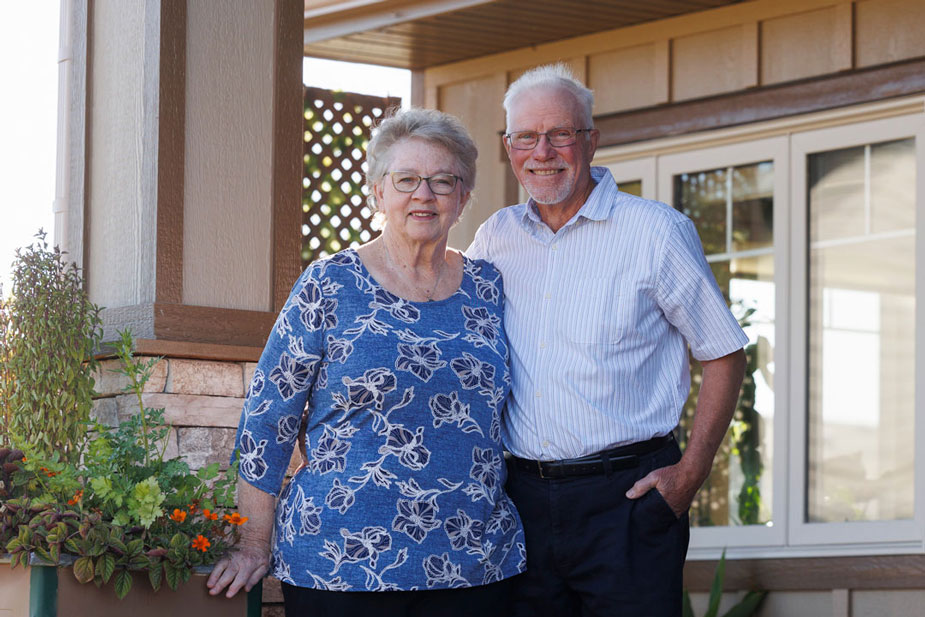
By Colleen MacPhersonBob Mason and Cora Greer will say they are ordinary people who have lived an ordinary life. What belies that is their extraordinary gift to the College of Agriculture and Bioresources (AgBio), funds that will enhance student experience for years to come.
The decision to make the gift “wasn’t a long discussion,” said Mason, a 1965 graduate of the college. “We ended up with more retirement income than we thought we would.”
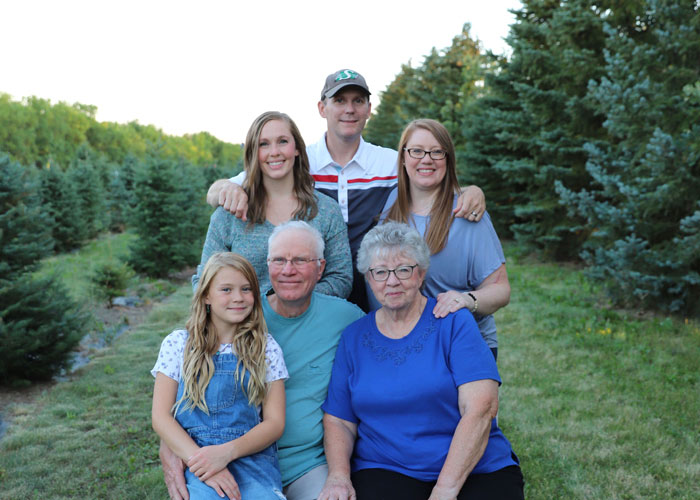
After discussions with AgBio Dean Dr. Angela Bedard-Haughn (PhD), the twochose to make their donation in their daughters’ names—Vanessa Lund and Katrina Mason—but without specific conditions on how the funds must be used.
Mason’s original idea was to provide funding for initiatives aimed at reversing the depopulation of rural areas and promoting more diversity in Saskatchewan agriculture and related industries. But after sitting down with the dean over tea and treats and talking about what she sees as the greatest opportunities for the college and the industry over the next few years, Mason and Greer realized there were many ways their support could help, and instead opted for a gift that would allow maximum flexibility for maximum impact
“Angela wants to encourage more students to get into the college, so we’ll let them decide how best to use the money,” said Mason. “Supporting ways to increase the number of younger brains working on solutions is a better use.”
Mason grew up on a farm near Tessier, moving to Saskatoon at age eight where his dad “farmed from the city” northwest of Kenaston. Convinced he wanted to follow in his father’s footsteps, “I thought a four-year program from the college would give me more options.”
The class of 1965 was just 42 students, many who are still friends. Mason recalls typical first-year struggles “but by second year, it became much easier as you get used to the process of university learning.”
He chose to study crop science. “It was foremost in my mind, and it was Dr. (Bill) White’s (PhD) specialty. He was my cub master when I was a kid and became dean the year I graduated.”
Not one to pick favourites among all his college instructors and professors, Mason does give credit to the late Dr. Frank Sosulski (PhD) “for pulling me through” his thesis on grain protein and yield in three prairie locations.
Mason also acknowledged Irene Ahner from Maple Creek, the only woman in the class of ’65 “and the glue that holds us all together to this day.”
With a degree in hand, Mason headed to Kenaston to join his parents, and immediately acquired seven quarters nearby, complete with a home along the Brightwater Creek. But instead of buying farm equipment, he bought sheep, 80 of them, thinking about the yearly return on investment. In 1973, Mason’s sister and brother-in-law joined him in the operation, and they added another 600 head.
“The whole farm was in grass, but we kept one quarter for grain for feed,” he said. “Learning about raising sheep was a combination of common sense and learning from my mistakes.”
In 1973, Mason was haying a government sheep farm at Mortlach when he decided he needed something to do in the evenings. He went into Moose Jaw, to the public library, looking for books. Being from outside the library region, he was sent to the main office of the Palliser Regional Library, “and this was the lovely woman who helped me get a library card,” he said, gesturing to his wife.
Fast forward four years and Mason heard Greer—then Palliser’s director— being interviewed on CBC about library week in Saskatchewan.
“He heard me introduced as ‘Miss’ so he assumed I wasn’t married,” said Greer, who is from the Cabri area, swore she would never marry a farmer, and has a BA from USask and a BLS (library science) from the University of Alberta. “He wrote me a letter through the library and thought I was rather insensitive because I was slow to respond, but I was on holidays.”
They were married in 1980.
“We had a long-distance marriage for 18 years,” she said; Greer lived in Moose Jaw with the girls, worked full time and commuted to the Kenaston farm almost every weekend. “No man could have done what she did,” said Mason.
To make life easier, Mason got out of sheep and switched to grain farming so he could spend winters in Moose Jaw with his family. He grew wheat, canola, and peas, “but that was a disaster.” Inflation at the time made it tough to acquire goodquality equipment, “one reason I kept my job,” Greer said.
The day their elder daughter graduated high school, Greer left the regional library and moved with the girls to the farm. “I just changed careers,” she said, “but it was hard the stresses of seeding and harvest, and I would be hauling at midnight with a young child bundled up in the seat beside me, but a lot of women did it.”
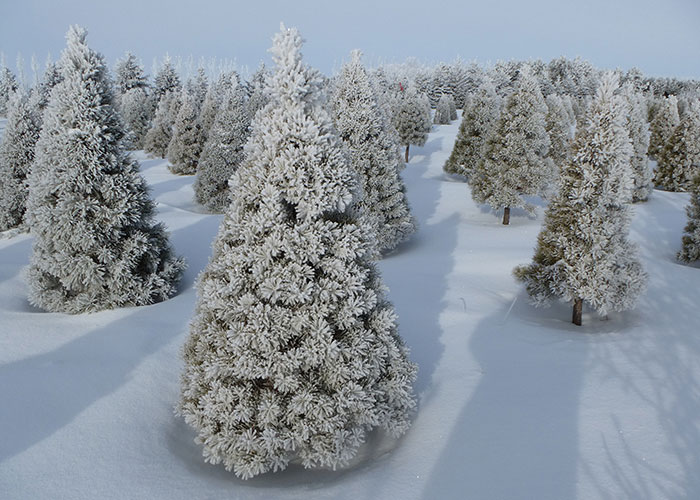
Then, in the late 1980s, “we planted some pine trees near the house to fill in an empty space, and somebody asked if they were Christmas trees,” Mason said, calling it a light-bulb moment. Bob loved trees so he thought “this is a way to diversify.”
Mason and Greer planted their first 1,500 conifer seedlings in 1990 and planted more almost every year until 2023, watering, weeding and shearing them through summers.
“In December 1997, we sold 150 trees off the back of a trailer in Moose Jaw,” said Greer. It was not easy hauling trees to various sales locations and there were times demand outstripped supply “so we decided to just sell from home.”
That was the start of the successful Mason Tree Farm’s U-cut operation, and the couple’s more than 25-year involvement with the Saskatchewan Christmas Tree Growers’ Association (now known as the Prairie Christmas Tree Growers).
In May of 2020, Mason and Greer sold their farm, “leaving a lot of trees for wildlife,” said Greer. “People in our area got used to a fresh Christmas tree that lasted a long time. There were a lot of tears when we closed.”
The couple now live at Crossmount Village, a retirement community southeast of Saskatoon.
But old habits die hard—among their many activities, Mason and Greer voluntarily tend a few young evergreen trees on the property.
Article originally published at https://agbio.usask.ca