


Science, sustainability, and storytelling
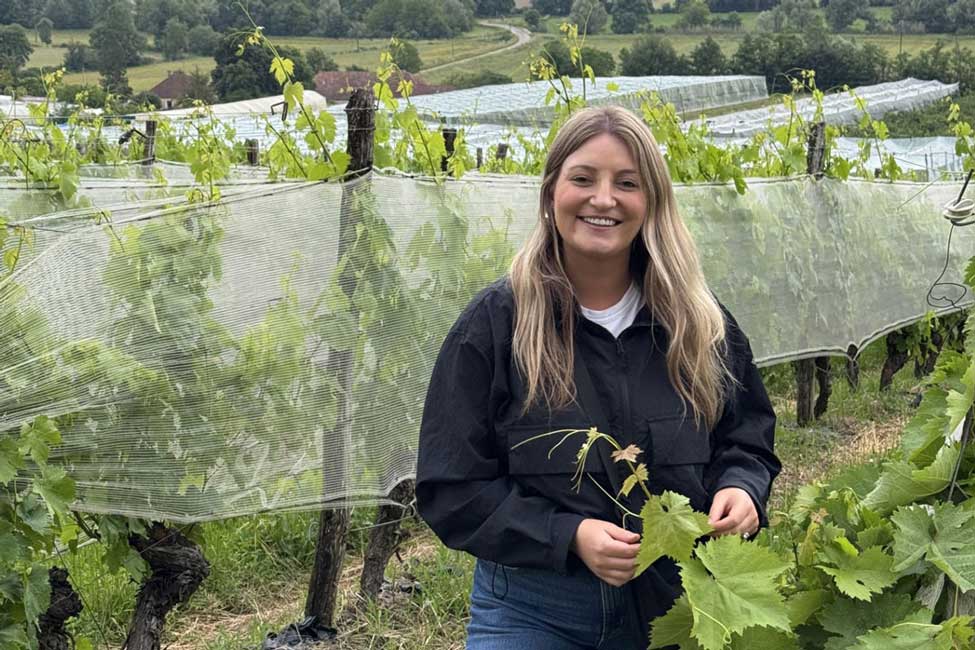
Meet USask alumna Jenna Sarich (BSc(AnBiosc)’19, MSc’23), an up-and-coming voice in Canadian beef research.
By Michelle BoultonLike many of her classmates, Jenna Sarich came to the University of Saskatchewan (USask) to study animal bioscience in 2014 with dreams of becoming a veterinarian. However, a formative summer job redirected her ambitions.
While working for Agriculture and Agri-Food Canada in Lethbridge, Alta., she joined Dr. Karen Beauchemin’s (PhD) research group investigating feed additives to reduce methane emissions from beef cattle.
“I absolutely loved the research and quickly became fascinated by the metabolic and physiological factors that influence animal health, performance, and wellbeing. That spurred me to pursue research,” she said.
In 2019, she returned to USask to begin a Master of Science under the supervision of Dr. Gabriel Ribeiro (PhD) in the Department of Animal and Poultry Science in the College of Agriculture and Bioresources.
She studied the effects of ergot alkaloids on ruminal metabolism, cattle health, welfare, and performance.
Sarich completed her research at USask’s Livestock and Forage Centre of Excellence, where she also took on a role as an outreach worker.
“I really enjoyed interacting with the public and taking technical research and making it digestible for people in industry and elsewhere,” she said.
These experiences uncovered a flair for science communication that would become central to her career.
Her next role, in 2022, was with the Canadian Cattle Association working as the technical consultant for public and stakeholder engagement. Later, her role expanded to a joint position with the Canadian Roundtable for Sustainable Beef, communicating the findings of the National Beef Sustainability Assessment.
“It let me flex my science brain and then present the information,” she said.
“I’ve talked about the assessment in almost every province in Canada and even internationally.”
Finding a global community: Embarking on her Nuffield Scholar journey
It was during one of those international presentations, at the World Food Forum hosted by the Food and Agriculture Organization of the United Nations, that Sarich discovered the Nuffield Canada Agricultural Scholarships. At the event, she met a group of Nuffield scholars and instantly knew she’d found her next step.
“I love travel, I love learning, I love research—it was a perfect combination,” she said.
In 2024, Sarich was selected as one of four Canadian Nuffield Scholars—joining a group of roughly 90 scholars from 16 countries. Scholars must complete at least 10 weeks of travel study within 24 months to research a topic of their choosing. Sarich’s topic is the sustainability of beef cattle systems.
Her Nuffield travels began in March, when all the scholars gathered in New Zealand for the Contemporary Scholar Conference. She then travelled throughout New Zealand and Australia for six weeks.
In May, she was able to participate in an optional Global Focus Program, thanks to secondary sponsorship. The six-week whirlwind tour took her across three continents and six countries—Singapore, Qatar, Belgium, France, Ireland, and Brazil.
“You start at the government level, learn about the policies and regulations of each country, and then go out onto different farms and research centres to see where the challenges and opportunities are,” she explained.
By the end, she and her fellow scholars were a close-knit group.
“We’re going to be friends for the rest of our lives,” Sarich said, adding that they have become part of the global Nuffield network. “Being able to go to any country and immediately have a community is such a cool thing.”

Lessons from the field: Sharing her insights
What has she learned? Sarich says almost every country is struggling to get young people interested in agriculture, which she describes as “the number one thing the industry globally needs to work on.”
Food security is also a pressing concern. Many countries are urgently working to increase domestic food production and trying to be more self-reliant, sometimes in the face of significant challenges. Coming from Canada, a country that produces a lot of food and exports much of it, she was reminded of the vital role global trade and market access plays in feeding the world.
In terms of her research topic, Sarich has been exploring sustainable beef production from a holistic perspective that considers the ecosystem benefits of having cattle on the land.
“When people talk about sustainability, they think it only means environment. But you also need to consider the social and economic aspects,” she said. “There’s no way you can implement a new technology if it’s going to put a financial burden on a producer. It’s never going to be sustainable.”
Sarich’s Nuffield experience will culminate in a report that will be published on their website. She’s also sharing what she’s learned on social media (@jenna.sarich on Instagram), writing articles, and speaking at conferences. And she’s on a mission to raise awareness of the Nuffield program.
“Usually when I talk about Nuffield in Canada, I have to describe what it is. In other countries, it’s quite well known. I really want to increase awareness when I’m disseminating my findings so more people can get the chance to be scholars.”
Advice for the next generation: Go for it!
What does Sarich want young people—especially women—considering agricultural science to know?
“Don’t let imposter syndrome keep you from doing what you want to do. Everyone feels like that, even people you admire,” she said. “Don’t let doubt stop you from applying or pursuing something.”
As for her own future, Sarich eventually plans to return to academia.
“I really want to work in industry for a while to get a good feel for where the research gaps are,” she said. “But I do want to do research of my own and I want to pursue a PhD, probably at USask.”
For now, she’s content to keep learning, exploring, and sharing Canada’s story with the world—her Saskatchewan roots grounding her, even as her discoveries span the globe.
Article originally published at https://agbio.usask.ca