


Celebrating President Stoicheff’s legacy of leadership
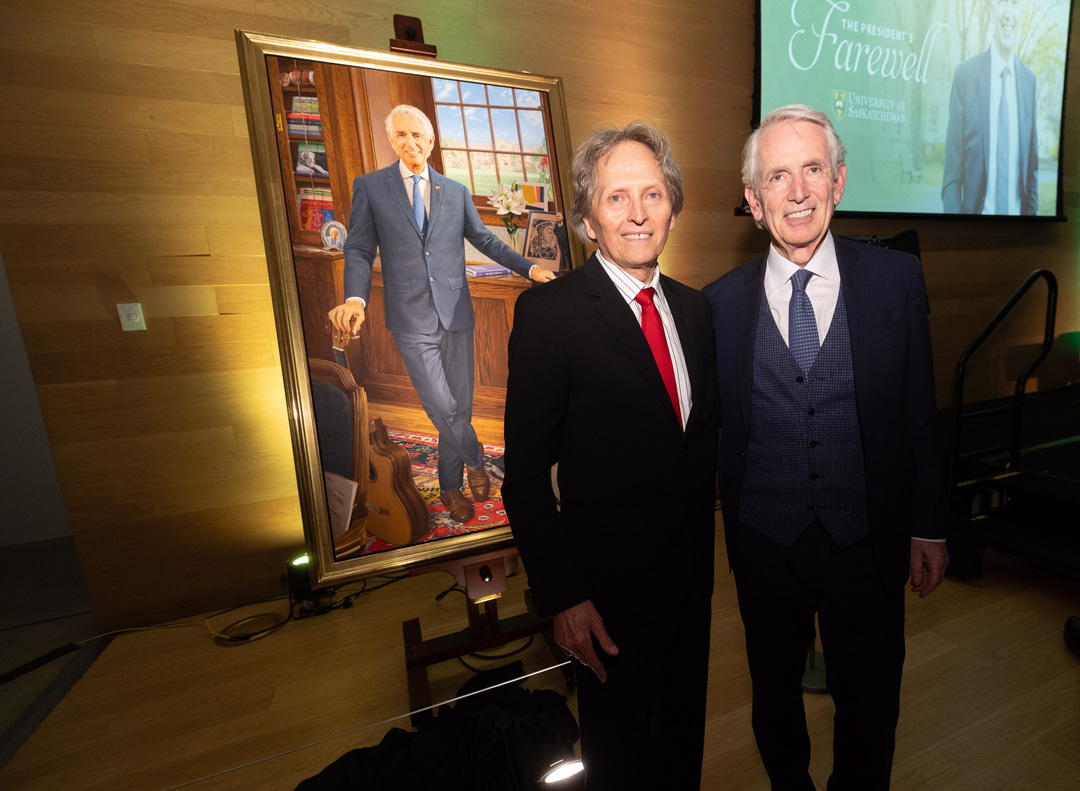
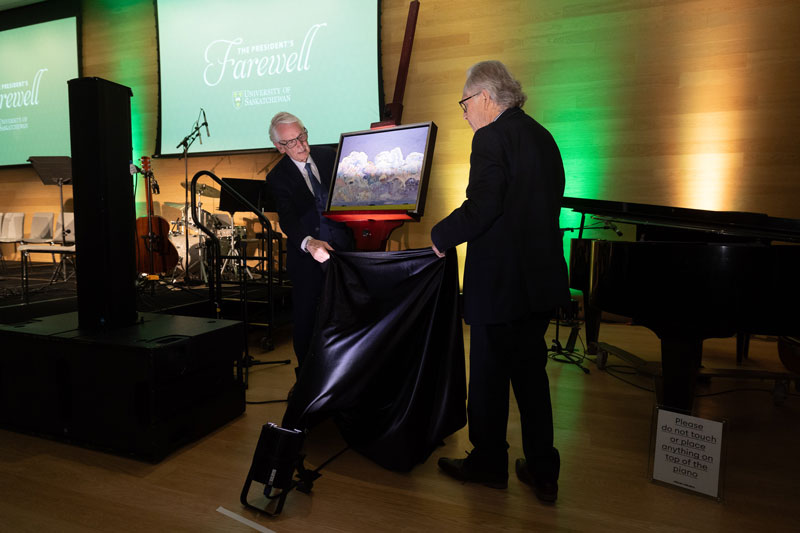
The official portrait of University of Saskatchewan (USask) President and Vice-Chancellor Peter Stoicheff, painted by renowned Canadian artist Phil Richards, was unveiled during a special community event at Remai Modern
By SHANNON BOKLASCHUKA decade of distinguished leadership and service at the University of Saskatchewan (USask) was celebrated on Dec. 4, 2025, as the official painted portrait of USask President and Vice-Chancellor Peter Stoicheff was unveiled during a special event in Saskatoon.
The artwork, which features Stoicheff standing alongside objects of personal, professional, and cultural significance, was created by Phil Richards, one of Canada’s most important portrait painters. Richards’ commissions have included the official Diamond Jubilee portrait of Her Majesty Queen Elizabeth II for the Government of Canada, as well as the official portrait of many academic, business, and government leaders, including former Saskatchewan Premier Brad Wall and Vaughn Solomon Schofield, the 21st lieutenant governor of Saskatchewan.
“It is a privilege to have a portrait painted by the extraordinary Canadian artist Phil Richards that so eloquently tells a story of the university’s remarkable past decade,” said Stoicheff.
“I hope it inspires in viewers what it does in me—appreciation for the beauty of the campus, our strong research legacy, the importance of the arts, our priority of Indigenous reconciliation, the critical support of donors and alumni, and the enduring vitality and optimism of the University of Saskatchewan.”
The portrait is imbued with symbolism from Stoicheff’s tenure as president. It is set in the dining room of the President’s Residence at USask, where Stoicheff and his wife, Kathryn Warden, hosted many gatherings to honour donors, celebrate the achievements of alumni, faculty, staff, and students, and entertain distinguished visitors to the university. A miniature portrait of Warden—who served as director of Research Profile and Impact at USask and then as special advisor to the Vice-President of University Relations and the Vice-President of Research—can be seen in the background, along with artworks by Saskatchewan artists Joe Fafard (DLitt’12), William Perehudoff, and Dorothy Knowles (BA’48), as well as two pieces by Pablo Picasso.
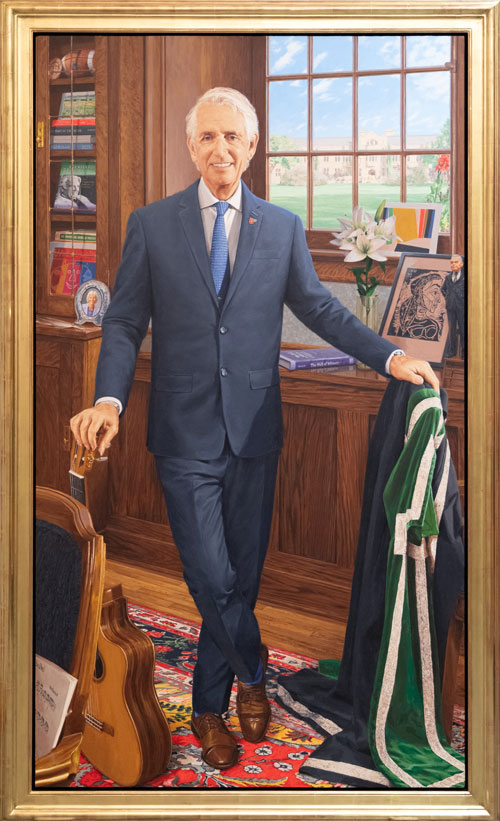
Stoicheff is standing, rather than sitting, in the portrait, with one hand resting on his presidential gown and the other on a classical guitar. The guitar, along with sheet music and several special books, further symbolizes Stoicheff’s passion for the arts and for creative and scholarly endeavours. An eagle feather in the painting represents a gift from Indigenous Elders and Knowledge Keepers that was given to Stoicheff at his presidential announcement in Convocation Hall in July 2015. In the upper corner of the painting, a signed football symbolizes Stoicheff’s support for the Huskies sports teams at USask and for USask’s student-athletes. Meanwhile, a U15 pin on Stoicheff’s suit lapel signifies the three years he spent as chair of the governing body of the U15 Group of Canadian Research Universities.
For Richards, the portrait painter, visiting the USask campus and learning more about Stoicheff and his legacy was a positive experience. Richards particularly appreciated Stoicheff’s support for the literary, performing, and visual arts and the opportunity to showcase that passion in the portrait.
“It gave me the opportunity to make reference to Canadian art and Canadian artists—especially Saskatchewan artists,” said Richards, who referred to Stoicheff as “a polymath.”
“He’s an accomplished musician, composer, poet, and performer.”
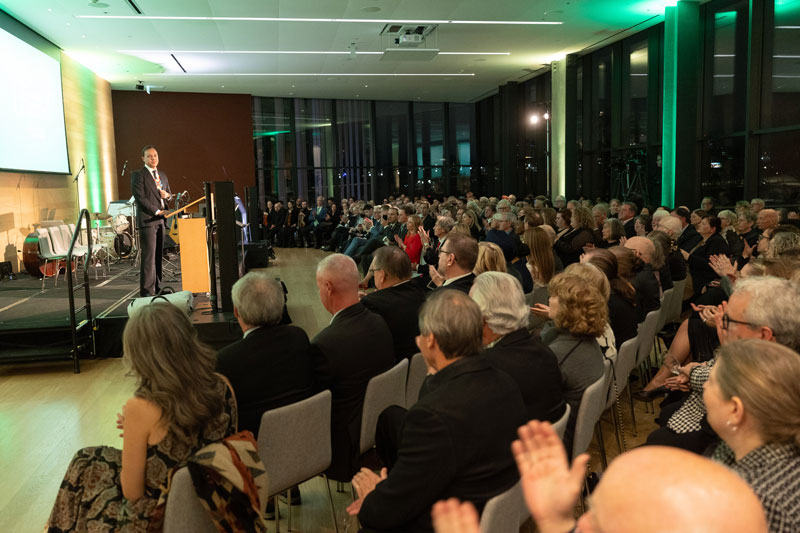
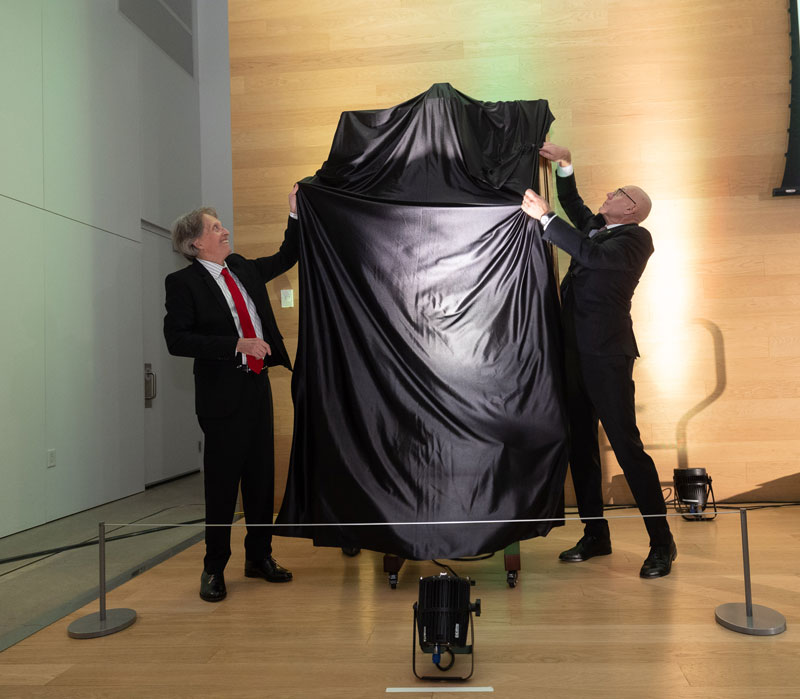
Stoicheff, who was announced as USask’s 11th president and vice-chancellor on July 9, 2015, will conclude his second five-year term on Dec. 31, 2025. The president’s portrait was unveiled by Richards and USask Chancellor Scott Banda (BA’86, LLB’90) during a celebration event at Remai Modern that included a crowd of more than 300 USask and community leaders, alumni, supporters, family members, and friends. Remai Modern is a place of significance for Stoicheff and Warden; during Stoicheff’s first term as president, in 2017, a historic memorandum of understanding was signed between the city-owned art museum and the university to formalize the institutions’ intentions to collaborate in areas of complementary strength and mission.
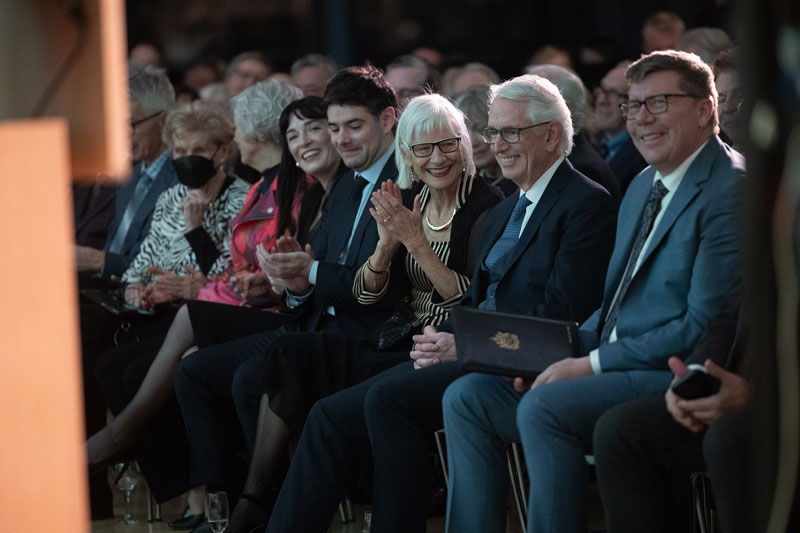
Many special guests and government and community leaders attended the president’s community farewell reception on Dec. 4, including USask honorary degree recipient Ellen Remai (LLD’23), Remai Modern’s lead patron; Saskatoon’s mayor, Cynthia Block; and Saskatchewan’s minister of advanced education, Ken Cheveldayoff. The farewell event’s speakers included Saskatchewan Premier Scott Moe (BSA’97); Charlie Clark, who served as Saskatoon’s mayor during much of Stoicheff’s presidency; USask Vice-President of University Relations Cheryl Hamelin (BSHEC’88); Chancellor Emerita Grit McCreath (BEd’91); and USask alumnus Max FineDay (BA’15), a former University of Saskatchewan Students’ Union (USSU) president, as well as Stoicheff and Richards. Banda also read remarks on behalf of Chancellor Emeritus Blaine Favel (BEd’87, LLD’12).
The presidential portrait was funded by philanthropists Gordon Rawlinson (BComm’68, LLD’24) and Jill Rawlinson (LLD’24), who are both USask honorary degree recipients.
The evening was an opportunity to celebrate Stoicheff’s impact at USask and far beyond and to express gratitude for his unwavering dedication and commitment to the university and its people. Stoicheff’s 39-year career at USask began as a professor of English in 1986. He then went on to serve as dean of the College of Arts and Science before becoming USask’s president in 2015. His 10-year tenure as president was marked by many significant achievements, such as leading the university during the historic Be What the World Needs fundraising campaign, the development of the Prince Albert Campus, a remarkable rise in research funding and international rankings, and the gifting of ohpahotân | oohpaahotaan—the Indigenous Strategy for USask—in 2021.
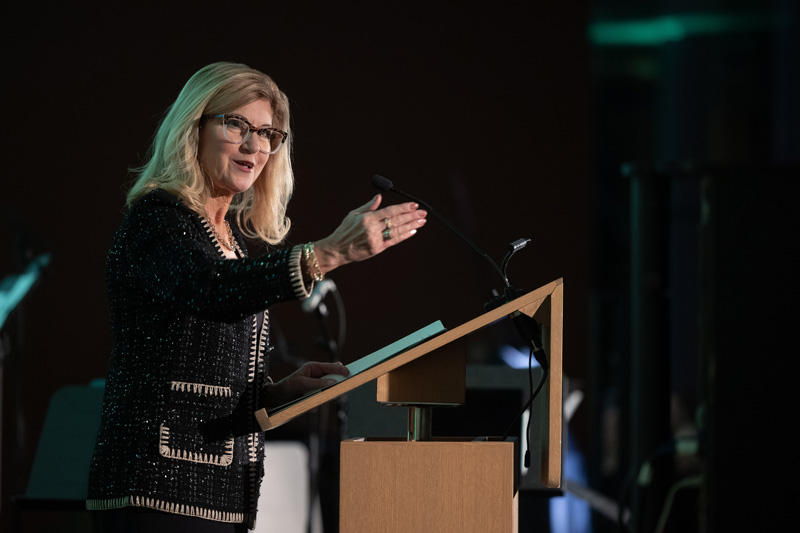
On behalf of the president’s executive team, Hamelin spoke to the crowd about Stoicheff’s legacy, describing him as an individual who leads with empathy, humility, and “the unwavering belief that education can and must be a force for good.” In her tribute, Hamelin said Stoicheff “sets a standard of excellence we all aspire to achieve,” noting that when he took on the role of president a decade ago, he brought with him a bold, ambitious vision that was “laser-focused” on the success of students, faculty, staff, alumni, and others.
“Thank you for your vision, thank you for your courage, thank you for believing in this university with your whole heart,” Hamelin said.
The farewell event featured many memorable moments, including the announcement of a transformational $10-million gift from USask alumni Xiaoping (Bob) Xu (MA’92, LLD’17), an honorary degree recipient, and Ling (Linda) Chen (MA’90). The couple previously donated $3 million to USask, which funded the David L. Kaplan Chair in Music that was named in honour of their former music professor. The couple’s new $10-million donation, gifted in honour of Stoicheff, will ensure the longevity of the David L. Kaplan Chair in Music and fund other initiatives in the School for the Arts in the College of Arts and Science.
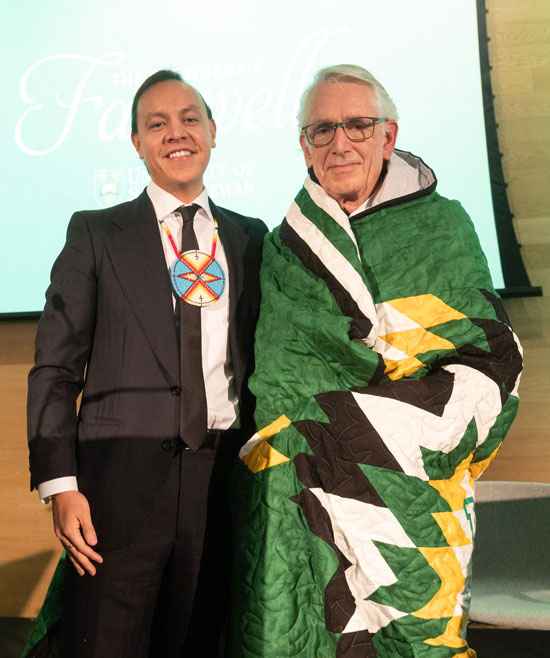
Other highlights from the farewell event included the presentation of a Starblanket to Stoicheff by FineDay, which FineDay described as a symbol of honour and respect. A painting created by acclaimed Canadian landscape artist Greg Hardy was gifted to Stoicheff on behalf of USask. As well, a video was played featuring heartfelt messages from University of Ottawa Professor Emeritus Dr. Chad Gaffield; philanthropist, businessperson, and honorary degree recipient Merlis Belsher (BComm’57, LLB’63, LLD’18); philanthropist, businessperson, and honorary degree recipient Jefferson (Jeff) Mooney (BA’66, LLD’19); Shelley Brown (BComm’78), former chair of the USask Board of Governors; award-winning Hollywood actor and USask honorary degree recipient Kim Coates (BA’81, DLitt’17); and philanthropists and USask honorary degree recipients Ron Graham (BE’62, DCL’13) and Jane Graham (BEd’62, LLD’22).
During the event, a new musical composition was performed publicly for the first time in Stoicheff’s honour. The piece was composed by USask alumnus Paul Suchan (BEd’07, BMusEd’07), a composer, performer, and sessional lecturer in USask’s School for the Arts. Suchan’s body of work includes more than 80 commissions that have been performed across Canada, the United States, and Europe by leading university ensembles, symphony orchestras, community groups, choirs, small ensembles, and others.
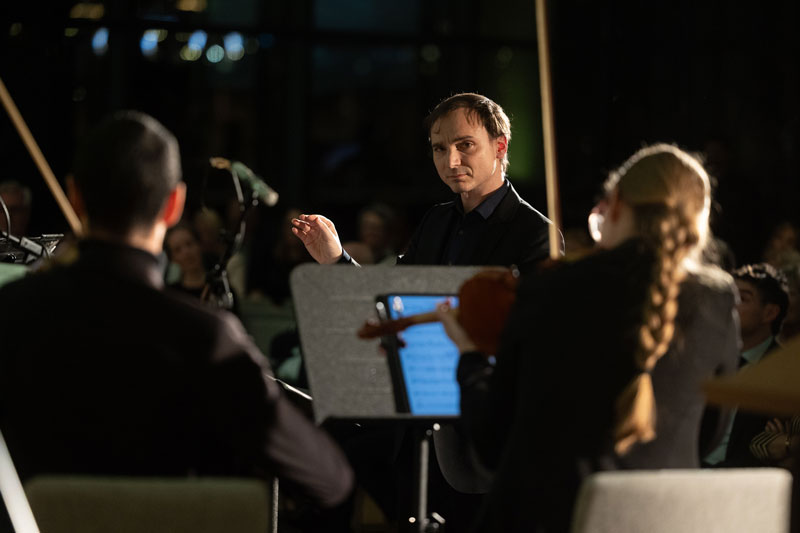
Suchan’s composition for Stoicheff’s farewell event, titled From the East to the West, was inspired by Ezra Pound's Canto XIII. Stoicheff, a scholar of English literature, has written on the work of Pound, an American writer and a major figure in the modernist poetry movement. Suchan conducted an ensemble that included numerous USask alumni: Dru Waltz (BMus’22, BEd’24) on violin; Wagner Barbosa (MMus’25) on violin; Sarah ter Velde (BA’25) on viola; Joel MacDonald (BA’10) on cello; Graham Pritchard (BMus’05, BMusEd’05) on guitar; Emmett Fortosky (BMus'18, CJazz’18, BEd’21, CTESL’23) on bass; and Brett Graham (BMus’11) on drums.
The painted portrait will be on view at the USask campus during the upcoming President’s Farewell event at Marquis Hall, which will be held on Dec. 9, 2025, from 2 pm to 4 pm. Visit this link to learn more about the objects featured in the painting and their importance and symbolism.
A unique approach to portrait painting
Creating a portrait of a “sitter,” such as USask President Peter Stoicheff, is a multi-layered and multi-phased undertaking for acclaimed Canadian portrait painter Phil Richards.
Each artwork that Richards creates is a personalized project that includes unique details and objects that are meaningful to the subject. In Stoicheff’s portrait, for instance, Richards painted references that symbolize the president’s support for the arts and the Huskies. Viewers will also see a miniature portrait of Stoicheff’s spouse, Kathryn Warden, along with other carefully chosen imagery, such as the USask crest and the USask lily—a plant that was developed by scientists to celebrate the university’s 100th anniversary in 2007.
“The way I work (hearkens) back beyond the Baroque period, mainly to the Renaissance—even the early Renaissance period—where artists depicted not just the image of the person but their surroundings as well,” Richards explained in a recent interview with the Green&White.
Richards is one of Canada's most important portrait painters. His commissions include many government and academic leaders and the official Diamond Jubilee portrait of Her Majesty Queen Elizabeth II, which was unveiled in 2012. Richards was in Saskatoon to attend the USask presidential portrait unveiling and farewell event for Stoicheff on Dec. 4, 2025, at Remai Modern.
“I love Saskatchewan,” Richards said. “They’ve been so good to me over my career. When the queen’s painting came (out), they had an exhibition of all the preparatory work that went with it. It was put on by the museum that’s part of Government House (in Regina).”
In the interview, Richards described how he documents each step in the portrait creation process through a series of photographs that are then compiled into what he calls a process sequence portfolio. On Dec. 3, Richards presented the 120-page process sequence portfolio for the presidential artwork to Stoicheff and Warden.
Richards begins each portrait project with extensive research. It was in August 2025 that Richards first came to USask to interview Stoicheff and Warden, as well as to take many photographs and to sketch and measure architectural elements on campus that could potentially be used in the portrait.
“There’s a few basic questions that come up when you are commissioned a portrait,” Richards said. “One is, where is it going to be set? Is it going to be indoors or outdoors? And, if it is going to be indoors or outdoors, where exactly? And then the second question is whether you want it to be a standing or sitting pose. And then the next question is, what are you going to be wearing, and why? All those questions can be answered in several different ways, so that means I’ve got to take a lot of photographs of different sites. I’ve got to take a lot of photographs of different poses and sometimes different outfits.”
In addition to this significant planning, Richards’ portrait work requires a deep understanding of mathematics and geometry. Richards’ process sequence portfolios detail each step of the portrait process, as he moves from early pose studies (pencil on paper) to tonal pose studies (charcoal and chalk on paper) to concept sketches, scaled perspective studies, and scaled perspective studies with geometric grids.
“There’s a great deal of geometry involved with the way I paint,” said Richards, noting the “most crucial” measurements in the human face are the distance between the eyes, from the mouth to the eyes, from the nostrils to the mouth, and from the nostrils to the eyes.
For Stoicheff’s painting, Richards created three different concept sketches featuring standing poses that were set in the President’s Residence on the USask campus. In early September, Stoicheff travelled to Toronto and again met with Richards—this time at the Mira Godard Gallery, which has represented Richard almost exclusively for 45 years. During that meeting Stoicheff and Richards selected the sketch that would later become the final painted portrait.
“Once that decision is made, then I can start being really specific about the architectural space,” Richards said. “That’s when I start doing these perspective renderings of the space that the image is going to be projected into. This is where all the measurements come in.”
Richards paints the background first in each portrait; in Stoicheff’s case, Richards first painted a window with a view to the iconic outdoor space on the USask campus known as The Bowl. Richards then continues painting inward toward the subject.
“I don’t think there’s anyone in the world who works like this, but I’ve come up with this,” Richards said. “I did my first portraits around 1968, ’69, so it’s been a long time evolving this process.”
Stoicheff’s portrait is unique for USask presidential portraits in that it features a standing pose rather than a sitting pose and includes many personal elements. The final portrait of Stoicheff is 63 inches by 36 inches.