


USask President Peter Stoicheff's official portrait
This portrait, created by renowned Canadian portrait painter Phil Richards, was funded by a gift from philanthropists and USask honorary degree recipients Jill and Gord Rawlinson.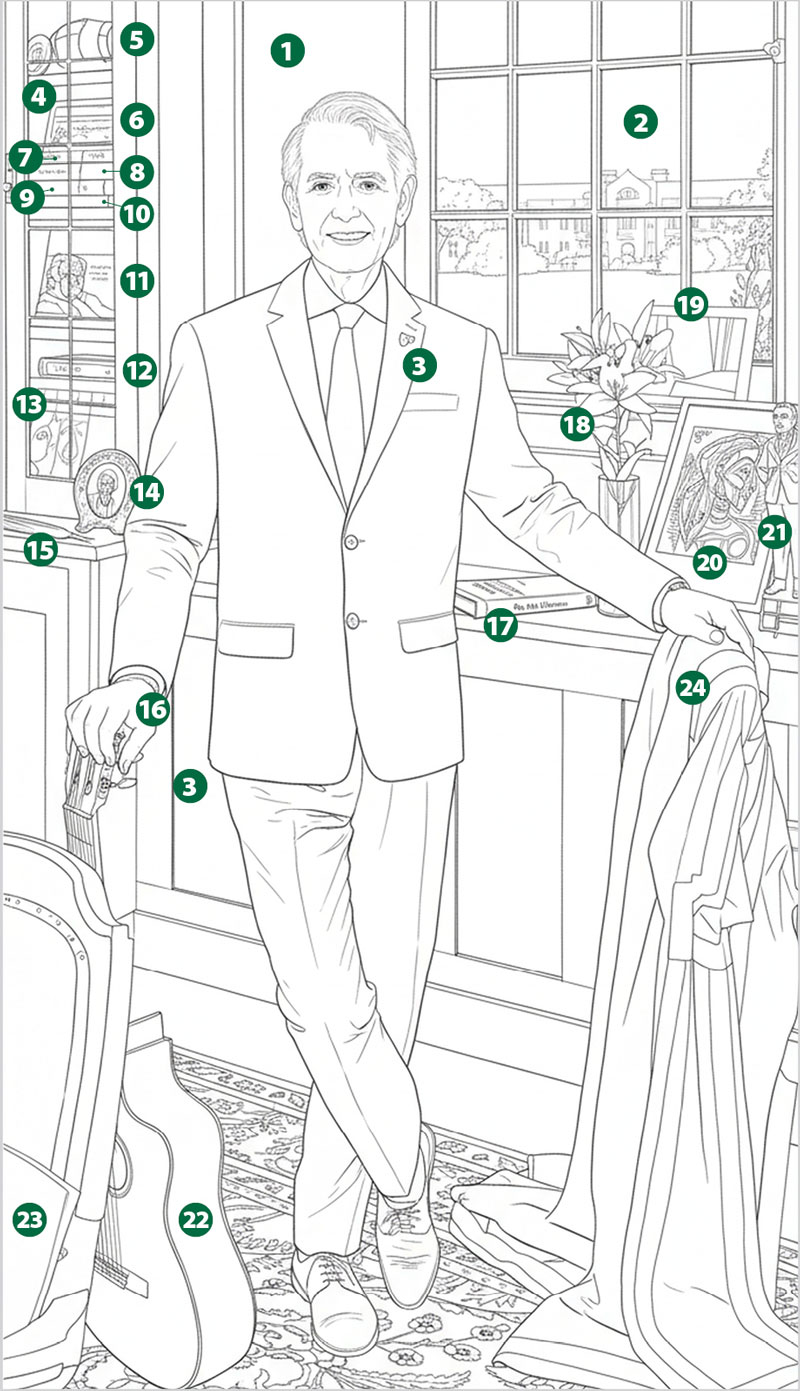
1. Setting: The portrait is set in the President’s Residence dining room where Peter Stoicheff and his wife Kathryn Warden hosted many gatherings over the past 10 years to honour donors and celebrate the achievements of alumni, faculty, staff and students, as well as to entertain distinguished visitors.
2. Window scene: A view of “The Bowl”, a beloved green space at the heart of the campus.
3. U15 Canada pin (on suit jacket lapel): Peter Stoicheff chaired U15 Canada, an association of Canada’s leading research universities, for three years.
4. University of Saskatchewan crest (left of the football): With wheat sheaves, an open book, and the motto ‘For God and country’, the crest is a reminder of the university's strong connection to the province of Saskatchewan and to the critical role of higher education in Canada (and beyond).
5. Huskies Football: This represents a football given to Peter Stoicheff that was signed by the Huskies football team players. Including it in the portrait highlights his support for Huskie Athletics in general.
6. Dorothy Knowles’ landscape painting: This painting is prominently displayed in the President's Office and honours influential artists from the acclaimed era of the Emma Lake Kenderdine campus.
Book spines:
7. Probable Impossibilities (2021): was written by Peter Stoicheff’s longtime friend Alan Lightman, a novelist, essayist, physicist, educator, and founder of the Harpswell residential centre for young female leaders in Cambodia. Lightman, a professor of the Practice of the Humanities at the Massachusetts Institute of Technology, gave a lecture for the USask Gail Appel Lecture Series and serves on the United Nation’s Scientific Advisory Council on breakthroughs in science and technology.
8. History of the Book: Honours Peter Stoicheff’s academic field of study during his four decades at USask—including his 2004 book The Future of the Page and a chapter in The Cambridge Companion to the History of the Book.
9. 50 Medieval Manuscript Leaves: This references a guide, created by USask librarian David Bindle, to the Otto Ege Medieval Manuscript Collection. Peter Stoicheff led a two-year USask project with graduate students to locate and digitally reconstruct the Ege manuscripts from 50 different sources.
10. Phil Richards 2025: This is the portrait artist’s creative way of signing the portrait. Phil Richards is a prominent Canadian portrait artist whose subjects include Canadian university presidents, former Saskatchewan Lieutenant Governor Vaughn Solomon Schofield, politicians such as Bob Rae and Brad Wall, and the late Queen Elizabeth II.
11. An Illustrious Life in Science: The biography of Nobel Prize winner Gerhard Herzberg was written by Boris Stoicheff, Peter Stoicheff's father, a physicist who worked with Herzberg at the National Research Council. During his 10 years at USask, Herzberg did fundamental research that paved the way for his Nobel Prize and for scientific endeavors today, including spectroscopy research at the Canadian Light Source synchrotron. More about Herzberg's accomplishments and how he came to USask is here: https://research.usask.ca/herzberg/index.php
12. Be What the World Needs: the aspirational and overarching brand for the University of Saskatchewan envisioned by Peter Stoicheff and later adopted as the title of the university’s vision and mission plan, as well as for the major fundraising campaign of his tenure.
13. Picasso linocut: This colorful 1956 Picasso linocut, obtained from USask alumnus and world-renowned Picasso print expert Fred Mulder, is a reminder of the linocuts and other art gifted to the university by Mulder, as well as of the MOU (memorandum of understanding) signed during Stoicheff's term between the university and the Remai Modern Gallery. The Remai houses the world's largest collection of Picasso linocuts thanks to philantropist and USask honorary degree recipient Ellen Remai.
14. Mini portrait: This honours Kathryn Warden, Peter Stoicheff's spouse, who served as director of Research Profile and Impact and then Special Advisor to the Vice-President of University Relations and the Vice-President of Research during Peter's term.
15. Eagle Feather: This was a gift from Indigenous Elders and Knowledge Keepers to Peter Stoicheff at his presidential announcement in Convocation Hall, July 2015 and was displayed with pride in the President's Office and as a reminder of the imperative to ensure USask was a welcoming place for Indigenous peoples.
16. Haida Gwaii bracelet: This bracelet, regularly worn by Peter Stoicheff, was carved by a Haida Gwaii artist and purchased during a visit to the island. Wearing it honours Indigenous arts, of which a variety are on display at the President's Residence.
17. The Hall of Mirrors: This book by Peter Stoicheff was the result of his early scholarly work on writers in modern literature.
18. University of Saskatchewan Lily: Developed by USask plant scientists to celebrate USask's 100th anniversary in 2007, this lily was bred to include university colors of white, green and gold. Including this in the portrait also recognizes USask's agricultural roots and its excellence in crop development and food security.
19. William Perehudoff painting: This is a miniature of the large, colorful painting Peter Stoicheff chose for his office. The work was created in 1970 by William Perehudoff, one of Canada's leading abstract painters who was inspired by Saskatchewan's vast prairies.
20. Portrait of Jacqueline: This unique Picasso portrait of his muse and second wife Jacqueline was donated to the President’s Residence in 2024 by USask alumnus, philanthropist, and world-renowned Picasso print expert Fred Mulder in honour of Kathryn Warden and Peter Stoicheff.
21. Sculpture of John Diefenbaker: Donated to the President’s Residence by philanthropists Jeff Mooney and Suzanne Bolton in 2024, this sculpture honours both these major USask donors and the artist Joe Fafard who taught sculpture at USask and produced renowned portraits of well-known artists and politicians. Saskatchewan-born former Prime Minister John Diefenbaker is buried on campus and his grave is next to the Diefenbaker Centre built in 1980.
22. Classical Guitar: The inclusion of Peter Stoicheff’s guitar highlights his passion for the acoustic guitar and the importance of music and musical instruments to USask's cultural history including the renowned Amati instruments and the David Kaplan Collection.
23. Sheet music: This signifies that Peter Stoicheff, who composed guitar music featured on his CD Ethereal Steel, valued creativity in the arts.
24. Presidential gown: Peter Stoicheff spoke and greeted graduates at 100 convocation ceremonies during his tenure.