


School of rock
USask alumni Steve Laycock (BComm’07) and Nancy Martin (BSc’19) balance elite curling competitions with busy professional careers
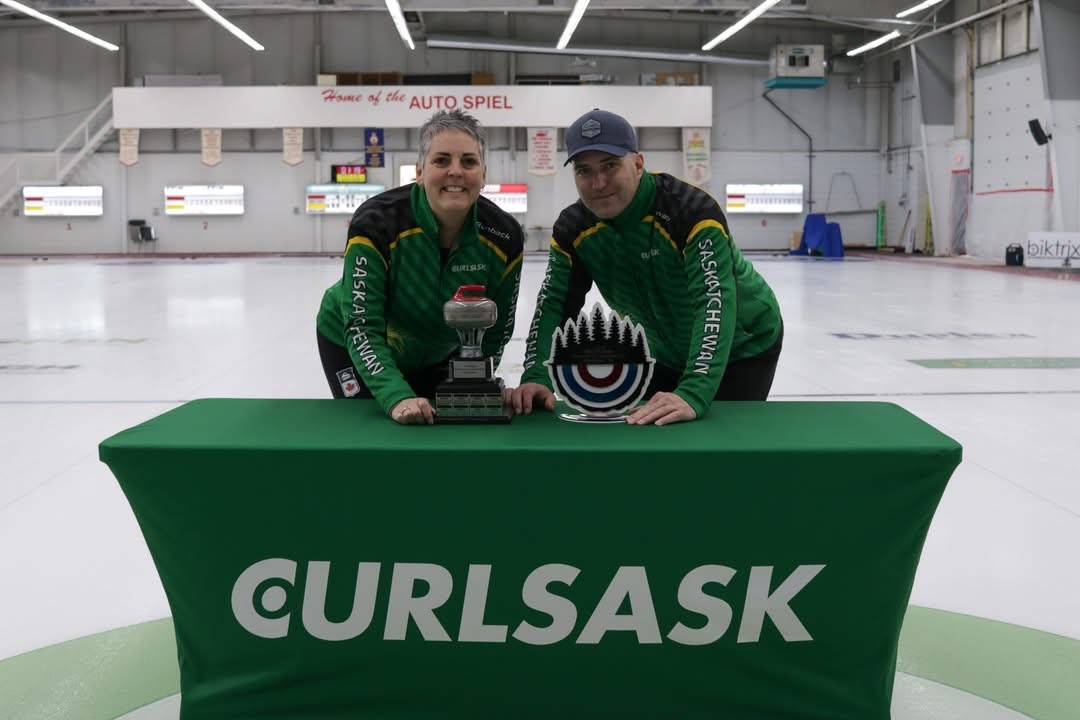
By Sean ConroyIn mixed doubles curling, success depends on trust, communication, and problem‑solving. These skills served University of Saskatchewan (USask) alumni Steve Laycock (BComm’07) and Nancy Martin (BSc’19) well both on and off the ice en route to winning the CURLSASK Mixed Doubles Provincial Championship earlier this year.
Away from the rink, Laycock and Martin both balance elite competition with demanding professional careers.
Laycock’s USask journey has continued as an employee. The commerce graduate began as a human resources generalist and now serves as compensation and benefits manager.
Martin is a longtime public servant with Correctional Service Canada, where she has spent nearly three decades working with complex offender‑information systems. After earning her computer science degree while working full-time, she now works at national headquarters in a data and coding‑focused role, using structured query language programming to compile national‑level information for senior leadership.
Before joining forces in mixed doubles, both Laycock and Martin had already built accomplished curling careers.
Laycock is a longtime fixture on the national stage, with multiple Saskatchewan men’s championships, 10 Brier appearances, and early success as a Canadian and world junior champion.
Martin’s experience on the women’s side includes a Saskatchewan women’s provincial title, multiple Scotties Tournament of Hearts appearances, and a long history of competing at the highest levels in both women’s and mixed doubles curling.
The Green&White spoke with the duo about their shared USask roots, their mixed doubles partnership, and what it takes to sustain excellence.
G&W: How has your USask degree shaped the way you approach your professional work or even the way you approach curling?
Laycock: The learnings I had while earning my degree have shaped both my professional work and my curling career. Analytical and critical‑thinking skills, teamwork, and leadership were all things I was refining during that time. I’d also say the time‑management skills I developed as a student‑athlete are something I still rely on regularly.
Martin: I went back to school later in life while working full-time, raising three kids, and curling. My classmates helped me not see age. Everyone had a different story and direction, but for that moment in time we were all working toward one goal. Curling is very similar to me. No matter the age, we’re all trying to improve and be competitive.
G&W: How do you balance the demands of your job with preparing to compete at a high level? What sacrifices are required?
Laycock: I’m incredibly appreciative of USask as an employer for being endlessly supportive of me chasing my sporting dreams. There’s a lot of trust in me to manage my time while still delivering on my work commitments. The tradeoff is that downtime between games or time spent in airports often becomes time to get work done.
Martin: That usually means working on the road, between games, or in airports. There are sacrifices, fewer holidays that aren’t focused on curling, but it’s what it takes to stay competitive while working full-time.
G&W: What’s a misconception about elite curlers you wish people better understood?
Laycock: Especially during the Olympics, people still think curling doesn’t require the same level of athleticism as other sports. With sweeping, our heart rates are maxed out for 15 to 20 seconds with only about a minute to recover, and we do that repeatedly for hours. It’s extremely demanding.
Martin: People don’t always realize how hard we work to stay competitive while holding full‑time jobs and balancing family, training, and travel. There is a lot going on behind the scenes.
G&W: How did your mixed doubles partnership come together?
Martin: I think it really started when we were both volunteering on a curling board. We played a few events together and realized we saw the game very similarly and that our skills complemented each other.
Laycock: Nancy was instrumental in me getting into doubles as she was playing this discipline long before me. She would often ask me to spare in local doubles events with her, due to her partner at the time curling out of B.C.
G&W: What makes you a strong mixed doubles team?
Martin: We each bring different skills to the game and work hard during training sessions to ensure those skills are maximized. Steve’s work ethic is like no other. He has challenged me to be more technically sound and taught me a lot about rock reaction and how to read angles.
Laycock: We both bring (a) significant amount of experience and past success to the table, so that was the foundation for being a strong team. But what has made the biggest difference is working on our communication and the ways we can get the best out of our partner.
G&W: You highlighted the season by winning the CURLSASK Mixed Doubles Championship. What was the journey like to get there?
Laycock: Winning mixed doubles provincials was a career bucket list thing for me. I’ve won quite a few provincial titles in four‑person curling, but despite competing at national mixed doubles championships and Olympic Trials, I hadn’t won a Saskatchewan doubles championship until this season.
Martin: For me personally, it was a long time coming. I lost quite a few provincial mixed doubles finals, including one with Steve. Last year we missed provincials because I won the women’s provincial title and went to the Scotties. So, winning this one felt like a great victory for us.
G&W: What challenges or turning points helped shape this season’s success?
Martin: Last year, we both took a step back from men’s and women’s curling to focus on mixed doubles after earning a spot at the Olympic Trials. We put everything into that.
The trials didn’t quite go how we hoped. I was sick and tweaked my back right before we travelled. But we beat some great teams and were really proud just to be there.
This season, we could really feel the benefits of that work. Our systems were smooth, our technical game was solid, and our strategy was ironed out. Winning provincials felt like we had done the work to deserve that national opportunity.
Laycock: We honestly got off to a great start right out of the gate at our first event this year, ultimately winning it by beating the team who were at the time ranked number one in the world. As much as the hard work we had put in didn’t result in us getting to represent Canada at the Olympics, it did set us up well for the continued success we would end up having this year.
G&W: Looking ahead, what excites you most about continuing as a mixed doubles team?
Martin: We both love to practice, we make each other better players, and after doing so much hard work, things start to feel a bit easier, and a bit more fun. We also enjoy travelling together and playing some golf in between games when the weather allows.
Laycock: Much of the excitement for me comes in the ways that the mixed doubles discipline has presented new challenges and a different set of goals to accomplish.