


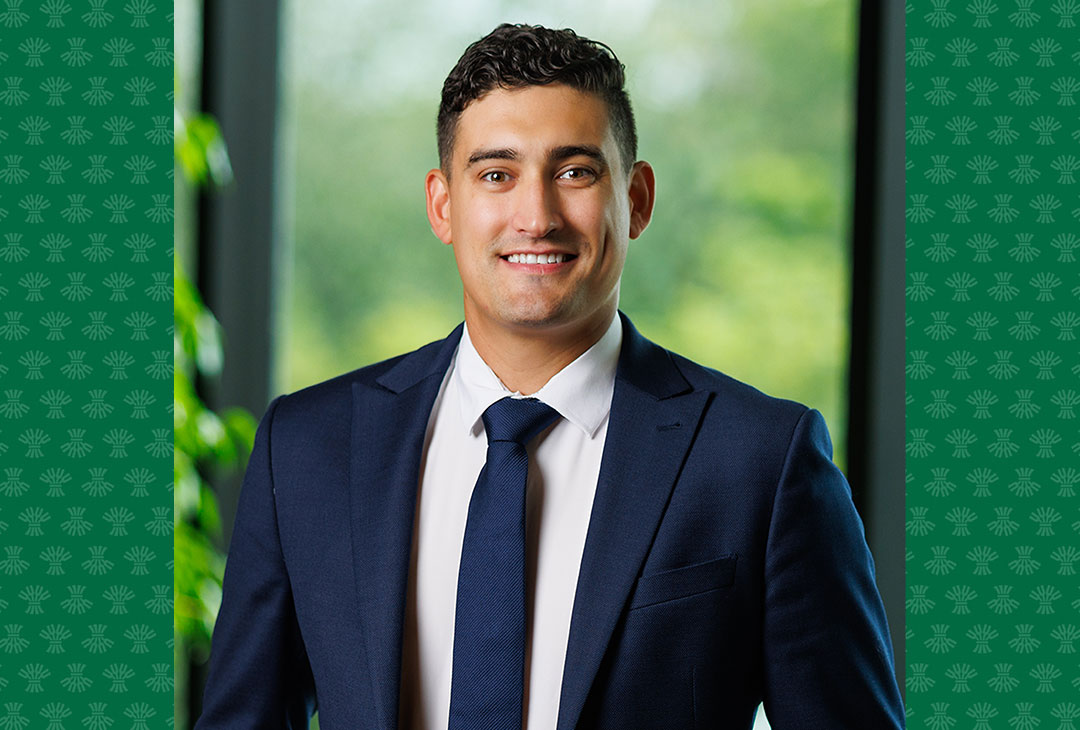
‘Representation matters’
Saskatoon lawyer Jared Brown (BA’15, JD’16) reflects on his career, his education at USask, and making history as the first Indigenous person to lead the University of Saskatchewan Students’ Union (USSU)
By SHANNON BOKLASCHUKIt’s been a decade since University of Saskatchewan (USask) alumnus Jared Brown (BA’15, JD’16) graduated from law school—a milestone that has sparked reflection and nostalgia.
“It is kind of hard to believe it’s already been 10 years,” Brown said in a recent interview with the Green&White. “In some ways, it feels like it was yesterday.”
The adage that “time flies when you’re having fun” seems to be true for Brown, who has gone from USask student to established Saskatoon lawyer in what can feel like the blink of an eye.
A member of Mistawasis Nêhiyawak, Brown made history at USask in 2012 when he was elected as the first Indigenous person to become the president of the University of Saskatchewan Students’ Union (USSU). It remains a memorable moment for Brown, who was 22 years old and a sociology student at USask’s College of Arts and Science at the time of the election.
“I never set out to become the first of anything. At the time, I was really focused on just serving students and doing the best job I could,” Brown said. “I think once I realized there was a historical significance attached to becoming the first Indigenous person elected to be USSU president, I just understood that the role maybe carried more responsibility and it was a little bit bigger than me, as an example. But, looking back, I am proud that the responsibility didn’t intimidate me or cause me to sink in that role or shrink in any way.
“Representation matters,” he added. “It changes perceptions about who can lead and who belongs in leadership spaces. And I’m proud that my election helped demonstrate that Indigenous students and people . . . belong in every level of leadership and governance.”
Today, 14 years after that USSU election, Brown continues to be grateful for the opportunity to serve his fellow students and for the support he received from across campus and beyond.
“It never felt like an individual accomplishment; it really felt like a whole community of people helped make it possible,” he said. “So many people believed in me. So many friends and classmates and mentors and family members believed that I could do it and they encouraged me to do it—and, you know, those things don’t really just happen in isolation. I think they happen because the people around you push you forward. They believe in you. And, as a result, you believe in yourself.”
Brown fondly recalls a photo from The Sheaf student newspaper that was taken moments after the USSU election results were announced. He is pictured with his aunt, Darlene Lanceley (BEd’84, BA’90, MA’02), his roommate, and close friends and cousins. Brown’s election running mate and fellow Indigenous Students’ Council (ISC) representative, Marylou Mintram, is hugging him in the picture, and fellow College of Arts and Science student Max FineDay (BA’15) is also in the photo. A year later, FineDay would become the second Indigenous person to serve as USSU president, after Brown, in 2013.
“It was a moment where a group of us just collectively realized that bigger things were possible for ourselves,” Brown said of the 2012 election photo. “It galvanized us and gave us energy.”
Brown was born in Prince Albert, Sask., and grew up in Saskatoon, on Treaty 6 Territory and the Homeland of the Métis. It was a natural fit for him to go to USask and, as a College of Arts and Science student, Brown was particularly drawn to sociology classes, following in the footsteps of his uncle, Rob Brown (BA’00), and aunty Darlene, who earned a master’s degree in the subject. He was also inspired by the late Dr. Patricia “Trish” Monture-Angus, a scholar, lawyer, writer, activist, and highly respected College of Arts and Science faculty member for whom the Trish Monture Centre is named. It was through studying sociology that Brown became more interested in examining systemic and social structures, as well as exploring leadership, governance, and institutional change.
“Through all the conversations and studying, and all the experiences that you’re getting when you’re that young, I started thinking more critically about how governance looks in institutions and how change occurs,” he said.
After his election as USSU president, Brown had the opportunity to learn more about leadership and governance by serving as a representative on USask’s Board of Governors from 2012 to 2013. Being part of the Board of Governors was “an incredible opportunity” for Brown to learn from and work alongside intelligent, dedicated people who helped shape his thoughts on decision-making and leadership during a formative time in his life.
“The issues that come before the Board are enormously complex, and there’s a tremendous amount of responsibility that’s associated to those decisions,” Brown said. “Throughout my life . . . I’ve just tried to learn the most by listening carefully to people around me.”
During his studies in the College of Arts and Science—where he ultimately earned his Bachelor of Arts degree in sociology in 2015—Brown also became interested in pursuing a legal career. Around the same time, he was elected president of the USSU and was also accepted into law school; however, he deferred his enrollment for one year to complete his term as president.
“The College of Law has a history of producing leaders in Saskatchewan,” Brown said.
“The presence of the Indigenous Law Centre made (the decision to enroll) a pretty easy decision to make,” he added.
The Indigenous Law Centre (ILC), located at USask’s College of Law, aims to facilitate access to legal education for Indigenous peoples; to promote the development of the law and the legal system in Canada in ways that better accommodate the advancement of Indigenous peoples and communities; and to disseminate information concerning Indigenous peoples and the law.
Brown described the ILC as “a great place to go,” noting he was involved with the centre throughout his time in law school. Brown also felt fortunate to attend one of the ILC’s flagship programs—which at the time was called the Program of Legal Studies for Native People (PLSNP) and is now known as the Spring and Summer Law Course for Indigenous Students—that brought Indigenous law students to the USask campus from across the country.
While studying law, Brown participated in the Kawaskimhon Moot, which is a negotiation moot designed to incorporate Indigenous values and concepts of dispute resolution. Through the Kawaskimhon Moot, teams from across Canada prepare written arguments and present their clients’ positions to their circles, with the goal of reaching a consensus on the issues at stake.
As a student in the College of Law, Brown had other opportunities to develop his skills and to connect with community members, including volunteering and working with CLASSIC (Community Legal Services for Saskatoon Inner City Inc.). As he did in the College of Arts and Science, Brown also showed leadership in the College of Law, serving as the vice-president of the Indigenous Law Students’ Association (ILSA) from 2014 until 2016.
After earning his Juris Doctor degree in 2016, Brown was admitted to the Saskatchewan Bar in 2017. He practiced with a major Saskatchewan law firm as well as a boutique law firm before taking on his current role as an associate in the McKercher LLP Saskatoon office, where he works primarily with the Indigenous Law Practice Group.
“A significant part of my practice is working with First Nations, Indigenous organizations, and general businesses on governance, economic development, and corporate commercial matters,” Brown said, noting he had dreamed of working with McKercher as a law student and this dream has become a reality.
“I’m very fortunate to work at McKercher, and I’m really fortunate to work with colleagues that are experts in their field,” he said.
Outside of his law practice, Brown continues to give back to the community. For example, he previously served as a board member with the Saskatchewan Intercultural Association, and he is currently a board member with Wanuskewin.
When asked about his advice for current USask students and recent alumni, Brown said it’s important to build technical and practical skills while studying on campus. He also encourages connecting with a wide variety of people, including those who may have different lived experiences and different perspectives, and to learn by listening.
“Academic performance is absolutely important, but so are the relationships you form,” he said.
“I think you need to be flexible because in university, when I first stepped foot on campus, I couldn’t have predicted what would have happened, right? I mean, some of the most meaningful opportunities come from just being willing to say yes to experiences. . . .I think it’s important to stay curious.”
When he thinks about his time at USask, Brown has wonderful memories of student life, and he enjoys returning to campus as a result. In 2024, for example, Brown was part of a panel discussion at the College of Law titled “The world after law school,” during which he spoke alongside fellow Indigenous legal professionals and USask graduates Lorne Fagnan (BA’13, JD’16) and Aaron Starr (JD’11).
“I love going back. I think for many graduates, it has this element of home,” Brown said of USask.
“Had I not gone to the University of Saskatchewan, I wouldn’t have the life I live today. I wouldn’t have met my wife; I wouldn’t have the closest relationships I have now. A lot of defining moments happened during those years, and there’s no doubt that being elected USSU president is one of the memorable moments for me.”