


Volden Goals
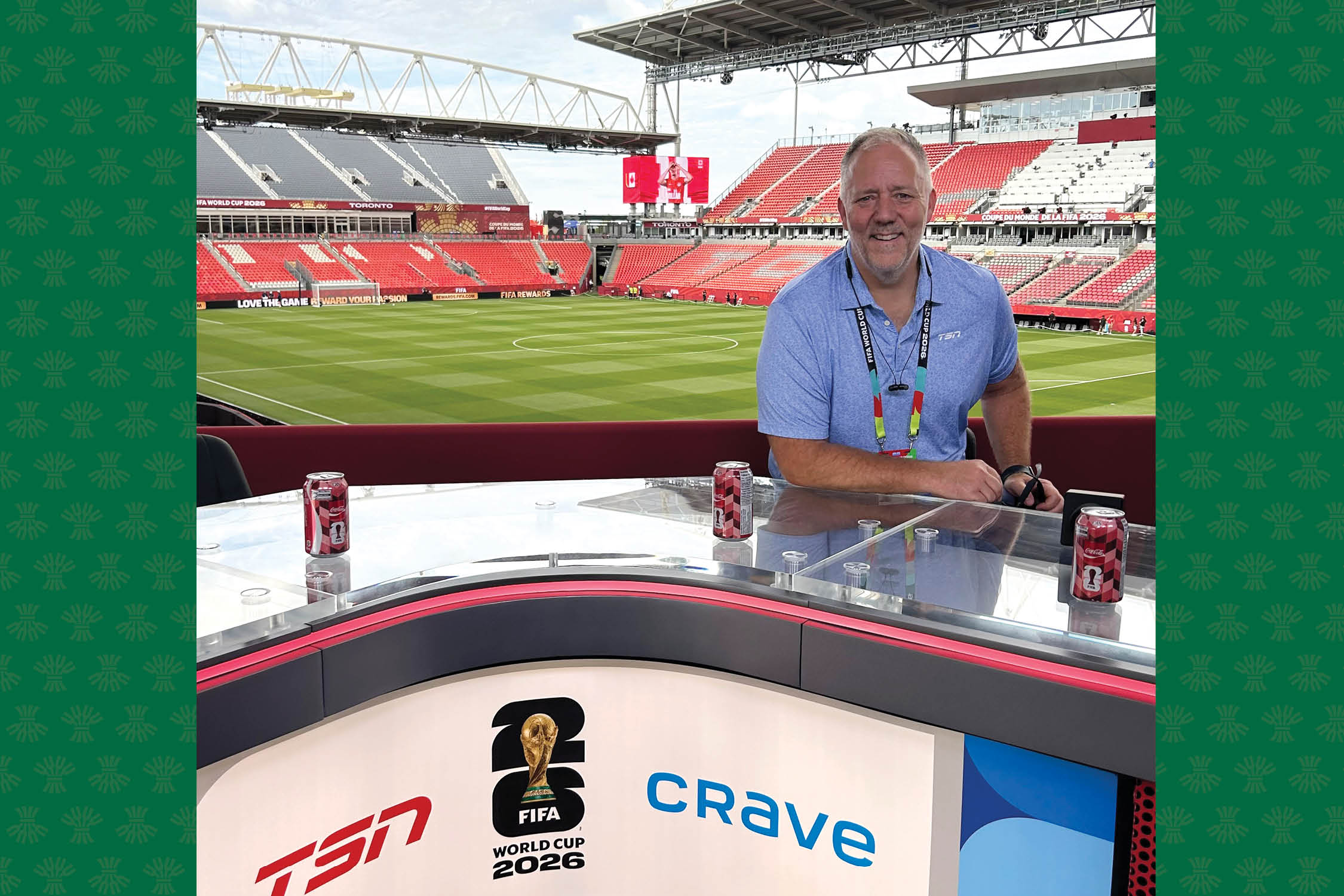
USask graduate Ken Volden (BSPE’90) is an executive producer at TSN who oversaw the sports channel’s coverage of the FIFA World Cup 2026.
By SEAN CONROYUniversity of Saskatchewan (USask) graduate Ken Volden (BSPE’90) has spent more than three decades at The Sports Network (TSN), where he has helped shape the coverage of some of the biggest sporting events in the world, including the 2026 FIFA World Cup and its flagship highlight program, SportsCentre.
Volden recently served as executive producer for the soccer tournament. He spoke with the Green&White about leading a major broadcast operation, storytelling in sports, and how his home province and his alma mater still influence his work today.
G&W: The FIFA World Cup is one of the largest sporting events in the world. What goes into preparing coverage of an event on that scale?
Volden: We really started prior to the 2022 FIFA World Cup in Qatar. Once Canada qualified and we hosted on-site there, that became the beginning of our planning for the 2026 tournament.
Three years out, we were already making decisions. We knew Toronto and Vancouver were hosting. We knew Canada would likely play two matches in Vancouver, so we started making decisions about staffing, where our talent would be located, how much coverage we'd provide around Team Canada, and what kind of programming we wanted to produce.
Then we're setting budgets, working with sales, booking facilities, booking travel, and building the team. Once the Final Draw happened, which sets the tournament groups and matchups, things became very intense. By then, we were moving from planning into execution mode. The last few months have really been about putting everything into action.
G&W: What would surprise viewers most about broadcasting an event like the World Cup?
Volden: People are always surprised by the amount of work. It takes years of planning and an incredible amount of detail. We go to these glamorous events, but a lot of the time producers and directors are sitting in a little truck in a parking lot watching the game through monitors.
There are so many people involved and so much work happening behind the scenes that viewers never see. That’s true whether you’re covering the World Cup, the Olympics, or any other major event.
G&W: The performance of the Canadian Men’s National Team captured the imagination of the country, including more than 11 million tuning in for both the historic victory over South Africa and the subsequent loss to Morocco in the knock-out round. Why do events like the World Cup resonate so strongly, even with casual viewers and people who don’t normally watch the sport?
Volden: Sports is about emotion. When you have your country involved, people immediately become invested. They want to see how those athletes perform, and they want to share in their successes and disappointments.
Our job is to tell those stories in a way that helps viewers connect with them. That’s why major events like the World Cup or the Olympics can bring in people who don’t normally watch sports.
Everybody understands hope, disappointment, pressure, and achievement.
G&W: What stands out most when you reflect on this World Cup and your role in it?
Volden: A lot of it is about the people. I’ve worked with many of these people for years. You hire them, you watch them grow, and then you get to see them succeed on one of the biggest stages in sports.
My role as executive producer is sort of like a general manager. I'm not in the trenches in the same way my senior producers are, but I get to see all these talented people do extraordinary work.
Getting to do something this significant with people you've worked alongside for decades is probably what I'll remember most.
G&W: You earned a Bachelor of Physical Education degree in what is now the College of Kinesiology and originally considered teaching. How did you end up pursuing broadcasting?
Volden: I didn't really know what I wanted to do. I always knew I was interested in media, but there wasn't a broadcasting school in Saskatoon and my family didn’t have a lot of money, so I wasn’t quite sure how I was going to make it happen.
I thought about teaching, but my mom pointed out that I didn't have much patience. Looking back, she was probably right.
I started volunteering at Telecable 10 in Saskatoon and got some experience there. Then my wife, Rayna (BE’91), got a job in Edmonton, and I was hired at ITV as a production assistant. I worked my way up through news production and eventually joined TSN as an associate producer more than 31 years ago.
From there, I just kept working my way up.
G&W: Why did you gravitate to sports broadcasting?
Volden: Sports is a great palette to tell human stories. I loved sports growing up, but the storytelling is what really attracted me. Whether it’s the Olympics, the World Cup, or the Grey Cup, you're talking about people who have invested years of their lives chasing a goal.
Then you get to see what happens. Sometimes they achieve it. Sometimes they don't. That’s compelling television because people connect with those stories.
G&W: Did you ever consider an on-air role?
Volden: I tried it. When I was working at Telecable 10, I co-hosted a local show. I saw myself on air and thought, “I don't want to do this.”
I realized pretty quickly that I wanted to be behind the scenes. I liked producing. I liked organizing things. I liked making decisions.
I’ve always enjoyed building something with a team more than being in front of a camera.
G&W: You've spent much of your career leading teams. How would you describe your leadership style?
Volden: Treat people fairly. Be upfront with them. I'm a direct person in general, so people usually know where they stand with me.
Leadership is really about people. One of the great privileges of this job is hiring talented people, watching them grow, and seeing them succeed.
When I think about the World Cup, I think about the producers, directors, reporters and broadcasters who worked incredibly hard and delivered something special.
I take a lot of pride in my people.
G&W: In your three-plus decades at TSN, what significant changes and evolutions have you observed?
Volden: When I arrived at TSN, I was surprised by how small it was. We had one channel. The company was much smaller. Over time, we've expanded dramatically. We've added more properties, more coverage, and more content.
I watched things like the IIHF World Junior Championship grow into the massive event it is today. I watched the network expand and evolve. Then we became part of Bell, which brought both opportunities and changes in culture.
The scale of everything is probably the biggest difference.
G&W: How did growing up in Saskatoon shape your sensibilities?
Volden: My Saskatchewan roots absolutely influenced me. I have a Saskatchewan tattoo on my arm. Those roots are deep.
Work ethic was ingrained in me growing up there. One of my sayings is basically, “Get to work.” That came from Saskatchewan. It came from my family. It came from the people who influenced me growing up. After all these years, the province is still very ingrained in me.
G&W: What stands out when you think about your time at USask?
Volden: I’m really proud to be a USask graduate. What I remember most are the people. I think about professors who were kind, straightforward, and genuinely invested in their students. As you get older and become a leader yourself, you start thinking about how those experiences shaped you and how you apply them to your own career.
I certainly think those experiences stayed with me.
G&W: After a career in which you covered the Olympics, Grey Cups, and now the once-in-a-lifetime World Cup on home soil, is there any dream event you haven’t had the chance to work on that you would like to?
Volden: A lot of the events I dreamed about, as a young producer, I've been lucky enough to experience. Now it's less about checking off a specific sporting event and more about the experience. I'd love to see Wimbledon or the French Open. I enjoy the opportunity to experience different places and different cultures.
I've been very fortunate to do a lot of different things throughout my career.