


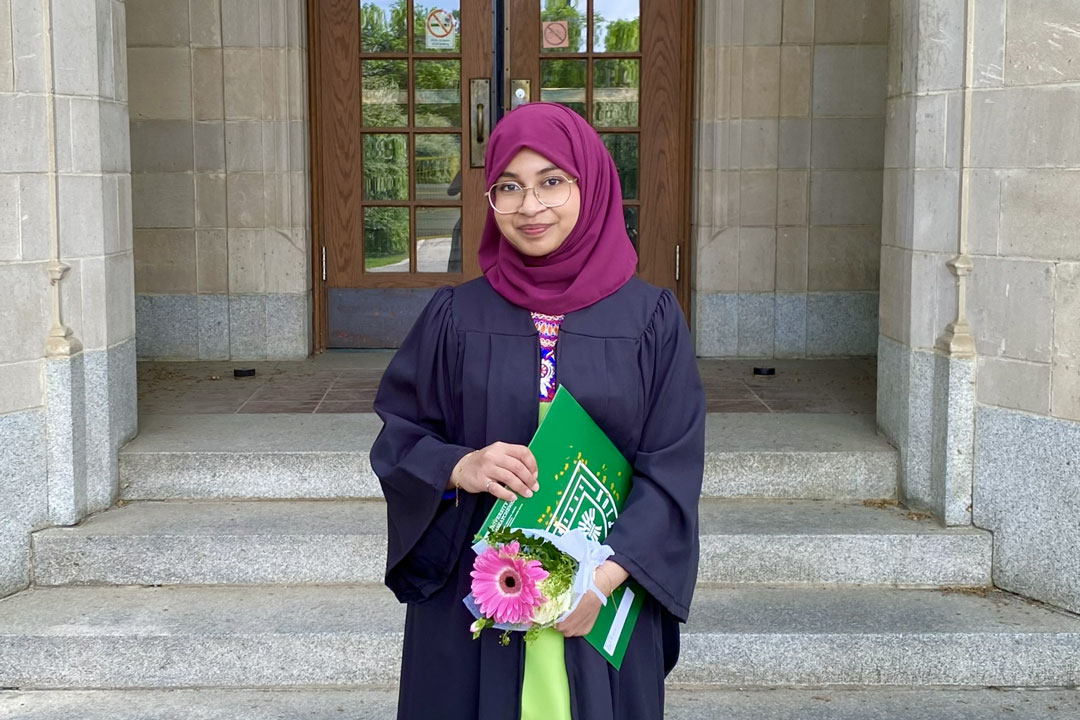
Engineering physics graduate values support and sense of community at USask
As an award-winning undergraduate student, Sarah Khalid (BE’26) made significant contributions to USask, the College of Engineering, and beyond
By SHANNON BOKLASCHUKWhen recent University of Saskatchewan (USask) graduate Sarah Khalid (BE’26) reflects on her time as an engineering physics student, she remains grateful for the support she received throughout her academic journey.
Khalid, who completed her Cambridge International Advanced Level qualifications in Saudi Arabia, first decided to come to USask because of the entrance scholarship that she was offered. Khalid was awarded a $3,000 Guaranteed Entrance Scholarship as well as a Margaret and Ted Newall Bursary valued at $11,800. The bursaries are open to students entering their first year of study in any direct-entry program at USask whose permanent residence is outside of Saskatoon.
The financial support at USask made a difference to Khalid when it was time to choose a university to attend.
“It was the highest entrance scholarship I received, and it made me feel like my achievements in high school were genuinely seen and valued,” she said. “I was also really excited by the university after attending the introductory online sessions about life at USask. Hearing about the student community, campus life, and the opportunities available to students made me really excited about the idea of moving to Saskatoon and starting university here.”
Throughout her time as a USask undergraduate student, Khalid received numerous other scholarships, awards, and honours, including the Nasser Family Gold Medal for Excellence in Innovation, Scholarship and Sportsmanship; the Isobel B. Harper Memorial Award for Women in Engineering; the Don McEwen Memorial Award in Physics; the Crescent Point Energy Women in Engineering and Geoscience Scholarship; the Douglas Durie Memorial Scholarship; and the Nasser Family Awards in Engineering.
“I am incredibly grateful to USask and to all of the donors who supported me throughout my undergraduate degree. Receiving these awards gave me financial support but, more importantly, they made me feel that my academic work, leadership, and contributions to the university community were recognized,” she said. “The support from these awards made a meaningful difference during my degree and allowed me to focus on my studies while being involved in research, leadership, and extracurricular activities.”
As an undergraduate student, Khalid made significant contributions to USask, the College of Engineering, and beyond; for example, she served as president of the Saskatoon Engineering Students’ Society (SESS), took part in quantum research at the Canadian Light Source (CLS), and was selected to be a part of the Waterloo Engineering Rising Stars Fellowship Program, a 16-week immersive summer research initiative at the University of Waterloo.
In June, Khalid received her Bachelor of Science in Engineering degree in engineering physics (with great distinction) during USask’s 2026 Spring Convocation. The Green&White recently asked the new alumna about her time at USask and her plans now that she has completed her degree.
In June, you graduated with a Bachelor of Science in Engineering degree in engineering physics (with great distinction). Congratulations! How did it feel to achieve this milestone?
It honestly felt a little surreal. I still remember getting my hard hat in second year, and then suddenly I was putting on my iron ring at the end of my final year. Four years really did go by incredibly quickly.
I was especially proud to have made the Dean's Honour Roll every year of my degree, but graduating felt like more than an academic milestone. When I look back, I think about everything that happened alongside my classes: research internships, conferences and competitions, serving as president of SESS, teaching first-year engineering students, and working on our nuclear reactor simulator capstone.
Graduating felt like the end of one chapter, but also the beginning of something I had been working toward throughout my degree: being able to take everything I learned and apply it to real engineering problems.
Why did you choose engineering physics? What appealed to you about this major?
I loved the combination of fundamental physics with practical engineering. One of the things I love most about physics is that it is our attempt to understand this fascinating universe at its most fundamental level, while engineering gives you the opportunity to take that understanding and actually build or solve something with it.
What are some of your fondest memories from your time as a USask student?
A lot of my favourite memories actually come from being involved outside the classroom. I loved being part of different student groups and getting to work with people from across the College of Engineering. I also had the chance to travel to conferences and competitions across Canada, which gave me the opportunity to meet students and researchers from completely different backgrounds.
My capstone project is definitely another highlight. Spending a year working with my team to develop an interactive CANDU nuclear reactor simulator was one of the most challenging and rewarding things I did at university. I got to dive much deeper into nuclear energy and work on a meaningful project intended for outreach and increasing nuclear literacy.
I also really enjoyed being a teaching assistant for first-year engineering students. Being on the other side of the classroom and helping students through concepts that I had once struggled with myself was quite rewarding.
You spent two years researching quantum materials at the Canadian Light Source (CLS). What was that experience like?
My research at the Canadian Light Source was one of the experiences that really taught me how to think like a researcher.
I analyzed synchrotron data and performed high-performance computing on the university’s supercomputer, Plato. A big part of my work involved developing theoretical models and trying to understand how well they matched the experimental results collected at CLS. There were definitely times when the results did not make sense right away, and I had to dig deeper into the physics and rethink my approach.
One of the things I loved most about CLS was seeing how broad the research was. I was working on quantum materials, but I was surrounded by people using the same facility to investigate everything from biology and chemistry to advanced materials and other areas that I knew very little about. It really opened my eyes to how interconnected and interdisciplinary scientific research can be.
You served as president of the Saskatoon Engineering Students’ Society (SESS). What inspired you to take on that leadership role?
I saw it as a way to give back to the engineering community that had become such a big part of my life at USask. I wanted to be able to advocate for my peers and make sure that female perspectives in engineering were being heard.
As president of SESS, I represented the engineering students on Faculty Council and the College of Engineering Undergraduate Academic Programs Committee. I also chaired the Dean's Funding Advisory Council, where we helped allocate funding to student groups and design teams.
A big part of my leadership was also advocating for students who were sometimes less represented or less heard. I had the opportunity to work with different groups on initiatives such as securing prayer spaces in the College of Engineering, and I really wanted to help create an environment where students from different backgrounds felt welcome and represented.
Now that you have graduated from USask, what are your current and future goals?
I have recently started an EIT (engineer-in-training) role with SaskPower’s SMR (small modular reactor) team, which I am incredibly excited about. Being able to start my career working on Saskatchewan’s SMR program is a really meaningful opportunity for me, especially after how much my interest in nuclear grew during my undergraduate degree and through my CANDU simulator capstone. I also intend to work toward my P.Eng. designation as I continue developing my engineering career.
Longer term, I haven’t ruled out graduate school, either. My research experiences at both USask and the University of Waterloo gave me a strong appreciation for research, and I could see myself returning to graduate studies once I have gained some professional experience.
Why would you recommend USask to other students?
I really loved the sense of community at USask. From the welcome events when I first arrived, to the professors, student groups, and people I met throughout my degree, I always felt like there were people around me who were willing to help.
The professors were another big part of my experience. Engineering physics is a relatively small program, so I got to know many of my professors quite well, and I found them to be genuinely invested in their students’ learning and success. There are also a lot of opportunities to get involved in research, conferences, competitions, and student leadership if you are willing to seek them out.
For me, USask also offered a really strong engineering physics program that I could complete in four years, which was an important factor when I was deciding where to study.
What is your advice for prospective students who may want to study engineering physics?
Be prepared for it to be challenging, and don’t expect yourself to get everything right the first time. It is very unlikely that you're going to ace every midterm and every final, and that’s OK. What’s important is that you learn from your mistakes, figure out where you went wrong, and clarify your understanding early. The material builds on itself quite quickly, so letting small gaps in your understanding accumulate can make the upper-year courses much harder. But, at the same time, don’t be intimidated. The pure physics classes on concepts such as quantum mechanics, general relativity, and electromagnetism were fascinating and really fun to do!
Is there anything else that you would like to add?
I think one thing I would really like to highlight is how much my experience at USask shaped not just what I want to do, but who I want to be as an engineer. I came to university thinking mostly about academics, but I ended up discovering interests in research, nuclear energy, teaching, science communication, and leadership that I hadn’t expected. I was also fortunate to be selected as one of 17 students across Canada for the Waterloo Engineering Rising Stars program, and I think opportunities like that really reinforced how much can come from saying yes to things that initially feel outside your comfort zone.
More than anything, I think I leave USask with a lot of curiosity. I still have so much to learn, and I’m excited about that.