


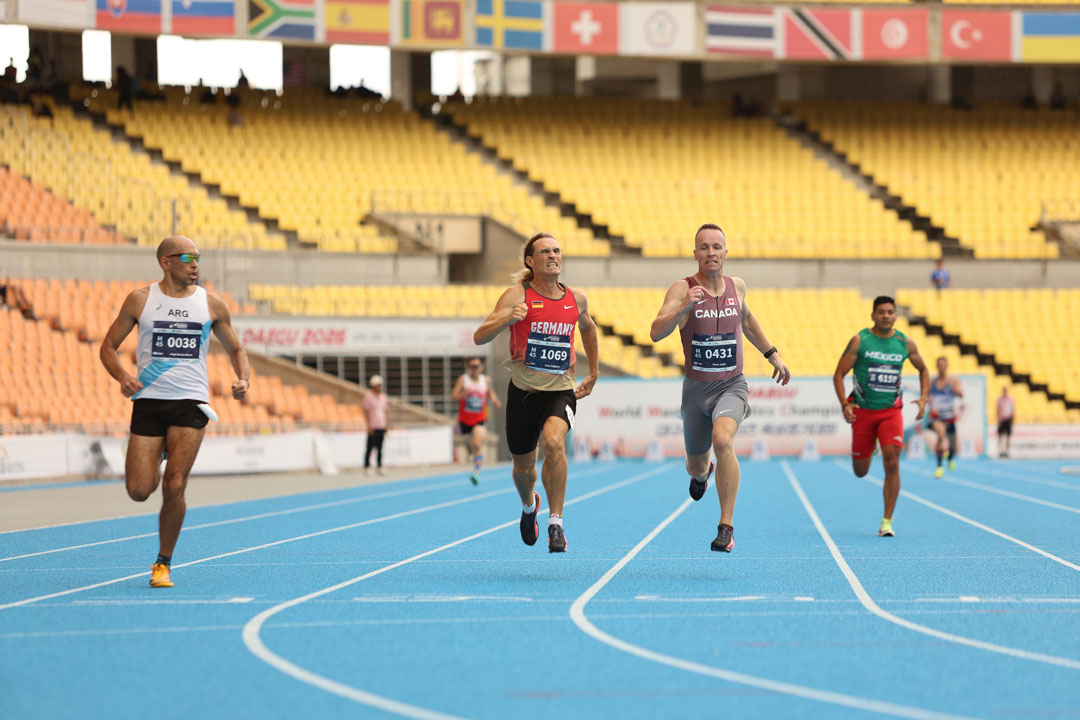
‘A 10-out-of-10 peak human experience’
USask graduate Trevor Jacek (BComm’03) was thrilled to win gold with his relay teammates at the 2026 World Masters Athletics Outdoor Championships in South Korea
By SHANNON BOKLASCHUKFor University of Saskatchewan (USask) graduate Trevor Jacek (BComm’03), it was “an incredible experience” to be a member of a Canadian relay team that won gold in South Korea earlier this month.
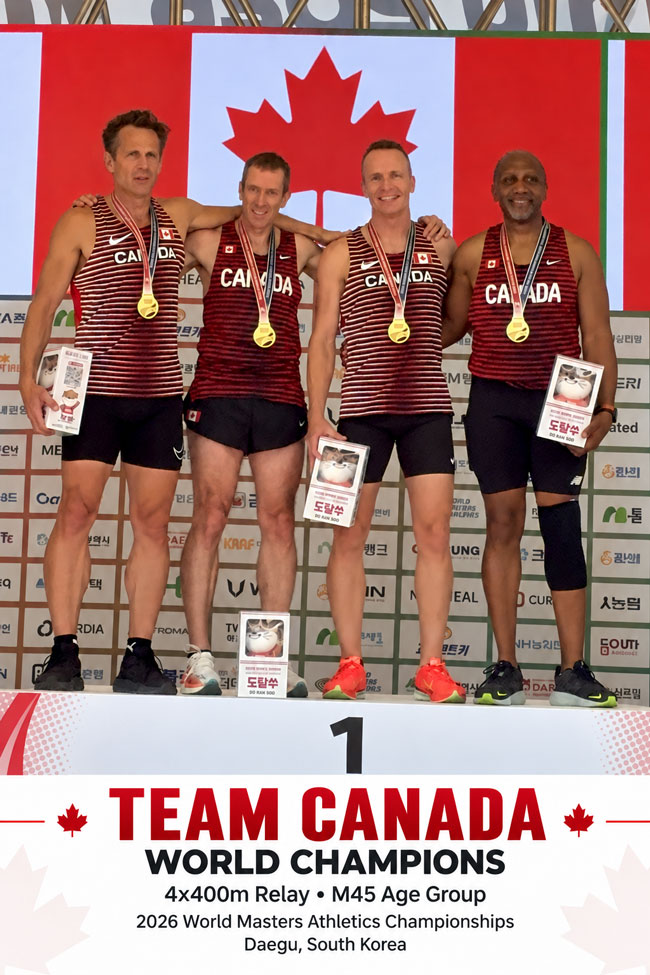
Jacek competed in the men’s 45- to 49-year-old 4×400-metre relay at the 2026 World Masters Athletics Outdoor Championships in Daegu, South Korea, on Sept. 3, along with teammates Luke Grinder, Patrice Doucet, and Marcus Skeete.
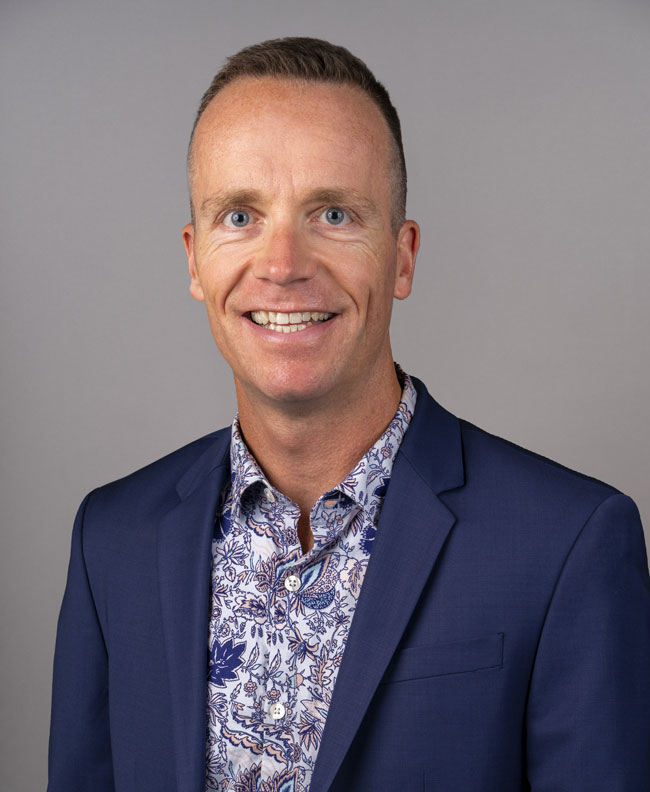
Winning the gold is something Jacek will never forget. Canada ran 3:45.79 to capture the top spot, with Australia coming in second with silver and the U.S. taking home bronze.
“I was fortunate to be on a team with some very good athletes, including one of my running idols, Patrice Doucet. Jumping into the arms of our anchor, Luke Grinder, at the finish line right after we won is going to be a core memory,” Jacek said.
“The moment of victory was special, but it was topped a few hours later when we stood on the podium together, had gold medals placed around our necks, and O Canada began to play. I remember getting goosebumps, fighting off a few tears, and then hearing the Canadian athletes and supporters in the stadium singing the national anthem with us. It was a 10-out-of-10 peak human experience and something I will remember for the rest of my life.”
The 2026 World Masters Athletics Outdoor Championships brought together about 7,500 athletes from more than 100 countries. Before, during, and after the Team Canada relay win, “we could really feel the energy of the other Canadians cheering us on,” Jacek said.
“Daegu Stadium is enormous,” he added. “It was originally built for the 2002 FIFA World Cup and has more than 65,000 seats. It is an open-air stadium with covered seating and mountains visible beyond the stadium, so it is a pretty spectacular place to compete.”
Jacek, who lives in Saskatoon, Sask., graduated from USask’s Edwards School of Business in 2003 with a Bachelor of Commerce degree in accounting. Today he works as the chief financial officer at Mid-West Group of Companies.
The Green&White recently asked Jacek about his career in business and about his latest experience at the World Masters Athletics Outdoor Championships.
Green&White: What inspired you to become a competitive runner?
Trevor Jacek: I have always loved sports and competition. I grew up in a small town and played every sport I could. I did not become a serious competitive runner until I finished university and was established in my career. I was decent at it, to start, and became a bit obsessed with finding out how good I could get. I love chasing a result, but I also genuinely enjoy the process of training and seeing how much I can improve. Running gives you a very objective measure of progress. The clock tells you exactly where you stand, and I enjoy the challenge of trying to move that number.
G&W: Why did you want to compete at the World Masters Athletics Outdoor Championships?
TJ: This was my fifth time competing at the World Masters Track and Field Championships, which is the highest level of competition available in masters track and field. It gives me something meaningful and difficult to work toward. You are competing against some of the best athletes in your age group from around the world who are still very serious about the sport. Worlds gives the training a purpose. It is one thing to stay fit; it is another to spend years preparing to line up against some of the best masters athletes in the world while wearing Canada on your chest.
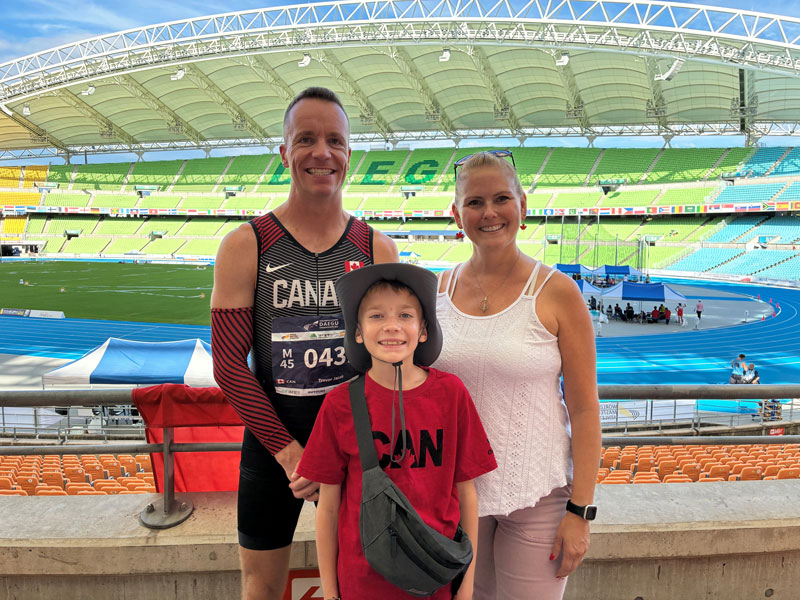
Beyond the competition, travelling to championships has created some incredible adventures for my wife, Nancy, and me. In the last few years, we have travelled for competitions in South Korea, Sweden, Poland, and Finland, as well as throughout the United States and most of Canada. We have also developed great friendships with Canadian athletes from all across the country. We spend a lot of time together during championships, and those friendships now extend well beyond track.
G&W: What was your training regimen like prior to the race?
TJ: My primary events are the 400 and 800 metres, so the training is a mix of speed, endurance, strength work, and recovery. The training is harder than the racing, but I enjoy the process and seeing the results. I genuinely look forward to the hard workouts, even if I know they are going to kick my butt.
Training and racing are a significant part of my life, and I build a fair amount of my week around them. Most weeks include multiple track sessions, strength training, easier aerobic running, mobility, and recovery work, so training touches most days of the week. This impacts my home life, family, and friends, and I am grateful to have an understanding and supportive network who knows how important this is to me.
I’m also fortunate to have a lot of great people in my corner: coaches, trainers, therapists, other athletes. I have also had opportunities to train with the USask track team, which exposes me to a very high-performance environment and younger athletes who keep the energy level high. In the months leading into Daegu, the focus became more specific to racing well in the 400 and 800 metres and arriving healthy at the championship. Because Daegu was expected to be hot and humid, I also did specific heat preparation before travelling to South Korea. At 45, I think consistency is more important than anything. You still have to train hard, but you also have to be smart enough to recover and get to the starting line healthy. I am still working to fully embrace this concept, but its importance has become evident!
G&W: What was the experience like on race day?
TJ: I raced several times during the championships, including the 800 metres, the individual 400 metres, where I finished ninth overall, and finally the 4×400-metre relay. On race days, there is always some nervous energy, but relay day was also a lot of fun. The team was really excited before the race.
I ran second leg, so my job was to get the baton, run aggressively, and put Patrice in the best possible position. The race ended up being incredibly close. Canada ran 3:45.79, Australia ran 3:46.01, and the United States ran 3:46.15, so the top three teams were separated by only 0.36 seconds.
G&W: What’s next for you? Do you have any more races coming up?
TJ: I still believe I can improve, and that is a big part of what keeps me motivated. I am excited to continue this journey. After a short reset, I’ll start preparing for the indoor season. I’ll race in several university meets, including the Sanderson Classic hosted by the USask Huskies, as part of the build toward the 2027 World Masters Indoor Championships.
G&W: You earned a Bachelor of Commerce degree at USask in 2003. What was the best part of studying at USask?
TJ: The best part was probably the people and the opportunities that came from being there. I came to university without having my career mapped out, and USask exposed me to people, ideas, and possibilities that I would not have encountered otherwise. I also really enjoyed being able to go to university in Saskatoon. It eventually became home for me, my family, and my career, so there is a pretty direct line between my time at USask and the life I have now.
G&W: You are now the chief financial officer at Mid-West Group of Companies. How has your education been beneficial to you in your work endeavours?
TJ: Growing up on a farm and then earning a commerce degree from the University of Saskatchewan gave me two very different but complementary foundations. That combination opened doors and gave me opportunities to prove myself. A lot of my time is spent on strategy, financing, real estate, people, problem solving, and making decisions with incomplete information. I still learn new things every week, but my education at USask gave me a strong base to build on.
G&W: You also serve on the boards of SaskTel Centre, Saskatchewan Drag Racing Association Inc. / Saskatchewan International Raceway, and the Greater Saskatoon Chamber of Commerce. Why did you want to get involved with these boards?
TJ: I have competitively raced drag cars for decades. Saskatchewan International Raceway is owned and operated by a non-profit organization, and I want the track and the sport to be around for a very long time. At some point I decided that if it mattered that much to me, I should be willing to help run the organization and contribute to its long-term future.
I feel similarly about Saskatoon. This is home for my family and our company, and I want the city and its business community to thrive. I accepted positions with the Chamber and SaskTel Centre because I would rather contribute to making things better than stand on the sidelines and complain about them. I want to be a small part of making Saskatoon a place people want to be.
G&W: What advice would you offer to new or prospective business students at USask?
TJ: I have four pieces of advice.
1) Talk to as many people as possible that are in all walks of life. Find out what they do for a living; why they like it or why they don’t. Develop a network of people that you can ask for advice when it comes to your career or life. People are generally good and willing to help, so put yourself in a position to receive that help and advice.
2) Technical knowledge matters, but learning how to communicate, work with people, ask good questions, and solve problems will probably be just as important over the course of your career. Be someone that people want to work with. As someone who hires young people, I put enormous weight on interpersonal skills. Technical skills and grades matter but being someone people want to work with matters just as much.
3) I would also tell students not to worry about having their entire career mapped out at 20 years old. Keep learning, say yes to opportunities that interest you, and be willing to change direction as you learn more about yourself and the world.
4) Think about what success actually means to you. When I was younger, I had a fairly narrow definition of success. I thought it meant continually sacrificing today for tomorrow and accumulating things like a bigger house, nicer cars, or other material goods. As I’ve gotten older, my definition has changed. Success to me now is largely about having control over how I spend my time and being able to spend most of that time doing things I find meaningful or enjoyable. Work is absolutely part of that for me, but it is not the entire definition. When people ask you what you want out of your career, don’t say “successful” unless you have also thought about what success actual means to you.