


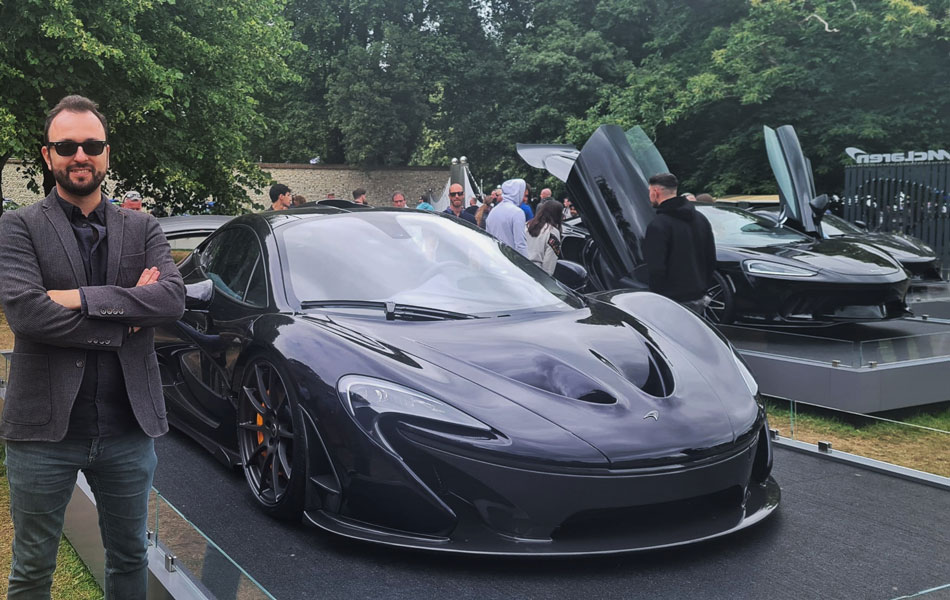
Curiosity to craft: Driving McLaren performance
USask College of Engineering graduate Mert Erayan (BE’08) holds a senior leadership position with McLaren Automotive, one of the world’s leading high‑performance road car manufacturers
By Sean ConroyWhen Mert Erayan (BE’08) arrived from Istanbul, Türkiye, to study engineering at the University of Saskatchewan (USask), he was driven by his curiosity and ambition. With a penchant for problem solving and design, the USask College of Engineering graduate has built a career in the global automotive industry with supercar manufacturer McLaren Automotive.
Wind in the sails
Erayan traces his fascination with engineering, and the way things work, back to the age of seven. He first started sailing, a hobby that sparked an early interest in aerodynamics and fluid mechanics.
“I knew early in my life that my career would be on a technical path,” said Erayan. “I wasn’t really good in any other area in high school, which made the choice of engineering an easy one.”
Seeking new surroundings and a degree that would open doors globally, Erayan evaluated several international destinations before placing Canada and USask at the top of his list.
“Studying abroad was a conscious decision, with the hope of discovering more about myself, experiencing a multicultural environment, and developing independence by stepping outside my comfort zone,” he said. “My time at USask turned into a life experience and an identity shift, not just where I earned a valuable degree.”
What began as an academic adventure helped shape the foundation of a career that would take Erayan from USask to senior leadership roles in the global automotive industry.
Choosing a lane
Problem‑solving is central to any engineering discipline. As a student, Erayan faced the challenge of narrowing the focus of his learning and determining where his interests in mechanical engineering might lead.
Alongside the familiar challenges many international students experienced, including adjusting to a new country and culture, Erayan was also navigating the broad range of career possibilities his field offered.
“Mechanical engineering has such a wide area of application. The choices are almost infinite,” he said. “At the time, I didn’t have a clear career path, and the uncertainty felt overwhelming.”
It was during this time that Erayan joined the Huskie Formula Racing team, an interdisciplinary group of USask students who design and fabricate open‑wheeled race cars for design competitions. It was with this group that Erayan’s passion for car design accelerated.
“Huskie Formula Racing was a fantastic opportunity to see competitive yet creative teamwork come together around a car,” he said. “It was a very friendly environment that complemented the theoretical knowledge from my courses.”
While Erayan sought out a community of like‑minded students with a shared interest in engineering and motorsports, he did not yet envision where exactly this experience might take him next.
Navigating without a map
At Convocation, Erayan acknowledged that he still didn’t have a complete picture of what came next, but he felt confident that his experience at USask had prepared him for the challenges ahead.
“Moving to Canada straight out of high school was a challenging transition that shaped my resilience, independence, and appetite for exploration,” he said.
After earning his Bachelor of Science in Engineering from USask, Erayan completed a Master of Science in Engineering and Technology Management degree at Boğaziçi University in Istanbul. Shortly after, he joined Ford Motor Company in Türkiye, where he advanced through a variety of roles over six years.
The winding road that Erayan took ultimately led him to becoming a key player at a world leader in innovation and performance.
“I never thought for one second that I would one day work at an industry‑leading supercar company,” he said.
From specialist to leader
Today, Erayan holds a senior leadership position with McLaren Automotive, one of the world’s leading high‑performance road car manufacturers, headquartered in Woking, England.
He joined McLaren in 2017 as a principal engineer in interior systems, a role in which technical excellence and subject matter expertise were central. Over time, that focus expanded into leadership.
“My focus shifted toward building high-performing teams and developing strategic leadership,” he said. “Becoming someone who not only performs at a high level but enables performance in others has been the most pivotal change in how I define success.”
Now nine years into his tenure at McLaren, Erayan serves as a vehicle line director, overseeing vehicle programs from early concept and design through engineering, production, and the full lifecycle of a car. In practical terms, this means he is accountable for an entire vehicle program: coordinating engineering, design, manufacturing, and business teams to ensure each car meets McLaren’s performance targets, quality standards, timelines, and cost goals.
“I was fortunate to have fantastic leaders around me who played a pivotal role in shaping my leadership style,” he said. “I became interested in expanding my business awareness while maintaining a deep technical understanding of how cars are engineered.”
Balancing the equation
Erayan knows that engineering ambition and real-world constraints can be competing dynamics in his role at McLaren. While pushing the limits of performance is central to the brand, timelines, budgets, manufacturing realities, and safety requirements must be considered.
“Balancing extreme engineering ambition with time‑to‑market, cost, and safety is the core tension of McLaren’s development philosophy,” said Erayan. “Performance comes from first principles rather than expensive late-stage fixes.”
Influenced by McLaren’s Formula 1 heritage and his own engineering foundations, Erayan emphasizes fundamentals from the outset. Lightweight design, aerodynamics, and data‑led decision-making shape development early, allowing innovation to be validated and delivered responsibly.
During his early years at McLaren, Erayan contributed to several high‑profile vehicle programs, including the McLaren Senna—a limited‑production, road‑legal track car named after legendary Formula 1 driver Ayrton Senna.
On the Senna program, Erayan was involved in the development of the vehicle’s interior systems, working within a highly specialized team environment focused on performance, precision, and driver experience. The project offered early exposure to the complexity and intensity of delivering a track‑focused supercar at the highest level.
A major milestone in Erayan’s career came with the McLaren Artura, his first opportunity to take on broader program responsibility for a new vehicle. The project marked a turning point, expanding his role beyond technical specialization to include cross‑disciplinary leadership across the full lifecycle of the car.
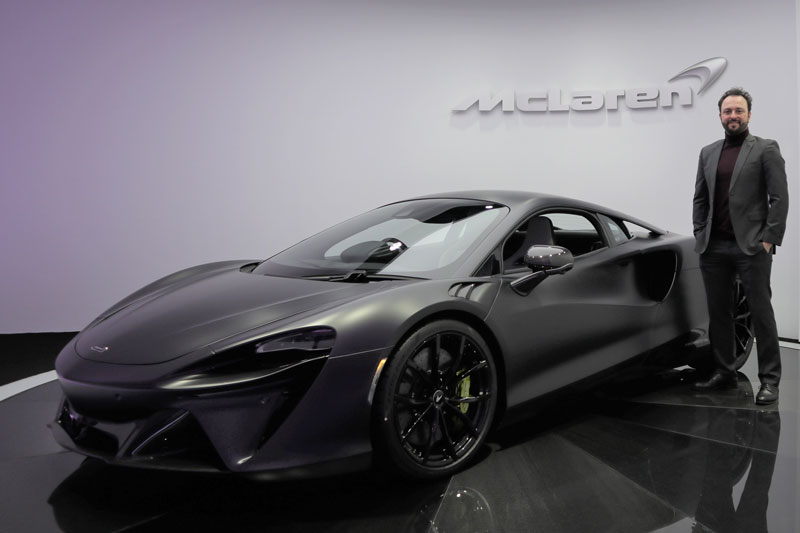
“Artura was a holistic hybrid supercar program from the ground up, and a defining moment in my transition into senior vehicle leadership,” said Erayan.
Erayan understands the global footprint that the McLaren brand has through many features in mediums like video games, movies, TV shows, and more. It is a signifier that the reach of his engineering goes beyond his colleagues, consumers, and competitors in the industry.
“Seeing a vehicle project go through the full product‑development journey, through intense teamwork, and then become something aspirational and emotionally engaging for people globally is special,” said Erayan. “Unlike many products that stay behind the scenes, McLaren vehicles often become part of wider cultural moments or lifestyle symbols. Sometimes that’s through a blockbuster film, and sometimes it’s simply as a reflection of a childhood dream car on a wallpaper. Both are equally meaningful.”
Giving back through mentorship
Erayan believes that high-performance is built on teamwork, shared standards, and environments that allow others to excel. Having benefited from mentorship throughout his own career, he wanted to give back through the USask Connects mentorship program.
“I’ve been a strong supporter of USask Connects from the day it started,” he said. “The program helped me step out of my daily bubble and better understand what younger talent values: intellectual stimulation, fresh thinking, and conversations that aren’t always about career paths, but often about outlook on life.”
Erayan characterized his mentorship journey as putting the mentee in the driver’s seat, allowing them to dictate the experience while sharing lessons he has learned equally from mistakes and successes.
“What’s important for me is to have an authentic framework,” he said. “And steer away from philosophical dilemmas and land at tangible actions to support my mentee to reach their goal.”
Looking back and ahead
In true engineering nature, Erayan is focused on the way forward in his industry and new frontiers to explore with gratitude for the depth and pace of his career up to this point.
“I’ve worked at the centre of product development, technical delivery, brand identity, and commercial decision‑making. What’s next is about scaling that impact and I am excited about what’s ahead for helping shape the future of high-performance vehicles with innovation, as the industry evolves.”
Reflecting on his time at USask and the many steps along the way, Erayan speaks with appreciation for an experience that shaped him, even without a fully mapped‑out path.
“Today, I can see the impact of the USask community on my life: the people who challenged me, the environment that pushed me, and the moments that quietly shaped me,” he said. “I’m proud of the journey I’m on, grateful for where it started, and mindful of what lies ahead.”