



USask graduate awarded ohpinamake Prize for Indigenous Artists
Catherine Blackburn (BFA’07), who earned her Bachelor of Fine Arts degree at USask’s College of Arts and Science, is a multidisciplinary artist and jeweller living in Toronto, Ont.
By SHANNON BOKLASCHUKUniversity of Saskatchewan (USask) graduate Catherine Blackburn (BFA’07), a member of the English River First Nation (Dënesųłinë́) in Treaty 10 Territory, is the latest recipient of the annual $10,000 ohpinamake Prize for Indigenous Artists.

Blackburn, a multidisciplinary artist and jeweller living in Toronto, Ont., said it was exciting to learn that she had been selected to receive the 2026 award.
“I think it's a really special award in that it celebrates collaborative work and community-focused approaches to Indigenous art practices, which are critical relationships to honour,” said Blackburn, who earned her Bachelor of Fine Arts degree at USask’s College of Arts and Science in 2007.
The ohpinamake Prize was created at USask in 2021 through a gift from Marian Knock and the late Jim Knock (BE’76). It celebrates a practicing Indigenous artist whose work empowers and uplifts others. In nêhiyawêwin (Cree), ohpinamake means “to lift others.” The name was gifted to the USask Art Galleries and Collection by a group of three Indigenous community leaders: Elders Maria Campbell (DLET’21) and Louise Bernice Halfe – Sky Dancer (DLET’19), and artist and USask alumna Ruth Cuthand (BFA’83, MFA’92).
“My husband, Jim, and I partnered with USask to create an award that positions art to bridge differences and to lift others. Our aim was to support important work that engages Canadians as we move forward together in the spirit of reconciliation,” said Marian Knock.
“Jim once said that ‘Art is the best visible example of the human spirit.’ I am so pleased to see the continuation of the ohpinamake Prize at USask, and I offer my heartfelt congratulations to this year’s exceptional recipient.”

The ohpinamake Prize for Indigenous Artists is organized by the USask Art Galleries and Collection. A jury of Indigenous artists—Audie Murray, KC Adams, and Tarralik Duffy—selected this year’s recipient. Adams and Murray are past recipients of the ohpinamake Prize, receiving the award in 2022 and 2025 respectively, while Duffy is an accomplished Inuk artist living and working in Saskatoon who was shortlisted for the prestigious Sobey Art Award in 2025.
The other artists shortlisted for the 2026 ohpinamake Prize were Michelle Sound (Vancouver, B.C.) and Joely BigEagle-Kequahtooway (Regina, Sask.).
Blackburn is the second USask alumna to receive the ohpinamake Prize, after it was awarded in 2024 to Joi T. Arcand (BFA’06), a multimedia artist from Muskeg Lake Cree Nation.

The 2026 ohpinamake award reception will take place on USask’s Saskatoon campus on Wednesday, March 25, from 3 pm to 5 pm in Convocation Hall. The event will feature a presentation by shortlisted artist Joely BigEagle-Kequahtooway and an in-person lecture from recipient Catherine Blackburn.
A member of the English River First Nation in Treaty 10 Territory, Blackburn was born in Patuanak, Sask., of Dene and European ancestry. Through stitchwork, she explores Indigenous sovereignty, decolonization, and representation. Her work merges mixed media and fashion to create dialogue between historical art forms and new interpretations of them.
Blackburn said her artistic practice continues to feature garment construction and adornment. She is currently focused on the method of assemblage, as she explores her newfound love of reconstructing vintage snowmobile apparel with other materials, such as caribou hides, beads, embroidery thread, wood, and gemstones.

“I’ve been very inspired by many Indigenous artists, such as the recipients of this award previously—Audie and Joi and KC—but also Ruth Cuthand and Rebecca Belmore,” said Blackburn.
“There is a growing list of Indigenous artists that continue to inspire my work and practice.”
Blackburn is looking forward to returning to USask later this month. She previously visited her alma mater in 2020 for a one-month residency and solo exhibition at the Kenderdine Art Gallery, titled with these hands, from this land.
During a performance at the Kenderdine Art Gallery in 2020, Blackburn was gifted a traditional marking by artist Stacey Fayant. Blackburn honoured her eyes by receiving markings on each side of her head in Dene syllabics, with a floral pattern from her late grandmother, paying tribute to her family history. The performance, titled Skin Stitched, involved using a needle and thread to stitch permanent ink into Blackburn’s skin.
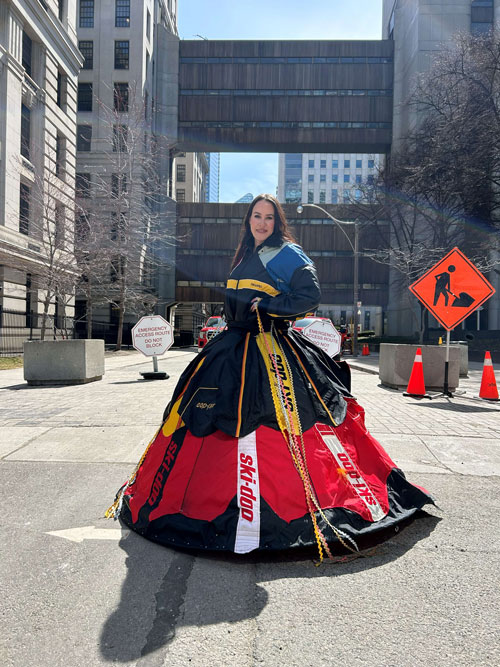
Blackburn’s work grounds itself in the Indigenous feminine and is bound through the ancestral love that stitching suggests. Her work has been showcased in numerous notable events and exhibitions, including the Santa Fe Haute Couture Fashion Show, Vancouver Indigenous Fashion Week, Radical Stitch at the National Gallery of Canada, and Àbadakone at the National Gallery of Canada. She has received many grants and awards for her work, including the Saskatchewan RBC Emerging Artist Award, the Melissa Levin Emerging Artist Award, a publication in Vogue online magazine, an Eitlejorg 2021 Fellowship, and a 2022 Forge Residency Fellowship, and she was included on the Sobey Art Award longlist in both 2019 and 2023.
Blackburn recently completed her Master of Fine Arts degree at OCAD University, where she was announced as the recipient of OCAD’s 2025 Governor General’s academic gold medal as well as received the graduate medal for her program. In April 2025, her thesis exhibition, Caribou-being beyond the Boreal, was presented to OCAD University in partial fulfillment of the requirements for her master’s degree. Through methods of rerouting, reconstructing, and reconsidering, Caribou-being beyond the Boreal stitched together Denesųłiné oral histories and family stories and explored inter-species-ness and inter-related-ness.
Completing her degree at OCAD University and living in downtown Toronto has led Blackburn, in recent years, to more deeply explore her urban Indigenous identity that imagines new futures born from the land.

“My time in the Interdisciplinary Arts, Media and Design Master’s program helped add to my material practice and exploration,” she said.
Blackburn is pleased to be this year’s recipient of the ohpinamake Prize, and she acknowledges the community that helps her artistic practice continue to thrive. Ongoing collaboration with Indigenous makers and community members is important to her, and she honours the labour and knowledge that makes her artistic practice possible.
“It's really important to honour the hands that go into my practice and not all of that is in the production sense, but also the materials and where I source and how I source materials from Indigenous communities and families,” Blackburn said. “It’s really important to me that that is clear and honoured.”
USask alumna Leah Taylor (BFA’04), who curated Blackburn's exhibition with these hands, from this land at USask, said it’s been exciting to watch Blackburn’s art career grow.
“I'm delighted for Catherine to be honoured as this year's recipient of the ohpinamake Prize. I admire Catherine's ability to create contemporary artworks that are closely related to her personal and familial experiences and cultural background,” said Taylor, curator at USask’s Kenderdine Art Gallery and College Art Galleries.
“She effortlessly and unapologetically moves between mediums to bring contemporary dialogues that incorporate elements of her traditional Dene culture, creating new interpretations of these traditional Indigenous art forms.”