


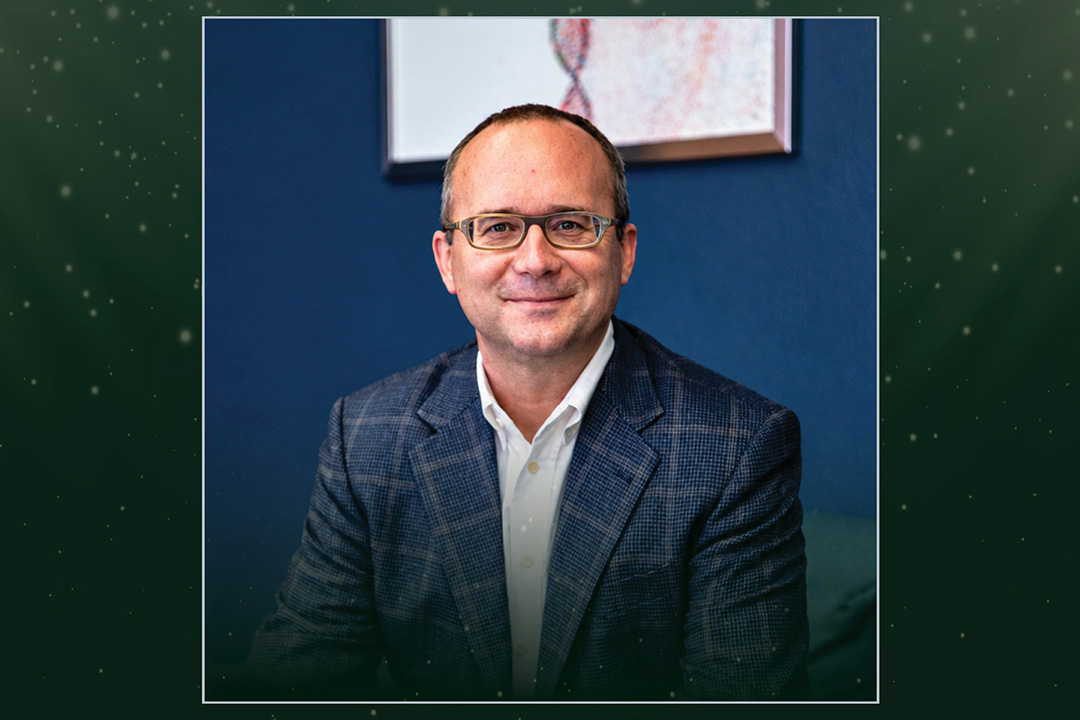
Three questions with entrepreneur, scientist David Rabuka
David Rabuka (BSc'97, PhD) encourages Arts and Science students to "get out of your comfort zone"
As a leader, entrepreneur and scientist, Dr. David Rabuka (BSc'97, PhD) knows that it's important to make the most of the opportunities available to you.
Rabuka is currently the co-founder, CEO and president of Acrigen Biosciences Inc., a cutting-edge biotech company focused on developing safe, efficient and novel precision gene-editing technologies.
His areas of scientific expertise include chemical synthesis, drug delivery, translational research, chemistry manufacturing and control, protein chemistry, and bioconjugation.
Raised in Prince Albert, Sask., Rabuka earned his Bachelor of Science (Honours) in chemistry at the University of Saskatchewan in 1997. He earned his Master of Science in chemistry at the University of Alberta in 1999. In 2008, he completed his PhD in chemistry/chemical biology at the University of California, Berkeley.
He was named one of the College of Arts and Science’s 2026 Alumni of Influence this summer.
In this Q&A, Rabuka tells us how his Arts and Science experience created opportunities to make new friends and connections for his career.
This interview has been edited for length and clarity.
Q: What is your favourite memory about your time at the College of Arts and Science?
There are a few memories that bubble up to the surface. What I most fondly remember is just the time that I was able to spend in the Thorvaldson Building and the chemistry department. My last couple years (I'd have) labs primarily in the afternoon. After labs were finished, I would skip out, have a quick meal somewhere, then would inevitably end up in the Thorvaldson Library. At the time it was a cozy little spot to work and read. There'd always be a handful of us that were always up there. Most of us chemistry majors and chemical engineers, and we'd work, study and chat, read the literature—just hang out there for a few hours every night as we were getting assignments done or getting ready for exams.
At some point, you could slip downstairs to the basement, and the Chemistry Student Society had a room down there. It was just really small and kind of crowded – but there was always a fresh pot of coffee, people chatting or playing board games. It was a really nice community of students and grad students that were all taking the same classes, working through the same assignments. It was a really great environment. Very supportive. I made a lot of very good friends and connections during those few years that I'm still in touch with today.
Q: How did an Arts and Science education help you in your career?
I remember I was in my third year as an undergrad, a professor at the time – Professor Richard Cassidy, who was teaching analytical chemistry – approached me sometime in very early spring. He said that he had just received some funding to support a couple of students to do research projects in the summer and asked if I would be interested in applying for that position.
He really encouraged me to do it. And so, I did it. That summer was really my first taste of working in a lab, working with other grad students on sort of bigger, broader scientific questions and problems. I don't think I ever successfully did anything that summer, but I actually learned a ton about what it means to have a career as a scientist, or a career as a researcher. (I learned about) the flow and ebb of experimentation and having the space and structure to think deeply and creatively about scientific questions that you have set out to answer.
I've always been very grateful that Professor Cassidy gave me that opportunity. He wanted us to see and to taste a little bit of what research is like. That was a very meaningful step in my career that I think is very unique—particularly to the department—where there were these opportunities for undergrads to really get an early sense of research. I know for certain that I would not have ended up as a biotech entrepreneur without those first tentative steps doing research in Professor Cassidy’s lab.
Q: What advice would you give to current students in Arts and Science?
There's this window of opportunity during undergraduate studies where you're going to be able to meet a lot of people. You're going to begin to build the foundations of your network.
The thing I would encourage students to take advantage of opportunities to engage in student societies, like the Chemistry Student Society. Start building those relationships early. Take advantage of all of the opportunities you're going to get, interact with people, and grow your circle of colleagues and friends and future collaborators.
Also, take advantage of this time to really explore and get out of your comfort zone – learning new things. There are very few times in one's life where everything's on the table.
Don't pigeonhole yourself into certain things. Be curious, take some risks on studying things that might be a little outside of the norm for, you know, what you perceive to be the norm. Build breadth of knowledge and breadth of experience while you can, because eventually, everything narrows down and becomes much more focused.
There are these windows where you have an opportunity to really explore with no penalty. When I was at the U of S, I don't know if I fully embraced that, but I was able to study random subjects and classes that were a little bit outside, say, maybe a traditional full on STEM path.
There's not that many times where you're able to really add to your toolbox. While you're in Arts and Science, there's all these tools that you can start to add to your arsenal that will help you think about problems and solutions in unique ways as you carve out your own niche in your career and life.
Article originally published at https://artsandscience.usask.ca