


Pitching, Playing, and Paving the Way
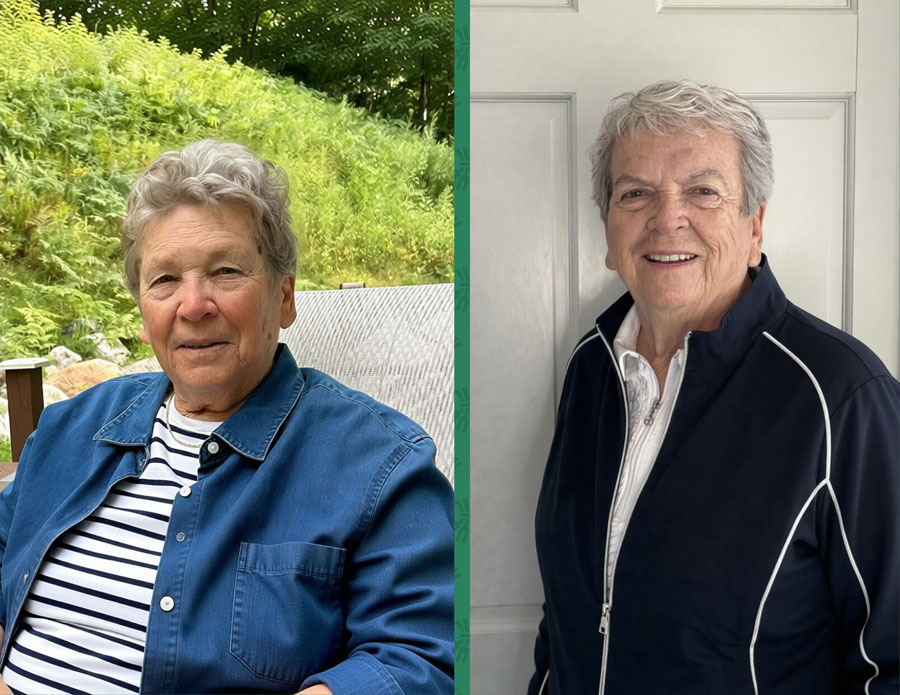
In life, few competitions are as fierce, or as meaningful, as those between siblings. As sisters, Judi Garman and Lorraine Klippel (BSPE’68) grew up competing against one another in sport, it helped pave the way for them to become Hall of Famers.
By Kinesiology Communications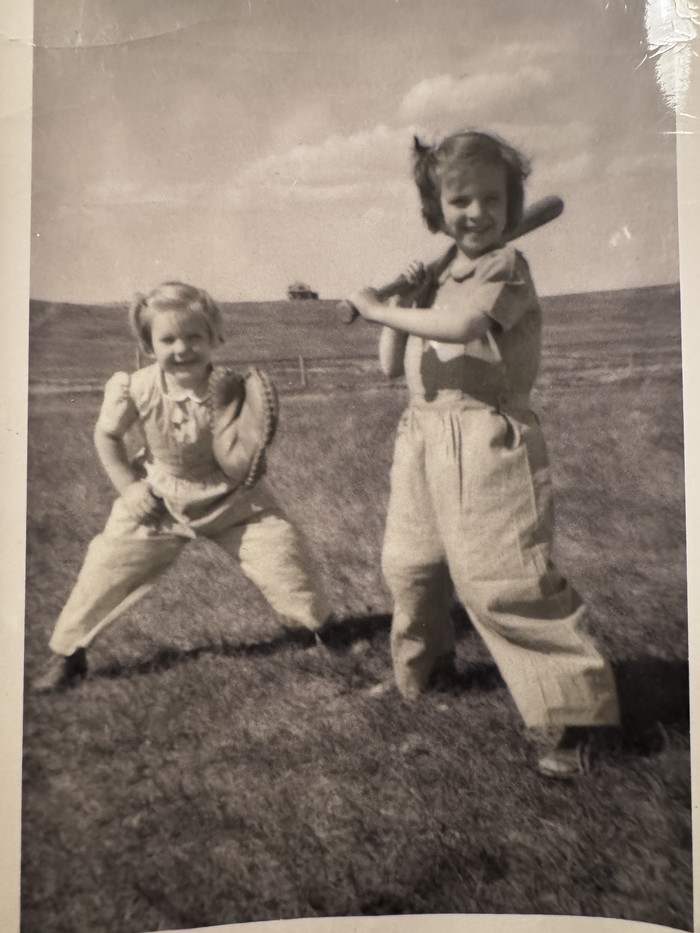
Born in the United States, Judi and Lorraine made the move to Kindersley, Saskatchewan as young children and quickly discovered their love of sport on the prairies. Self-described as “tomboys”, the pair played every sport possible.
“One of my favourite photos is of me pitching to Lorraine outside our house in the middle of prairies,” said Judi, who lives with her partner in Colorado. “Mom loved softball, playing in her long skirt and no glove, at church picnics.”
At nine years old, they were invited to play on the Kindersley women’s softball team. From there, Judi landed a pitching role on the local boys Little League team until, at a tournament, their opponent refused to play against her team because the pitcher – Judi – was a girl.
When the sisters reached their teenage years, the family relocated to Saskatoon. Lorraine enrolled at Mount Royal Collegiate, and Judi attended Rosthern Junior College until grade 12, eventually moving into the city to join her sister and train under an experienced physical education teacher.
After graduation, the two sisters had different goals as they headed to university. “I always knew I wanted to be a physical education teacher,” Lorraine explained. “I briefly considered teaching math, but a high school teacher told me, ‘You’ll never last, you should go into phys ed.’ So that’s what I did.”
Both enrolled in the College of Physical Education (now Kinesiology) at the University of Saskatchewan (USask), where they excelled academically while competing in multiple sports including field hockey, basketball, volleyball, and track and field. While balancing academics with a single sport is challenging on its own, they took it a step further, committing to several sports simultaneously while managing the demands of their education.
“You just made time,” Lorraine said, “for classes, studying, practices, games, and even a little fun.”
Their time in the College of Physical Education was especially rewarding because of the people. Both credit their professors’ example as a major influence. “They were so supportive and genuinely involved with students,” Judi recalled. “They helped students become the best they could be”—an approach both women carried into their own sports careers.
Judi remembers her dream of coaching as a student-athlete.
In her college years, Judi played with the Saskatoon Imperials, winners of the Canadian Senior Women’s Fastball championship in both 1969 and 1970. She said she learned a great deal from coach Bob Stayner, who was a basketball coach for the Saskatoon Aces. Judi spent time on the bench and ensured she sat next to Bob at games to learn all she could taking many notes.
“After graduation, it amazed me that the school paid me to stay on for the next year to teach physical education activity class with lots of supervision and feedback. It was the best training I could have had,” said Judi.
Judi enrolled at the University of California Santa Barbara for a master’s in sports psychology. “Softball was just starting as a college sport at that time” and after graduation, she first went to Golden West College before moving to California State Fullerton in 1979.
There, she built the softball program into one of the most successful in the U.S. In 1993, she was inducted into the National Fastpitch Coaches Association Hall of Fame, and when she retired in 1999, Judi was the winningest coach in softball history.
In 2020, she moved to Italy to coach the Italian national women’s team. “We made it to the world championships in 2002 at Gordie Howe Field in Saskatoon, the field I used to play on. Being introduced and walking onto that field was a thrill.”
Judi links her coaching success to the fact “I never stopped learning. Because softball was so new when I started, I went to every baseball and basketball coaching clinic I could find, and I always came away with one or two new things I could try for our team.”
After graduating from USask, Lorraine returned to Pennsylvania, where she spent four years teaching physical education in Pennsylvania schools. It was during this time that she discovered a new passion in sport: golf.
“Going to the University of Saskatchewan shaped me as an athlete and gave me a top-notch education,” Lorraine reflects. When she began working on her Master’s in Biomechanics, she quickly recognized the strength of her academic foundation. “I realized just how much more advanced the education at the U of S was,” she says.
Her knowledge was so well-developed that she was able to take PhD-level coursework, having already mastered the concepts typically delivered at the graduate level.
After a year of play on the golf course, Lorraine transitioned into teaching at a local golf club, where she found the perfect intersection of her biomechanics expertise and her growing love for the sport. “It just made sense,” she explains. “I used what I had learned in biomechanics to analyze golf swings and applying that knowledge to coaching became very clear.”
What kept her invested, she says, was the sport’s endless pursuit of improvement. “No matter how good you got, you could never completely master it,” she shared.
“It’s always a challenge,” Lorraine adds, “but the physics of it made sense to me. I wanted to see how good I could get, and how far I could push myself.”
She became so skilled that she had the opportunity to play on the LPGA Tour. “But that wasn’t what I wanted,” she said. “I knew I could compete at the professional level, but teaching was my true passion. The best part was using my education to quickly identify one or two ways to help someone improve their game—and getting paid to do it.”
In addition to her induction into the LPGA Hall of Fame, Lorraine was twice honored as the organization’s Professional of the Year. She was a trailblazer who would become the first woman in the U.S. to custom-make golf clubs and alongside her business and life partner, the first woman to build, own, and operate a dedicated golf teaching and practice facility, which remained open until 2022.
Reflecting on their successful careers, the sisters are grateful they grew up in Saskatchewan. “As girls, we had opportunities in sport that our U.S. cousins never had,” Lorraine said.
They remain close and plan to vacation together later this year—where Judi expects to get “a whole bunch of free golf lessons.” Of course, they still enjoy teasing each other. Lorraine’s favorite line is that Judi “picked the easy sport because the ball is bigger.” “Yeah, right,” Judi shoots back. “Softball is easier to play, but not to coach.”
Article originally published at https://kinesiology.usask.ca