


Emmett Hall: A legacy of nation-building
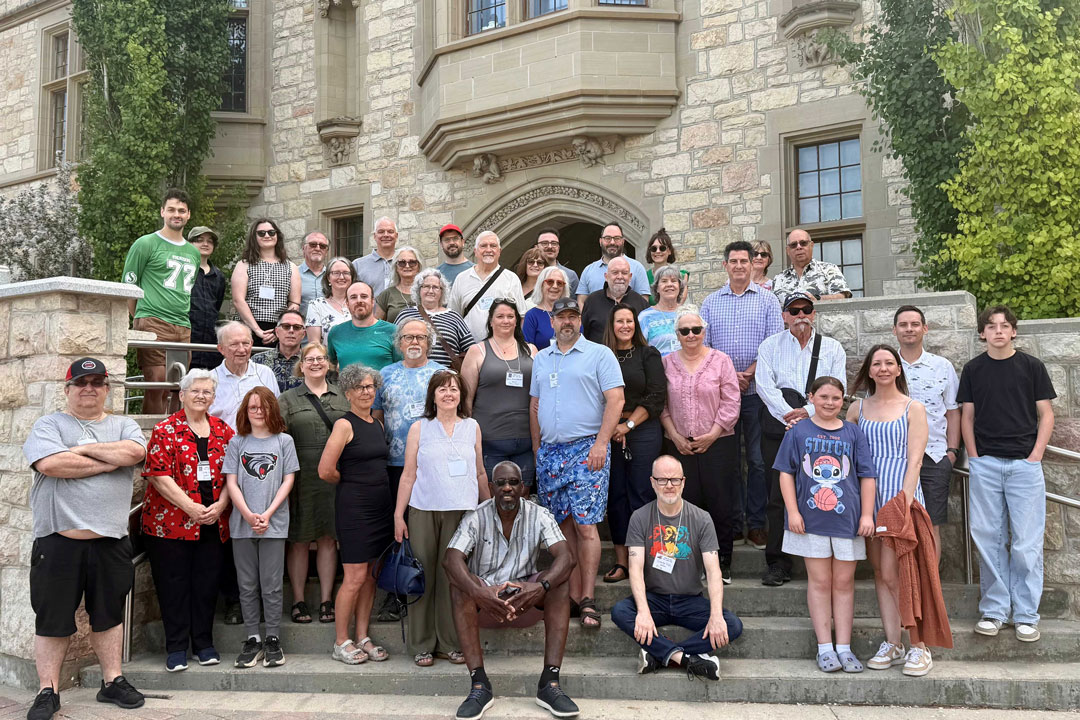
Dozens of descendants of the Hall family gathered earlier this year at USask, where Hall had strong ties as an alumnus, educator, chancellor, and honorary degree recipient
By Kathryn Warden, Board member, University of Saskatchewan Retirees Association (USRA)Editor’s note: This article first appeared in the Sept. 14, 2026, edition of the USRA newsletter.
This past summer, 75 descendants of the Hall family from across Canada gathered in Saskatoon to honour the legacy of their remarkable relative Emmett Hall (LLB’19, DCL’64), a University of Saskatchewan (USask) alumnus whose leadership as a lawyer, judge, and policymaker led to the creation of Canada’s public health-care system and paved the way for our country’s modern Indigenous land-claims process.
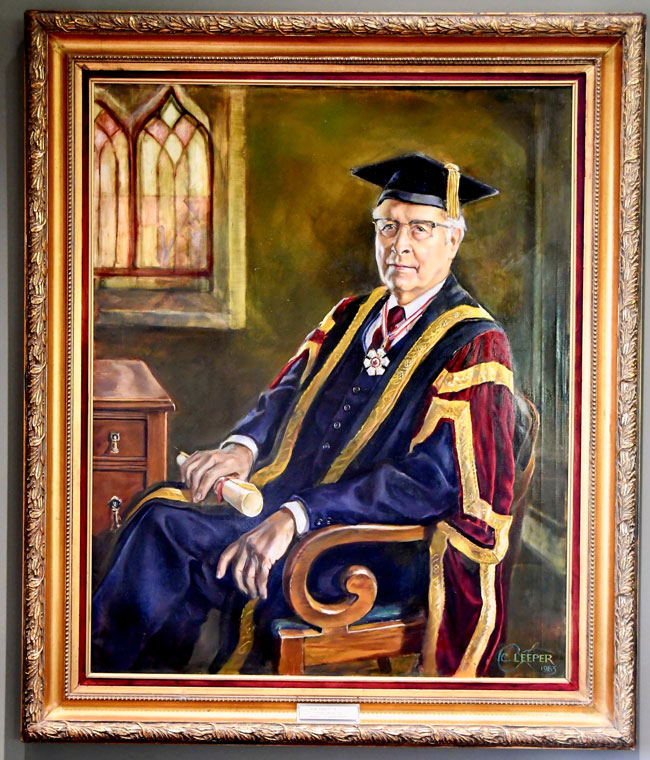
“Hall was a nation-builder whose legacy is inextricably linked to the history of the University of Saskatchewan,” USask President Emeritus Peter Stoicheff told the family in the Emmett Hall Boardroom, where Chancellor Emeritus Hall’s portrait hangs. Stoicheff noted that Hall’s connections throughout his life to USask were strong—he taught at USask, received a USask honorary Doctor of Civil Law degree in 1964, and served as the university’s chancellor from 1980 to 1986.
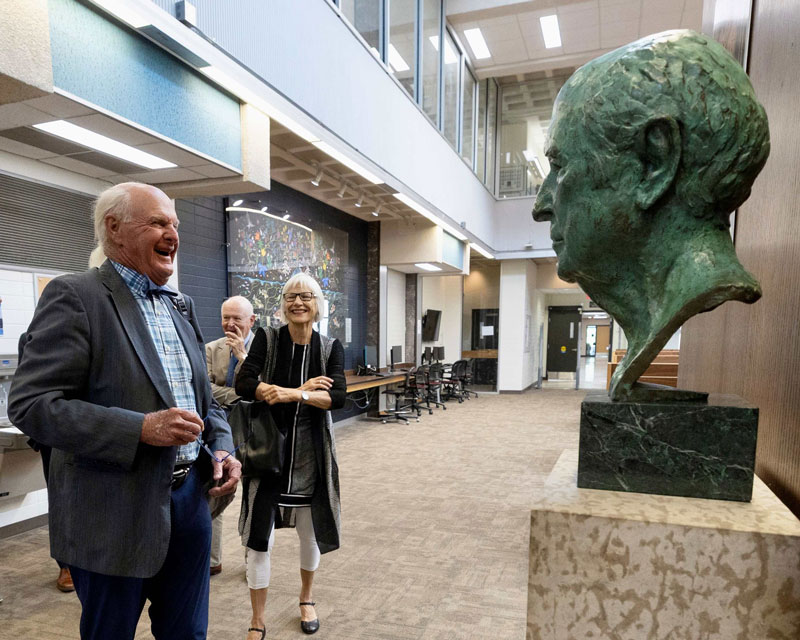
The family members visited a new tribute wall at the entrance to the College of Law library showcasing a bust of Hall and Indigenous artwork gifted to him, as well as a recently installed tribute plaque in the Health Sciences Building featuring the medal awarded to Hall when he was posthumously inducted into the Canadian Medical Hall of Fame.
Hall was born in 1898 in a village north of Montreal to an Irish Quebecer dairy-farming family of 11 children. Lured by the promise of cheap land and free education at a new provincial university, his family moved to Saskatoon in 1910. That same year, Hall, then just 12, was in the audience when Prime Minister Wilfred Laurier spoke at the cornerstone ceremony for the future USask campus.
After graduating in 1919 from USask’s College of Law, Hall practised law in Saskatchewan for 35 years. In 1957 at age 58, he was appointed chief justice of the Court of Queen’s Bench. Hall later became chief justice of Saskatchewan’s Court of Appeal and was then appointed to the Supreme Court of Canada (he was fluent in French), where he became one of the most respected jurists in the history of the court.
Described by biographer Dennis Gruending (BA’70, ARTS’84) as an “establishment radical,” Hall was known as a man who was passionate about social justice and individual rights but was someone who did not suffer fools well and sometimes took contrary and controversial positions on major issues rather than popular political ones, a trait that may explain his lack of success in politics as a Conservative candidate.
In the 1920s, Hall defended a newspaper editor against the Ku Klux Klan and was reportedly burned in effigy by the Klan one summer evening. He defended participants in the 1935 Regina Riot, sparing most of the men—who were driven to despair due to joblessness—from conviction. He defended a Saskatchewan doctor for performing five abortions, establishing that the abortions had been vital to preserving each woman’s life. As a member of Regina’s elite Assiniboia Club, he led its decision to undo its exclusion of Jews. He also wrote a letter to the Saskatoon Club that was instrumental in changing the club’s decision not to include women as members. He was a defender of Indigenous rights and those of people with disabilities. As biographer Frederick Vaughan puts it, Hall displayed “unswerving determination to bring to bear all his energy and passion for justice on any case where he believed that there was a miscarriage of justice.”
In 1961, Prime Minister John Diefenbaker (BA’15, MA’16, LLB’19, DCL’58), Hall’s former USask law school chum, asked Hall to lead the Royal Commission on Health Services to assess whether Canada should set up a universal, government-funded medical care insurance system, a controversial innovation that Premier Tommy Douglas (LLD’62) had long championed for Saskatchewan but which was not yet in place. As a result of the Hall Commission’s work, the National Medical Care Insurance Act was passed in the House of Commons in 1966, earning Hall the title “Father of Canada’s medicare system.”
Hall received many awards and accolades over his career, but his grandchildren say that one of the most meaningful was being named an honorary chief of the Nisga’a Nation in British Columbia. They recall him sharing stories with them about this honour.
In the late ‘60s, Chief Frank Calder, first president of the Nisga’a Tribal Council, sued the federal government over whether Nisga’a title to territory had been lawfully extinguished by previous colonial proclamations. Hall’s dissenting judgment was later accepted by the Supreme Court as law, leading to the affirmation of Indigenous land rights in Canada and the signing in 1998 of the first modern treaty, the largest land claim treaty in Canadian history.
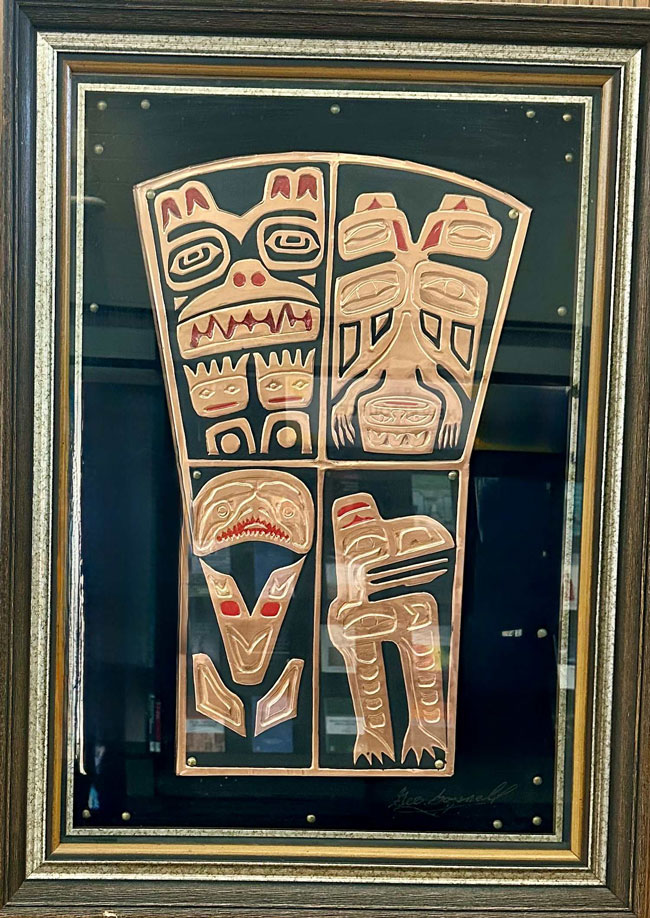
As a thank you to Hall, Calder presented him with a hand-carved hammered copper shield, a highly valued treasure traditionally presented to chiefs in honour of their status, wealth, and authority. The bear on the shield is considered by Elders to represent “the very foundation of the Nisga’a Nation.” The Indigenous artist, George Gosnell, was part of a Nisga’a family that played a key role in negotiating the treaty that put an end to the myth that B.C. could ignore Indigenous land claims.
The artwork was donated to the College of Law in 2025 by Hall’s grandson and renowned orthopedic surgeon Dr. John Wedge (MD’69, BSc’73, LLD’14), a USask alumnus who also earned a USask honorary degree and, like his grandfather, has been a generous donor to the medical college.
Jurisprudence excellence was carried on by Hall’s daughter Marian Wedge (BA’44, LLB’61), who became a Saskatchewan Queen’s Bench judge, and by his granddaughter Catherine Wedge (BA’72, ARTS’73, LLB’80, LLD’22), also a USask alumna, who became a justice on the Supreme Court of British Columbia as well as a USask honorary degree recipient.
Another granddaughter, Toronto ophthalmologist Dr. Charlotte Wedge (BSc’82, MD’87), recalls being asked by a patient why a photo of Emmett Hall was hanging in her office. The patient turned out to be Stephen Truscott, who had been tried for murder at age 14 and found guilty on circumstantial evidence. On an appeal to the Supreme Court, Hall’s strong sense there had been a miscarriage of justice and his lone dissenting opinion eventually led to Truscott’s exoneration in 2004.
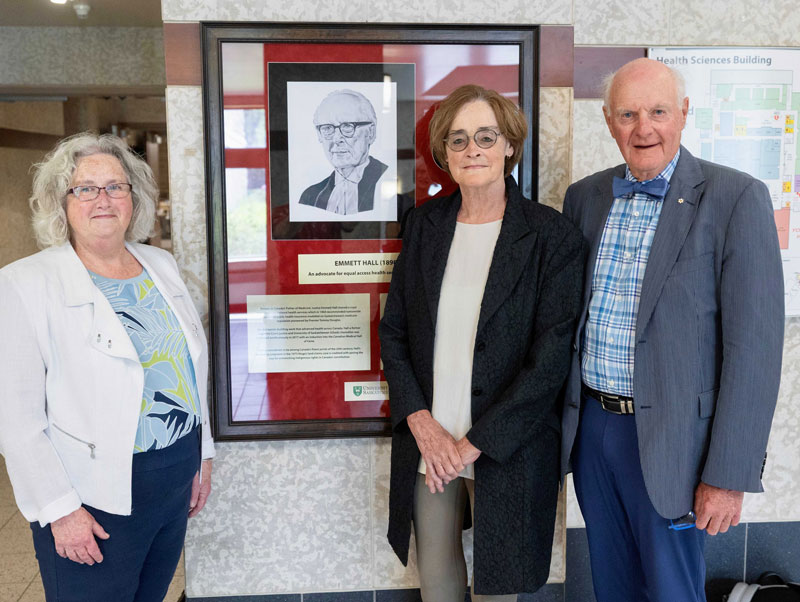
Though Hall died three decades ago, his legacy lives on. His niece, USask alumna Mary Scissons (BA’72, BEd’79, MEd’89), who organized the family reunion, says her uncle strongly believed that access to health care is a basic human right. While she says he would be disappointed by the number of people today who don’t have access to primary care doctors, she adds, “When I think about all the people going through severe health issues and without financial barriers are receiving world-class care here in Saskatchewan and across Canada, it means the world to me that this is in large part due to my uncle’s exceptional passion for social justice.”