


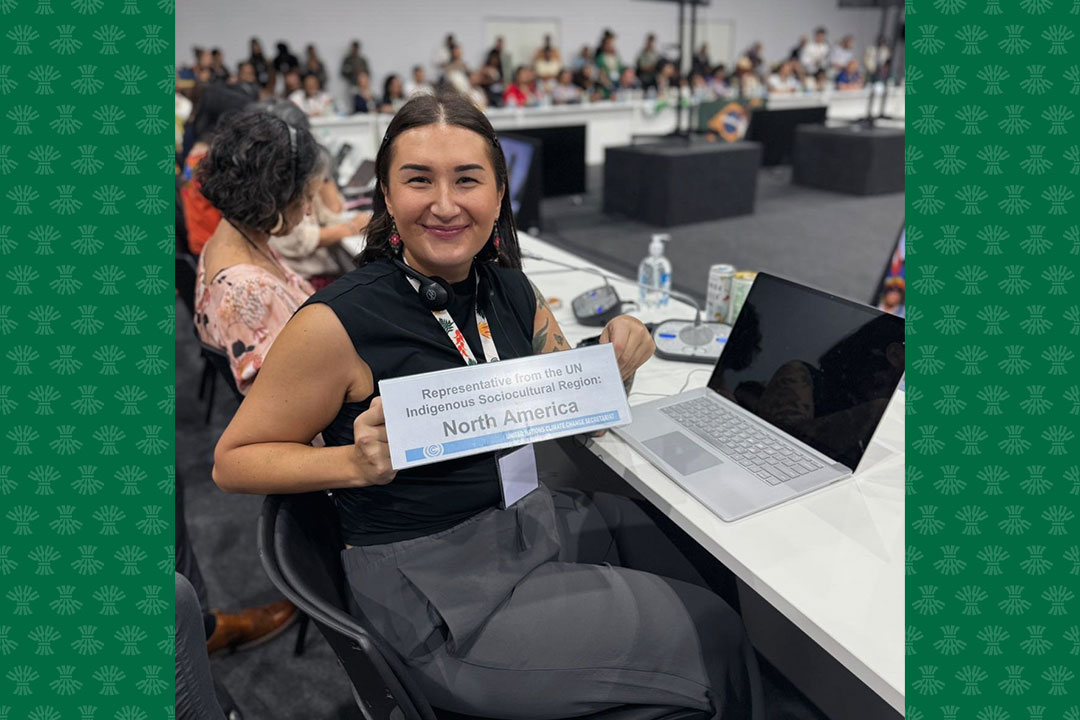
Award-winning Métis scholar values experiences as a USask graduate student
Kate Gillis (MA’24), who was awarded the inaugural Gabriel Dumont Graduate Scholarship in Métis Studies, now works for the Métis National Council
By SHANNON BOKLASCHUKKate Gillis (MA’24) made history when she was awarded the inaugural Gabriel Dumont Graduate Scholarship in Métis Studies during her time as a University of Saskatchewan (USask) graduate student.
Receiving the award for 2020-21, valued at $20,000, was “incredibly meaningful and affirming,” Gillis said.
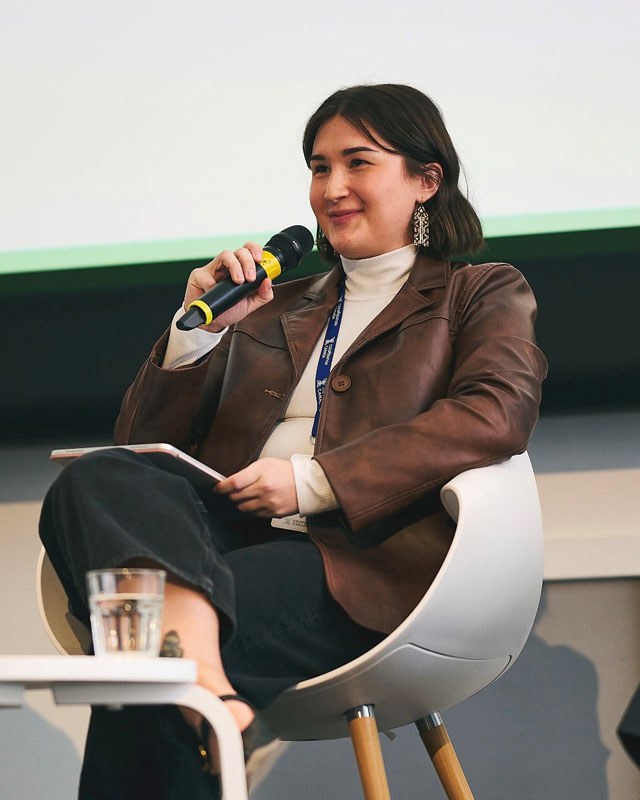
“Being the inaugural recipient made the experience particularly special because the scholarship represented a new and significant investment in Métis students and Métis-specific research,” she told the Green&White. “As a young Métis scholar, it reassured me that the questions I was asking and the histories I wanted to explore were important. Being the first recipient also came with a sense of responsibility to honour the purpose of the scholarship and the Métis women whose lives were at the centre of my research.”
Gillis came to USask after completing a Bachelor of Arts degree in history at St. Mary’s University in Calgary. She then pursued a Master of Arts degree in the Department of Indigenous Studies in USask’s College of Arts and Science.
At USask, Gillis’ master’s thesis research explored Métis feminisms. Through focusing on the worldviews of Wahkohtowin (all of our relations) and Otipemisiwak (the people that own themselves), Gillis’ research goal was to assert the fundamental role that Métis women played in the establishment of the Métis Nation.
In 2021, Gillis was honoured during Indigenous Achievement Week (IAW) at USask with an award recognizing academic excellence. In 2022, she again made history as the first Indigenous intern at the Permanent Mission of Canada, which acts as a channel of communication and diplomacy between Canada and the United Nations in New York City.
In 2024, Gillis graduated from USask with her Master of Arts degree, and she has been working for the Métis National Council (MNC) since then. The Green&White recently caught up with Gillis to reminisce about her time at USask, to learn more about what she’s doing now, and to ask her about her advice for current and prospective students.
Green&White: You earned your Master of Arts degree at USask in 2024. What have you been doing since graduating from USask?
Gillis: Following my graduation, I joined the Métis National Council as the senior policy advisor for international relations. The MNC is a national Indigenous organization that works to advance the collective priorities and interests of the Métis Nation at the federal and international levels. In my role, I support the Métis Nation’s engagement in international forums, help develop international policy and strategy, and build relationships with partners across Canada and around the world.
Green&White: Where are you currently living and working?
Gillis: I am currently based in Calgary, Alberta, where I was born and raised. I spent two years in Ottawa working in person at the MNC offices and building relationships with national and international counterparts, but I was very happy to move back home to the Prairies. That said, the scope of my work means I travel frequently across the Métis Homeland and around the world.
Green&White: You received the inaugural Gabriel Dumont Graduate Scholarship in Métis Studies. How did that impact your studies at USask?
Gillis: The scholarship gave me the time, stability, and confidence to fully commit to my research. Graduate school can be financially challenging and having that support allowed me to focus more closely on my coursework, writing, and development as a researcher.
Green&White: During your graduate studies work, you examined historical contributions of Métis women. What was the focus of your master’s thesis?
Gillis: My thesis, Balancing Otipemisiwak and Wahkohtowin: Métis Women at St. François Xavier, Manitoba, 1790–1840, examined the contributions of Métis women to the early development of the Red River community of St. François Xavier. It explored how women balanced independence and self-determination with their responsibilities to family, kin, and community. Ultimately, I argued that Métis women were not supporting figures in Métis history, but leaders and Nation-builders.
Green&White: What inspired you to choose this topic for your research?
Gillis: As a Métis woman studying Métis history, I often found that women were missing from, or pushed to the margins of, dominant historical narratives. My Métis identity comes through my maternal family, and my mom always instilled in me a strong sense of pride in who we are and where we come from. That made me increasingly aware of how rarely Métis women, and the essential roles they played in building families, communities, and the Nation, were centred in the histories I was learning. I wanted to better understand and highlight those contributions.
Green&White: How are you continuing to apply what you learned during your thesis work post-Convocation?
Gillis: The principles at the centre of my thesis continue to guide how I approach my work. Wahkohtowin reminds me that policy and diplomacy are grounded in relationships, responsibilities, and accountability, while Otipemisiwak reinforces the importance of Métis self-determination. I carry these mutually reinforcing worldviews into my work developing international partnerships and supporting the Métis Nation’s representation in global spaces.
Green&White: You were honoured with an award for academic excellence during Indigenous Achievement Week at USask. How did it feel to receive that award?
Gillis: Receiving the award was incredibly affirming, especially because it came during my first year of graduate studies. Beginning a master’s degree can feel daunting, so the recognition gave me confidence that I was on the right path and that my work had value. It was also very meaningful to celebrate alongside Indigenous students from across USask, whose achievements reflected so many different forms of academic, creative, and community leadership.
Green&White: What was your experience like in the College of Arts and Science and the Department of Indigenous Studies?
Gillis: My experience in the Department of Indigenous Studies was foundational to both my academic and professional development. The program challenged me to think critically about how research is conducted, who it serves, and the responsibilities researchers have to the communities connected to their work. Although much of my time in the program took place during COVID-19 and we were not always able to gather in person, the department still made a strong effort to centre relationships and create a sense of community. I was fortunate to learn from professors, classmates, and mentors who supported my growth as a researcher, writer, and Métis scholar.
Green&White: What are some of your fondest memories from your time as a USask graduate student?
Gillis: Some of my fondest memories are connected to the relationships I built throughout the program. Graduate studies gave me the opportunity to learn more about myself, my family history, and my place within the Métis Nation, while also building meaningful relationships with professors, classmates, and the broader community. I am especially grateful for the relationship I developed with my supervisor, Dr. Allyson Stevenson (BA’00, MA’04, PhD’15), whose guidance, encouragement, and belief in my work shaped both my thesis and my confidence as a scholar. The program made my research feel deeply personal but also connected to something much larger than myself.
Green&White: What is your advice for current and prospective USask students who may want to follow in your footsteps and pursue a Master of Arts degree in Indigenous studies?
Gillis: My advice would be to choose a topic that matters deeply to you while remaining open to learning where you and your research fit within a broader community. Indigenous Nations have their own governance structures, priorities, protocols, and ways of determining what research is useful. Taking the time to understand those systems is essential to conducting work that is respectful and accountable. Research is not only about what you want to study; it is also about the relationships you build and the responsibilities that come with being trusted with people’s histories and knowledge. I would also encourage students to say yes to as many opportunities as possible, whether that means scholarships, conferences, teaching, research positions, or community events. You may not always feel ready, but those experiences will absolutely shape both your studies and the path you take afterward.